Saudi Arabia imposes 24-hour curfew in Makkah, Madinah in coronavirus clampdown

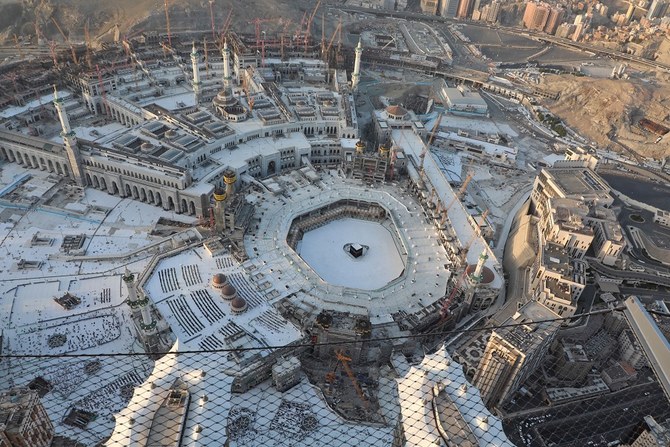
In this file photo, an aerial view shows an empty white-tiled area surrounding the Kaaba in Makkah's Grand Mosque on March 6, 2020. (AFP)
Short Url
Updated 03 April 2020
Follow

Saudi Arabia imposes 24-hour curfew in Makkah, Madinah in coronavirus clampdown

  • Residents will be allowed to leave their houses for medical care and to obtain food supplies in their respective neighborhoods from 6 a.m. until 3 p.m. 

JEDDAH: Saudi Arabia’s two holy cities, Makkah and Madinah, have been put under a 24-hour curfew as of Thursday April 2, until further notice.

Col. Talal Al-Shalhoub, the Ministry of Interior spokesman, said that the decision to raise the preventive measures taken against the coronavirus disease (COVID-19) is to protect the health of residents in the two cities.

The curfew is applicable to all parts of Makkah and Madinah. The curfew does not apply to those working in key occupations in the private or governmental sector who were previously exempted.

Adult residents of Makkah and Madinah are only allowed to leave their houses in dire emergencies, such as health care and food supplies and only around their districts from 6 a.m. to 3 p.m. In case of going out in a four-wheeler, only the driver and another person are allowed out to limit human contact as much as possible. 

“A mechanism will be deployed soon on how to use banking services and ATM machines in accordance with the Saudi Arabian Monetary Authority, Ministry of Interior and Ministry of Health,” said the spokesman.

All commercial activity is to be put on hold in these two cities, except for pharmacies, supermarkets, petrol stations and banking services.

Al-Shalhoub encouraged people to use phone applications to order food and grocery supplies. He also spoke about the few cases of curfew breaking, saying that the numbers are small in comparison to those who are keeping themselves and their loved ones safe by staying indoors.

“The Ministry of Interior will not tolerate those who do not abide by curfew regulations and show off their insubordination openly on social media outlets, whoever they may be,” said Al-Shalhoub.

The move comes at a time when the number of new COVID-19 cases in two cities — 48 cases in Makkah and 46 in Madinah — are the highest in the Kingdom.

The Health Ministry’s spokesperson, Dr. Mohammed Al-Abd Al-Aly, announced 165 new cases — two of which are related to traveling and have been quarantined.

The overall number confirmed cases is 1,885 — 1,536 of which are active.

Al-Aly announced five further deaths, bringing the total number to 21. The 64 recoveries makes the total number 328.

“The preventive measures taken by the Kingdom must be maintained, as they’ve helped us all keep our numbers low — we don’t want our elderly or young to suffer,” said Al-Abd Al-Aly.

He addressed the cities that have not recorded any coronavirus cases yet and encouraged them to practice self-isolation.

“No community is immune; they could be in an incubation stage right now, and symptoms can start showing later on,” he added.


Orphans’ Day: OIC calls for renewed efforts amid escalating crises

Updated 12 sec ago
Follow

Orphans’ Day: OIC calls for renewed efforts amid escalating crises

  • Day cannot be commemorated without highlighting suffering of orphans in Gaza, says secretary-general
  • Hissein Brahim Taha: Caring for orphans is a collective responsibility and a religious, humanitarian and ethical duty that requires concerted efforts

RIYADH: In commemoration of Orphan Day in the Islamic World, which falls on the 15th day of Ramadan each year, the General Secretariat of the Organization of Islamic Cooperation called on the international community, member states and humanitarian institutions to intensify efforts aimed at promoting the care of orphans.

The annual commemoration serves to implement the decision of the Council of Foreign Ministers issued at its 40th session (Conakry 2013), which aims to institutionalize concern for orphan issues and place their requirements at the top of the OIC’s humanitarian agenda, said an official statement.

OIC Secretary-General Hissein Brahim Taha said: “Caring for orphans is a collective responsibility and a religious, humanitarian and ethical duty that requires concerted efforts to ensure that they enjoy their full rights and provide a safe and supportive environment that enables them to build their future and participate actively in the development of their communities.”

The secretary-general added that the event comes amid increasing humanitarian challenges, which call for more comprehensive and sustainable approaches to ensure the protection and care of orphans, especially in light of natural disasters and conflicts in OIC member states and the resulting increase in the number of orphans and their many needs.

He said that the day could not be commemorated without highlighting the suffering of orphans in the Gaza Strip, where there are 57,000, including 17,000 children who were orphaned as a result of the recent brutal Israeli war, 3,000 of whom lost both parents.

This makes the Gaza Strip in dire need of a large number of care homes to provide a decent life for orphans, he said, adding that orphans in Gaza were the biggest victims of the Israeli aggression due to the lack of education and the destruction of many schools and educational and social facilities that used to support them.

The secretary-general highlighted the importance of developing institutional and family care programs, supporting education and psychological and social rehabilitation for orphans, and strengthening partnerships with charitable and humanitarian institutions to provide integrated health and living services that ensure their positive integration into their communities.

He said that caring for orphans and protecting their rights is a fundamental value in Islam, which calls for their care and urges the provision of comprehensive protection for them educationally, health-wise, socially, and in terms of living conditions to ensure their proper upbringing, preserve their human dignity and support their future.