Israel’s health minister has virus, top officials to isolate

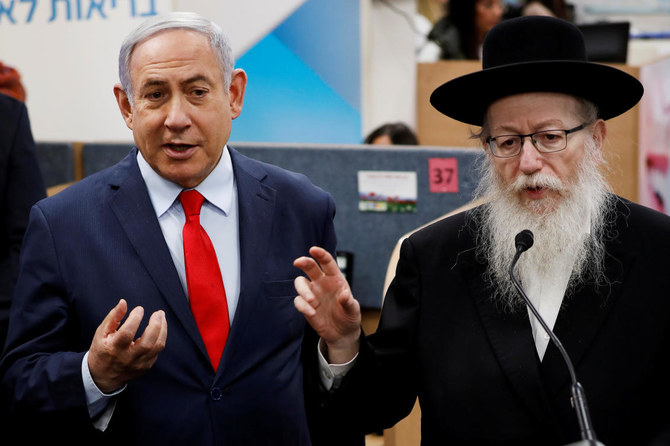
Israel’s health minister Yaakov Litzman, right, had frequent contact with Prime Minister Benjamin Netanyahu, left, and other top officials. (Reuters)
Short Url
Updated 02 April 2020
Follow

Israel’s health minister has virus, top officials to isolate

  • Israel has gone into near-lockdown to try to contain the virus outbreak
  • Israel’s Ultra-Orthodox community, of which Yaakov Litzman is a member, has been particularly hard hit by infections

JERUSALEM: Israel’s health minister, who has had frequent contact with Prime Minister Benjamin Netanyahu and other top officials, has the new coronavirus, the Health Ministry announced Thursday.
Yaakov Litzman and his wife, who also has contracted the virus, are in isolation, feel well and are being treated, the statement said. Requests to enter isolation will be sent to those who came in contact with the minister in the past two weeks, the announcement said.
The Israeli daily Haaretz reported that the head of Israel’s Mossad spy agency and the National Security Council were asked to go into isolation because of their contacts with Litzman. Netanyahu had gone into isolation previously after a top aide tested positive for the virus, but Netanyahu has so far tested negative.
Israel has gone into near-lockdown to try to contain the virus outbreak.
Israel’s large, insular Ultra-Orthodox community, of which Litzman is a member, has been particularly hard hit by infections. In the early phases of the outbreak, some rabbis had pushed back or ignored government-mandated movement restrictions, but resistance appears to have diminished.
Israel has reported just over 6,000 confirmed cases of infection with the new coronavirus, and 26 people have died of COVID-19.


Kuwait airport targeted as Iran presses on with attacks on Gulf states

Updated 5 sec ago
Follow

Kuwait airport targeted as Iran presses on with attacks on Gulf states

KUWAIT CITY/DUBAI: Gulf nations on Sunday reported new missile and drone attacks, while Iran vowed to press on with strikes against neighboring countries as the war entered its second week.
Kuwait’s defense ministry and Kuwait's Public Authority for Civil Aviation said that the country’s forces were “responding to a wave of hostile drones” that penetrated the country’s airspace.
“The fuel tanks of Kuwait International Airport were attacked by drones in a direct targeting of vital infrastructure,” the defense ministry spokesman said, according to a post by the Kuwaiti military on X.

Saudi Arabia's Ministry of Defense was also reporting a wave of drone attacks, saying 21 unmanned aerial vehicles were intercepted and destroyed in the last four hours.

Major General Turki Al-Maliki, spokesman for the Defense Ministry, said in separate posts on X that 13 drones were intercepted and destroyed east of the national capital, Riyadh city, while eight drones were shot down just after entering Saudi air space.

Before midnight on Saturday, loud explosions were heard in Dubai, the Qatari capital Doha and Bahrain’s Manama, with attacks reported in the UAE, Saudi Arabia, Qatar and Kuwait, where the national oil company announced a “precautionary” cut to production.
The attacks came despite Iran’s president earlier apologizing to Gulf countries for earlier strikes. He had said they would no longer be targeted unless strikes were launched from their territory first.
Hours later, Iran said it would continue conducting strikes on sites in Gulf countries which were “at the disposal of the enemy.”
UAE President Mohammed bin Zayed Al Nahyan said in a rare televised address that the Emirates were in “a period of war” and “will emerge stronger” from it.
Dubai authorities said Saturday evening one person had been killed by debris from an “aerial interception,” adding they were a Pakistani national.

Dubai airport closed, reopens 

Earlier in the day, Dubai closed its main airport — the world’s busiest for international traffic — after authorities said an unidentified object was intercepted nearby.
The government said there had been “a minor incident resulting from the fall of debris after an interception,” without directly mentioning the airport. It said there were no injuries.
The Flightradar24 tracking website earlier showed planes circling above the airport in an apparent holding pattern.
In a statement since deleted from X, Emirates, the largest airline in the Middle East, had announced it was suspending all flights to and from Dubai until further notice, but later said it had resumed operations.
The UAE, a US ally and home to American military installations, has been the most heavily targeted nation in the Gulf during the war.
Earlier in the day, the Ministry of Defense said that of the 16 ballistic missiles fired at the country on Saturday, all but one had been intercepted, with that missile falling into the sea.
Of the 121 drones detected, 119 were brought down, while two fell within Emirati territory.
The barrage brings the number of ballistic missiles detected by the UAE since the start of the war last Saturday to 221, the defense ministry said, with the number of drones surpassing 1,300.
Flights from Dubai’s main airport had partially resumed on Monday despite daily drone attacks targeting sites in the UAE.
Last Saturday, four employees were injured and an airport terminal damaged as the war broke out following US-Israeli strikes on Iran.
Iranian attacks have also hit Abu Dhabi airport, the upmarket Palm Jumeirah development and the Burj Al Arab luxury hotel over the past week, while drone debris caused a fire at the US consulate in Dubai on Tuesday.

Relentless air threats

Elsewhere in the Gulf on Saturday, Qatar’s defense ministry said its military had intercepted two missile attacks targeting the country.

Kuwait said Saturday night it had intercepted seven drones since dawn, with the attacks resulting “only in material damage from falling debris.”
And Bahrain said it has intercepted and 92 missiles and 151 drones since the start of the “brutal Iranian aggression.”
AFP journalists heard an explosion Saturday night in Manama, Bahrain’s capital, as authorities said one person was injured after rocket shrapnel fell in a public street.
In Saudi Arabia, the defense ministry said it had destroyed three ballistic missiles heading toward Prince Sultan Air Base, which hosts American troops, as well as 17 drones over the Shaybah oil field in the southeast.
Kuwait also reported intercepting a drone, while the country’s national oil company announced a “precautionary” cut to its production of crude due to Iranian attacks and threats to the Strait of Hormuz, a key transit point for Gulf hydrocarbons.
Further north, Jordan accused Iran of directly targeting sites in the kingdom, saying Tehran had fired 119 missiles and drones in the past week.
“These missiles and drones were targeting vital installations inside Jordan and were not passing through our territories,” said military spokesman Brig. Gen. Mustafa Hayari.

(With AFP)