Gaza factories pivot to masks in corona response

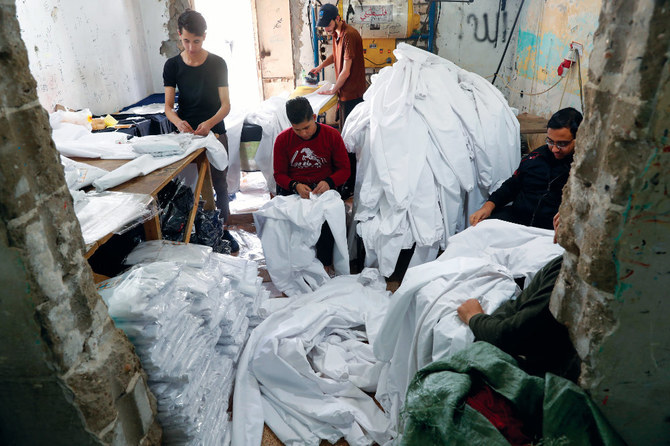
Palestinians in Gaza make protective overalls for export to Israel. AP
Short Url
Updated 02 April 2020
Follow

Gaza factories pivot to masks in corona response

  • The Gaza Strip has only had a handful of confirmed COVID-19 cases so far

GAZA CITY: Queen Tex factory in Gaza used to specialize in manufacturing shirts and jeans, but with the coronavirus (COVID-19) epidemic sweeping the globe it has pivoted into medicalwear.

Now lines of men are using old sewing machines to stitch together masks while also wearing them, as the blockaded Palestinian enclave develops a homegrown response to the crisis.

“We were intending to import masks and suits from China but there were difficulties importing, so we decided to make them ourselves,” manager Hassan Alwan said.

His factory says it works to international standards but only has enough material to make around 1,000 hazmat suits.

The Gaza Strip has only had a handful of confirmed COVID-19 cases so far. The suits, masks and gloves are being made initially for the local market, with the potential to later export to Israel which is fighting a far larger outbreak.

Gaza has been largely closed off by Israel since Hamas seized control of it in 2007.

Much of the world considers Hamas, which has fought three wars with Israel, a terrorist organization.

FASTFACT

2007

Gaza has been largely closed off by Israel since Hamas seized control of it in 2007.

Hamas has stipulated no masks or suits can be exported until the local market’s needs have been met.

But Hassan Shehata, co-director of another factory, Hasanco, is optimistic he can sell to the Israeli market. 

“Israeli companies sent us the cloth to produce medical masks for them. They need millions of masks,” he said.

“We want to produce three million masks.”

Dozens of employees work 10-hour days but there are not enough machines to hit their targets, he said.

Many Palestinian factories used to supply the Israeli market before 2007.

Now, the coronavirus crisis could allow the struggling Gaza textiles industry to make a comeback, said Maher Al-Tabbaa of the local chamber of commerce.

“The Gaza clothing industry is characterised by high quality that competes globally if it is given the possibility of exporting.”

Gaza has so far declared only 10 cases of the new coronavirus, starting with two people who returned from Pakistan and were already in quarantine when diagnosed.

Seven guards connected to them were later found to have been infected, while a 10th case was announced on Monday.

Hamas authorities have closed schools and mosques and Gaza’s only other border, with Egypt, has also been closed.

More than 1,500 Palestinians who returned from Egypt shortly before the closure have been quarantined in the south of the strip.

Yet fears remain that any outbreak in impoverished Gaza could spread rapidly.

United Nations envoy Nickolay Mladenov said Monday that Gaza’s health system was overstretched even before the disease emerged.

“Gaza is one of the most densely populated areas in the world — this coupled with its already fragile health care system makes it a particularly high-risk case for the COVID-19 outbreak,” he told the UN Security Council.

Gaza has far maintained a semblance of normality, with barbers and other stores still open, though staff are required to wear protective gear.

Apart from scissors and hair gel, barber Rami Azzam has boxes of gloves and masks and sanitiser spray at the ready as he snips.

“Health ministry employees come daily to sterilize the barbers, they have imposed tough measures,” he said.

“But hardly any customers come for a shave.”

Customer Suleiman Al-Dahdour, 28, said he had been avoiding having a haircut until he heard of the protective measures.

“Of course there’s fear,” he said. “But as you see, the barber’s wearing a mask and gloves.”


Airports in GCC are turning stopovers into tourism growth

Updated 14 February 2026
Follow

Airports in GCC are turning stopovers into tourism growth

  • Governments and airport operators are turning aviation as a central pillar of tourism and economic strategy

CAIRO: Once defined by fleeting layovers and duty-free corridors, airports across the Gulf Cooperation Council are increasingly gateways to short-stay tourism, driving non-oil growth, hospitality revenues and job creation. 

Across the region, governments, airlines and airport operators are treating aviation not merely as a transport sector but as a central pillar of tourism and economic strategy. Through streamlined visa regimes, airline-led stopover programs and sustained investment in airport infrastructure and technology, GCC countries are turning transit passengers into visitors. 

“Across the GCC, destinations have shifted from functioning primarily as global transit hubs to positioning themselves as places travelers actively choose to visit, even for short stays during onward journeys,” Nicholas Nahas, partner at Arthur D. Little, told Arab News. 

Airports in the Middle East are investing heavily in biometric processing systems, e-gates and digital border controls designed to shorten waiting times and improve passenger flow. These upgrades, backed by coordinated public-private initiatives, are narrowing the gap between arrival and exploration, making short stays viable even for passengers transiting for less than 48 hours. 

Unified GCC visa 

Two years after its initial proposal, the long-discussed unified GCC tourist visa is moving through final coordination stages, a development expected to further accelerate tourism spending linked to stopovers. 

Looking ahead, the visa could allow the region to function as a single tourism corridor. Robert Coulson, executive adviser for real estate at Accenture, said the next phase is about regional continuity. “The next leap for the GCC is making the region feel like one seamless journey while differentiating each stop with a distinct identity,” he told Arab News. 

First proposed in 2023 and approved in principle in 2024, the visa is designed to allow travel across Bahrain, Kuwait, Oman, Qatar, Saudi Arabia and the UAE under a single permit. Analysts say Saudi Arabia is positioned to be among the biggest beneficiaries, given its scale, expanding destination portfolio and growing aviation capacity. 

The unified visa is expected to complement existing stopover initiatives by allowing travelers to combine short visits to Saudi Arabia with trips to Dubai or Doha, effectively turning the Gulf into a single multi-country itinerary rather than a series of isolated transit points. 

Saudi aviation surge 

Saudi Arabia’s aviation-driven tourism growth has accelerated rapidly. The Kingdom welcomed an estimated 122 million visitors in 2025, moving closer to its Vision 2030 target of attracting 150 million tourists annually. 

“GCC travel hubs have stopped selling connections and started selling experiences,” Coulson said. “They’ve cracked the stopover-to-stayover model, turning a layover into a mini-holiday rather than dead time.” 

In January, Abdulaziz Al-Duailej, president of the General Authority of Civil Aviation, said international destinations served from Saudi Arabia increased to 176 in 2025, while the Kingdom remained home to some of the world’s busiest air routes. 

He credited this performance to the “unlimited support” of the Kingdom’s leadership, identifying aviation as a key enabler of Vision 2030 and broader economic diversification. 

Saudi Arabia’s newest airline, Riyadh Air, is expected to contribute more than $20 billion to non-oil gross domestic product and create over 200,000 direct and indirect jobs, underscoring aviation’s expanding economic footprint. 

A key pillar of Saudi Arabia’s strategy has been the introduction of a digital stopover visa in 2023, allowing transit passengers to enter the Kingdom for up to 96 hours. The initiative enables short visits for Umrah, trips to Madinah or exploration of the country’s cultural and historical sites.  The policy reflects a broader regional effort to turn time spent between flights into economic activity beyond the airport terminal, particularly in hospitality, transport and cultural tourism. 

Short-stay shift 

This evolution has been driven by global connectivity, simplified visa access and the ability to deliver high-quality experiences within a 24-to-72-hour window. The UAE, particularly Dubai, was the earliest and most established example of this transition, converting a growing share of its transit traffic into visitors through airline-led stopover packages, flexible visa categories and dense, short-stay-friendly attractions. 

Dubai International Airport handles more than 85 million passengers annually. Curated stopover products combining hotel stays with cultural and entertainment experiences have helped transform transit traffic into leisure demand. Direct metro access and streamlined entry processes have further reduced friction. As a result, Dubai welcomed around 19 million international overnight visitors in 2025. 

Other GCC destinations have since adopted similar models. Abu Dhabi expanded stopover offerings through its national carrier, promoting entertainment and cultural districts as compelling short-stay experiences. Qatar embedded stopover tourism into its national tourism strategy, converting transfer traffic at Hamad International Airport into city stays. Saudi Arabia expanded its tourism offering through its 96-hour digital visa linked to onward flights. 

A smooth transit experience is often the deciding factor in whether passengers remain airside or choose to explore. Fast entry processes, intuitive airport design and reliable airport-to-city connectivity can turn even a six- to eight-hour layover into usable time rather than idle waiting. 

Under Vision 2030, Saudi Arabia has invested heavily in airport expansion, digital border processes and urban mobility projects designed to shorten the distance between arrival and experience. Airline stopover platforms, transport apps and airport-based destination messaging increasingly reduce uncertainty and enable spontaneous exploration. 

Beyond transit traffic, Nahas said tourism growth across the GCC has been driven by integrated destination ecosystems. Successful destinations are designed end-to-end — from trip planning and arrival through accommodation, mobility, experiences and departure — requiring coordination across tourism authorities, airlines, airports, transport providers and experience operators. 

Designing destinations 

For developers shaping the region’s next phase of tourism growth, the focus has shifted toward creating destinations that capture travelers from the moment they arrive. 

Sultan Moraished, group head of technology and corporate excellence at Red Sea Global, said next-generation destinations are being designed to resonate with global travelers beyond a flight connection. 

“As we design and build next-generation destinations, our focus is always on creating experiences that resonate with global travelers from the moment they arrive to when they choose to explore beyond a flight connection,” he told Arab News. 

Moraished said offering experiences travelers cannot find elsewhere, from cultural immersion to nature-based activities, creates compelling reasons to extend visits beyond simple transit. He added that collaboration across aviation, hospitality and destination authorities ensures that every part of the journey is aligned with a shared vision for tourism growth. 

Looking ahead, Moraished said the intersection of innovation and hospitality will continue to open new pathways, from smart digital experiences to regenerative tourism practices that appeal to increasingly conscious travelers and encourage repeat visitation. 

Experience economy 

Airports have shifted from being standalone infrastructure assets to functioning as world-class distribution engines for cities and destinations. Investments in gateway airports have made them part of the destination brand promise. 

Tourism operates as a continuous conversion funnel, Coulson said. Every step removed between the flight gate and the city increases the likelihood that travelers will leave the terminal and spend money locally. Fast connections, predictable baggage handling and clear wayfinding reduce perceived risk, while simplified transit visas make spontaneity possible. 

A unified GCC tourist visa could unlock longer stays and multi-country itineraries, supported by investment in walkable districts, waterfronts and climate-smart design. 

Taken together, the transformation of transit hubs into tourism powerhouses reflects a broader shift in how the Gulf approaches aviation-led growth. Airports are no longer just points of passage but economic gateways where short stopovers translate into tourism spending, jobs and long-term diversification.