

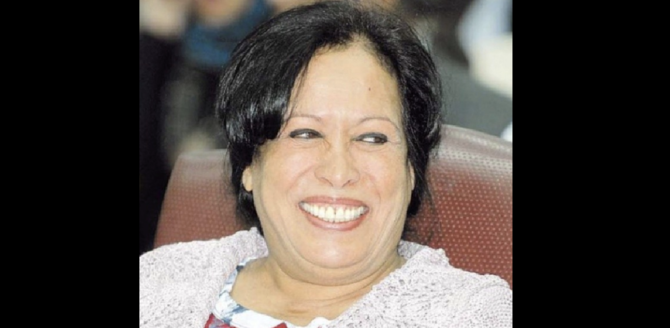
Kuwaiti actress Hayat Al-Fahad triggers uproar with call for expat ban over coronavirus

Hayat Al-Fahad told a local television station that foreigners in the country should be kicked out during the health crisis. (Instagram: hayatalfahad_fans)
Short Url
Updated 01 April 2020
Follow

Kuwaiti actress Hayat Al-Fahad triggers uproar with call for expat ban over coronavirus

  • Many people online criticized the actress’ comments, with one Twitter user saying it was “so unacceptable”
  • Kuwait has also announced that it will treat COVID-19 patients — including non-Kuwaitis, who account for nearly 70 percent of the population — for free

KUWAIT CITY: A famous Kuwaiti actress has sparked a furor by calling for expatriates to be expelled from the country so that locals can be sure of having a hospital bed if they fall ill with coronavirus.
Hayat Al-Fahad, 71, known for her roles and extensive career in Arabic dramas, told a local TV channel that foreigners residing in the country should be kicked out during the ongoing health crisis.
“We are fed up. If we get sick, there are no hospitals (for us),” she said during a telephone interview on Tuesday.
“Why, if their countries do not want them, should we deal with them? Aren’t people supposed to leave during crises?
“We should send them out... put them in the desert. I am not against humanity, but we have reached a stage where we’re fed up.”
Many people took to social media platforms to criticize the actress’ comments, with one Twitter user saying it was “so unacceptable.”
“How many Kuwaitis are outside Kuwait at the moment? Should everyone also apply her logic when it comes to them?” another person posted.

Another Twitter user said that whilst Saudi Arabia’s government was “spreading peace and assistance even for violators,” Al-Fahad is demanding that expats should leave Kuwait during the coronavirus pandemic. 

The user was making a reference to King Salman’s latest directive to provide all coronavirus patients in Saudi Arabia, even those in violation of residency laws, with free treatment.  

“You are chilling in your ‘luxurious’ house and crying about how foreigners should be kicked out while you and everyone knows they’re the one’s that build your country,” another user tweeted. 

Another person tweeted that she prays that God would guide Al-Fahad and said that whilst she is a “beloved actress,” “it is hard to accept her insulting any human being.”

There have been 317 cases of the COVID-19 disease recorded in Kuwait so far, with no deaths. There have been no reports that the country's health system is under more strain due to the virus.
It has adopted some of the strictest measures in the Gulf to combat the spread of the novel coronavirus by largely locking down the country.
Kuwait has also announced that it will treat COVID-19 patients — including non-Kuwaitis — for free.

(With AFP)


Hundreds flee to government-held areas in north Syria ahead of possible offensive

Updated 16 January 2026
Follow

Hundreds flee to government-held areas in north Syria ahead of possible offensive

  • Many of the civilians who fled used side roads to reach government-held areas
  • Men, women and children arrived in cars and pickup trucks that were packed with bags of clothes

DEIR HAFER, Syria: Scores of people carrying their belongings arrived in government-held areas in northern Syria on Friday ahead a possible attack by Syrian troops on territory held by Kurdish-led fighters east of the city of Aleppo.
Many of the civilians who fled used side roads to reach government-held areas because the main highway was blocked with barriers at a checkpoint that previously was controlled by the Kurdish-led and US-backed Syrian Democratic Forces, Associated Press journalists observed.
The Syrian army said late Wednesday that civilians would be able to evacuate through the “humanitarian corridor” from 9 a.m. to 5 p.m. Thursday. The announcement appeared to signal plans for an offensive against the SDF in the area east of Aleppo.
There were limited exchanges of fire between the two sides.
Men, women and children arrived in cars and pickup trucks that were packed with bags of clothes, mattresses and other belongings. They were met by local officials who directed them to shelters.
In other areas, people crossed canals on small boats and crossed a heavily damaged pedestrian bridge to reach the side held by government forces.
The SDF closed the main highway but about 4,000 people were still able to reach government-held areas on other roads, Syrian state TV reported.
A US military convoy arrived in Deir Hafer in the early afternoon but it was not immediately clear whether those personnel will remain. The US has good relations with both sides and has urged calm.
Inside Deir Hafer, many shops were closed and people stayed home.
“When I saw people leaving I came here,” said Umm Talal, who arrived in the government-held area with her husband and children. She added that the road appeared safe and her husband plans to return to their home.
Abu Mohammed said he came from the town of Maskana after hearing the government had opened a safe corridor, “only to be surprised when we arrived at Deir Hafer and found it closed.”
SDF fighters were preventing people from crossing through Syria’s main east-west highway and forcing them to take a side road, he said.
The tensions in the Deir Hafer area come after several days of intense clashes last week in Aleppo, previously Syria’s largest city and commercial center, that ended with the evacuation of Kurdish fighters from three neighborhoods north of the city that were then taken over by government forces.
The fighting broke out as negotiations stalled between Damascus and the SDF over an agreement reached in March to integrate their forces and for the central government to take control of institutions including border crossings and oil fields in the northeast.
The US special envoy to Syria, Tom Barrack, posted on X Friday that Washington remains in close contact with all parties in Syria, “working around the clock to lower the temperature, prevent escalation, and return to integration talks between the Syrian government and the SDF.”
The SDF for years has been the main US partner in Syria in fighting against the Daesh group, but Turkiye considers the SDF a terrorist organization because of its association with Kurdish separatist insurgents in Turkiye.