

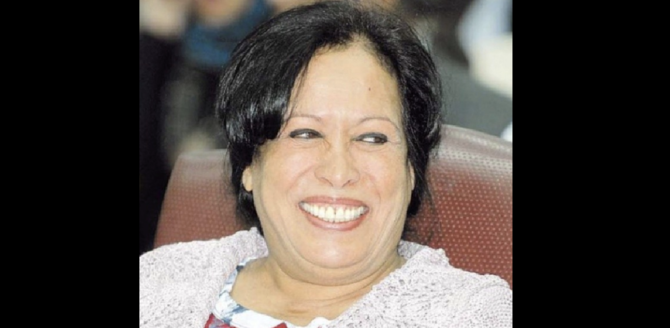
Kuwaiti actress Hayat Al-Fahad triggers uproar with call for expat ban over coronavirus

Hayat Al-Fahad told a local television station that foreigners in the country should be kicked out during the health crisis. (Instagram: hayatalfahad_fans)
Short Url
Updated 01 April 2020
Follow

Kuwaiti actress Hayat Al-Fahad triggers uproar with call for expat ban over coronavirus

  • Many people online criticized the actress’ comments, with one Twitter user saying it was “so unacceptable”
  • Kuwait has also announced that it will treat COVID-19 patients — including non-Kuwaitis, who account for nearly 70 percent of the population — for free

KUWAIT CITY: A famous Kuwaiti actress has sparked a furor by calling for expatriates to be expelled from the country so that locals can be sure of having a hospital bed if they fall ill with coronavirus.
Hayat Al-Fahad, 71, known for her roles and extensive career in Arabic dramas, told a local TV channel that foreigners residing in the country should be kicked out during the ongoing health crisis.
“We are fed up. If we get sick, there are no hospitals (for us),” she said during a telephone interview on Tuesday.
“Why, if their countries do not want them, should we deal with them? Aren’t people supposed to leave during crises?
“We should send them out... put them in the desert. I am not against humanity, but we have reached a stage where we’re fed up.”
Many people took to social media platforms to criticize the actress’ comments, with one Twitter user saying it was “so unacceptable.”
“How many Kuwaitis are outside Kuwait at the moment? Should everyone also apply her logic when it comes to them?” another person posted.

Another Twitter user said that whilst Saudi Arabia’s government was “spreading peace and assistance even for violators,” Al-Fahad is demanding that expats should leave Kuwait during the coronavirus pandemic. 

The user was making a reference to King Salman’s latest directive to provide all coronavirus patients in Saudi Arabia, even those in violation of residency laws, with free treatment.  

“You are chilling in your ‘luxurious’ house and crying about how foreigners should be kicked out while you and everyone knows they’re the one’s that build your country,” another user tweeted. 

Another person tweeted that she prays that God would guide Al-Fahad and said that whilst she is a “beloved actress,” “it is hard to accept her insulting any human being.”

There have been 317 cases of the COVID-19 disease recorded in Kuwait so far, with no deaths. There have been no reports that the country's health system is under more strain due to the virus.
It has adopted some of the strictest measures in the Gulf to combat the spread of the novel coronavirus by largely locking down the country.
Kuwait has also announced that it will treat COVID-19 patients — including non-Kuwaitis — for free.

(With AFP)


First responders enter devastated Aleppo neighborhood after days of deadly fighting

Updated 12 January 2026
Follow

First responders enter devastated Aleppo neighborhood after days of deadly fighting

  • The US-backed SDF, which have played a key role in combating the Daesh group in large swaths of eastern Syria, are the largest force yet to be absorbed into Syria’s national army

ALEPPO, Syria: First responders on Sunday entered a contested neighborhood in Syria’ s northern city of Aleppo after days of deadly clashes between government forces and Kurdish-led forces. Syrian state media said the military was deployed in large numbers.
The clashes broke out Tuesday in the predominantly Kurdish neighborhoods of Sheikh Maqsoud, Achrafieh and Bani Zaid after the government and the Syrian Democratic Forces, the main Kurdish-led force in the country, failed to make progress on how to merge the SDF into the national army. Security forces captured Achrafieh and Bani Zaid.
The fighting between the two sides was the most intense since the fall of then-President Bashar Assad to insurgents in December 2024. At least 23 people were killed in five days of clashes and more than 140,000 were displaced amid shelling and drone strikes.
The US-backed SDF, which have played a key role in combating the Daesh group in large swaths of eastern Syria, are the largest force yet to be absorbed into Syria’s national army. Some of the factions that make up the army, however, were previously Turkish-backed insurgent groups that have a long history of clashing with Kurdish forces.
The Kurdish fighters have now evacuated from the Sheikh Maqsoud neighborhood to northeastern Syria, which is under the control of the SDF. However, they said in a statement they will continue to fight now that the wounded and civilians have been evacuated, in what they called a “partial ceasefire.”
The neighborhood appeared calm Sunday. The United Nations said it was trying to dispatch more convoys to the neighborhoods with food, fuel, blankets and other urgent supplies.
Government security forces brought journalists to tour the devastated area, showing them the damaged Khalid Al-Fajer Hospital and a military position belonging to the SDF’s security forces that government forces had targeted.
The SDF statement accused the government of targeting the hospital “dozens of times” before patients were evacuated. Damascus accused the Kurdish-led group of using the hospital and other civilian facilities as military positions.
On one street, Syrian Red Crescent first responders spoke to a resident surrounded by charred cars and badly damaged residential buildings.
Some residents told The Associated Press that SDF forces did not allow their cars through checkpoints to leave.
“We lived a night of horror. I still cannot believe that I am right here standing on my own two feet,” said Ahmad Shaikho. “So far the situation has been calm. There hasn’t been any gunfire.”
Syrian Civil Defense first responders have been disarming improvised mines that they say were left by the Kurdish forces as booby traps.
Residents who fled are not being allowed back into the neighborhood until all the mines are cleared. Some were reminded of the displacement during Syria’s long civil war.
“I want to go back to my home, I beg you,” said Hoda Alnasiri.