

Iran warns of lengthy ‘new way of life’ as virus deaths rise

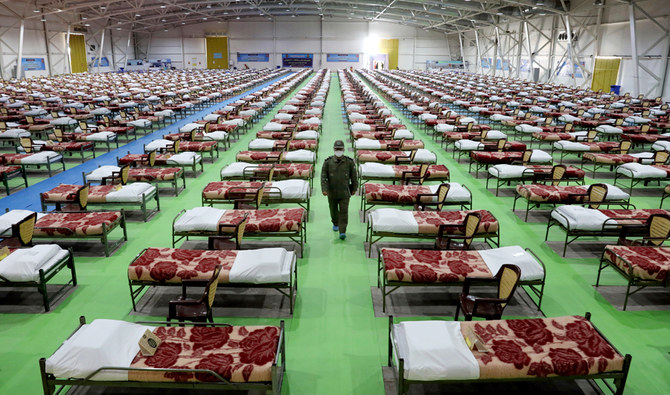
An Iranian army soldier walks through a temporary hospital in Tehran, Iran, Thursday, March 26, 2020. (AP)
Short Url
Updated 30 March 2020
Follow

Iran warns of lengthy ‘new way of life’ as virus deaths rise

  • Without an official lockdown in place, the government has repeatedly urged Iranians to stay home “as much as possible”

TEHRAN: President Hassan Rouhani has warned that “the new way of life” in Iran was likely to be prolonged, as its declared death toll from the novel coronavirus rose to 2,640.
Iran is one of the countries worst-hit by the virus, which first originated in China.
Iran announced its first infection cases on Feb. 19, but a senior health official has acknowledged that the virus was likely to have already reached Iran in January.
At his daily news briefing, health ministry spokesman Kianoush Jahanpour said 123 more people in Iran had died from the virus in the past 24 hours.
He reported 2,901 new cases of COVID-19 infection, bringing the overall number of officially confirmed cases to 38,309.
According to the official, 12,391 of those hospitalized have recovered and 3,467 are in “critical” condition.
“We must prepare to live with this virus until a treatment or vaccine is discovered, which has not yet happened to date,” President Hassan Rouhani said in a Cabinet meeting.
“The new way of life we have adopted” is to everyone’s benefit, he said, adding that “these changes will likely have to stay in place for some time.”
After weeks of refraining from imposing lockdown or quarantine measures, Tehran decided Wednesday to ban all intercity travel until at least April 8.
Without an official lockdown in place, the government has repeatedly urged Iranians to stay home “as much as possible.” Schools and universities in some provinces were closed in late February and the measure was later extended to the whole country.
After Rouhani’s warning, the reopening of schools following this year’s new year holidays of March 19 to April 3 appears unlikely.

FASTFACT

Iran announced its first infection cases on Feb. 19, but a senior health official has acknowledged that the virus was likely to have already reached Iran in January

On a positive note, Rouhani said he had been told by top health experts and doctors that “in some provinces we have passed the peak (of the epidemic) and are on a downward trajectory.”
Several Iranian government officials and notable figures have been infected by the new coronavirus, some of whom have died.
The most recent case of infection was Mohammed-Reza Khatami, brother of former president Mohammad Khatami and an ex-deputy speaker of parliament.
He is currently hospitalized.
Iraj Harirchi, a deputy health minister who tested positive for the virus in late February, has returned to public life and appeared on state television to emphasize safety precautions.


Bahrain arrests four for spying for Iran’s IRGC as Gulf attacks intensify

Updated 12 March 2026
Follow

Bahrain arrests four for spying for Iran’s IRGC as Gulf attacks intensify

  • Investigators said the suspects were found to have sent pictures and coordinates of vital locations in Bahrain to the IRGC via encrypted software

MANAMA: Bahrain has detained four citizens suspected of spying for Iran’s Islamic Revolutionary Guard Corps (IRGC), as Tehran’s retaliatory strikes on Gulf states show no signs of letting up.

Bahrain’s General Directorate of Criminal Investigation and Forensic Science identified the four detainees as Murtadha Hussain Awal, 25; Ahmed Isa Al Haiki, 34; Sarah Abdulnabi Marhoon, 36; and Elias Salman Mirza, 22. A fifth suspect, Ali Mohammed Hassan Al Shaikh, 25, remains at large abroad.

Investigators said Murtadha Hussain and his cohorts, acting on IRGC instructions, used high-resolution equipment to photograph and record coordinates of vital locations in Bahrain, transmitting the data to the IRGC via encrypted software.

The arrests come as Iran escalates attacks across the Gulf. Bahrain’s Interior Ministry issued an advisory urging residents in Hidd, Arad, Qalali and Samaheej to stay indoors and seal windows against smoke from fires sparked by Iranian strikes. Fuel tanks at a facility in Muharraq Governorate, northeast of Manama, were among the targets. Oman’s Port of Salalah also battled blazes at fuel storage tanks following separate Iranian drone strikes.

Elsewhere in the region, two Iranian drones struck near Dubai International Airport, wounding four people, though flights continued uninterrupted. A fire broke out at a luxury apartment tower in Dubai Creek Harbour after another drone hit — extinguished by Thursday morning.

Iran also targeted commercial ships and struck what officials described as the world’s busiest international airport on Wednesday, as US and Israeli strikes continued to pound Tehran.

A war now 12 days old — and costly

The conflict began on February 28, when US and Israeli forces launched coordinated strikes on Iran. Tehran has since retaliated by targeting Gulf states, US and Israeli assets, and critical energy infrastructure.

Iran has declared a blockade on energy shipments through the Strait of Hormuz, a vital chokepoint for global oil and gas flows, sending commodity prices surging and rattling international markets.

The Pentagon told Congress this week that the first week of war cost the United States $11.3 billion — including $5 billion in munitions in the conflict’s opening weekend alone.

The UN Security Council on Wednesday voted to approve a resolution demanding a halt to Iran’s attacks on its Gulf neighbors. Bahrain’s UN Ambassador Jamal Alrowaiei welcomed the move.

“The international community is resolute in rejecting these Iranian attacks against sovereign countries that are threatening the stability of the peoples, especially in a region of strategic importance to global economy, energy security and global trade,” he said.

Despite the resolution, there were no immediate signs the conflict was easing.

(With AP)