ISLAMABAD: Azad Jammu and Kashmir President Sardar Masood Khan said on Sunday he was satisfied with the efforts of various state departments and institutions to contain the coronavirus pandemic in the territory.
On Monday, a three week lockdown in the territory came into effect for its roughly 4 million residents. Khan said there were currently 90 people suspected to have contracted the disease, with two testing positive and six whose final results were awaited. No fatalities have so far been reported in the region.
“As the testing increases, there may be other cases but by and large the impact of coronavirus is less in the region,” the president told Arab News and added: “We are not facing any food shortages so far and supply chains are fully working.
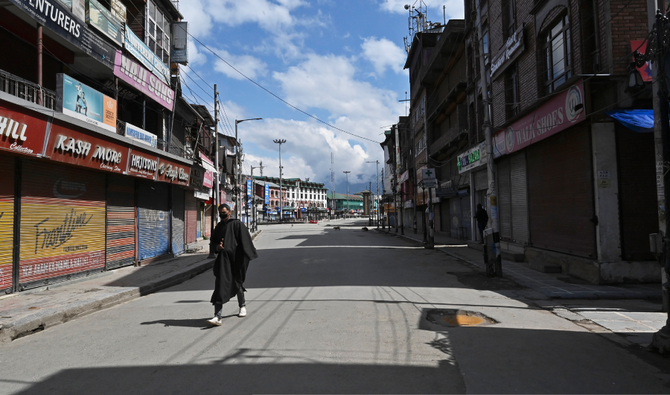
The lockdown has been enforced in all big and small cities, he added, with various measures adopted for social distancing as well as to ensure little participation in religious congregations and social gatherings.
He said the government had set up quarantine centers and upgraded facilities at all major hospitals, and Pakistan’s National Disaster Management Authority (NDMA) had extended its help.
At the same time, Khan said he was deeply concerned about the spread of the pandemic across the border in Indian administered Kashmir, and urged the Indian government to immediately release thousands of Kashmiris languishing in various Indian prisons.
He said the prisons in India and Indian administered Kashmir were crowded beyond capacity.
“The outbreak of COVID-19 has necessitated immediate release of all the prisoners particularly the inmates suffering from complicated diseases,” he said.
“People in Indian Kashmir are under double lockdown,” he added and appealed to the international community, particularly the United Nations, to take strict notice of new restrictions imposed by India on the movement of citizens and on the Internet in Indian administered Kashmir.
“The people of occupied Kashmir are facing great difficulties in reaching hospitals and health facilities due to the latest Indian restrictions, and getting information about the COVID-19 due to blockade of Internet services,” he said, and warned the current state of affairs could lead to a faster spread of the virus in the Indian administered territory.
On Sunday, Pakistan’s foreign office said in a statement the humanitarian situation in Indian administered Kashmir had been dire since August last year, and called for the immediate release of Kashmiri prisoners and the lifting of restrictions in the territory in the wake of the deadly new pandemic sweeping the world.
The total number of Covid-19 cases in India crossed the 1,000 mark on Sunday with around 33 cases in Indian administered Kashmir.


Lockdown to stem virus in Azad Kashmir so far effective, says president
https://arab.news/c6a85
Lockdown to stem virus in Azad Kashmir so far effective, says president

- Says 90 suspected cases in region with two testing positive so far
- Khan urged Indian government to immediately release thousands of Kashmiris languishing in Indian prisons

Pakistan reports first wild polio case of 2026 despite vaccination campaigns
- Four-year-old girl infected in Sindh’s Sujawal district as virus persists in high-risk areas
- Pakistan conducted last nationwide campaign in January, vaccinating over 45 million children
ISLAMABAD: Pakistan reported its first wild poliovirus case of the year, health authorities said on Thursday, underscoring the persistence of the disease in high-risk areas despite ongoing vaccination campaigns.
The latest infection was confirmed in a four-year-old girl in Sujawal district of the southern Sindh province, according to the Regional Reference Laboratory for Polio Eradication at the National Institute of Health in Islamabad.
Polio is a highly contagious viral disease that can cause permanent paralysis, mainly in children under the age of five. Pakistan and neighboring Afghanistan are the only two countries in the world where the disease remains endemic.
“The case was reported through the polio surveillance network and confirmed by the Regional Reference Laboratory for Polio Eradication at the National Institute of Health, Islamabad,” the statement said.
“The Polio Eradication Initiative is already analyzing the best response to tackle and prevent further transmission.”
In 2026, Pakistan conducted a nationwide polio campaign in January that vaccinated more than 45 million children, while the next national campaign is planned for April.
Since 1994, Pakistan has cut polio cases by 99.8 percent through vaccination efforts, reducing infections from an estimated 20,000 in the early 1990s to 31 in 2025.
Pakistan reported 31 polio cases in 2025. Southern Khyber Pakhtunkhwa accounted for more than half of the country’s polio cases in 2025, with 17 of the 31 infections reported from the region.
According to health authorities, 74 cases were reported in 2024.
More than 200 polio workers and police officers assigned to protect polio teams have been killed in Pakistan since the 1990s, according to health and security officials.
Militants often falsely claim the vaccination campaigns are part of a Western plot to sterilize Muslim children.
The vaccination campaigns are also undermined by parental refusals in remote regions.


