

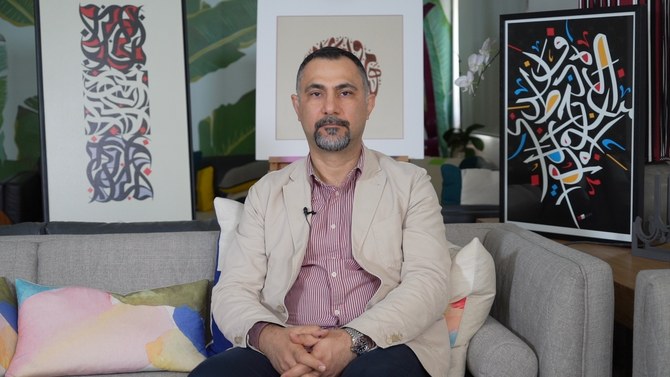
Calligraphy artist Wissam Shawkat seeks to break the mold after mastering classic styles

Wissam Shawkat pictured at Tashkeel in Dubai. (Arab News)
Short Url
Updated 30 March 2020
Follow

Calligraphy artist Wissam Shawkat seeks to break the mold after mastering classic styles

DUBAI: “If you continue practicing calligraphy in its traditional scripts, that’s a limitation by itself,” Iraqi artist Wissam Shawkat told Arab News while explaining the need to master the craft and then innovate to push Arabic calligraphy into the future.

“I mean I am not against learning traditional scripts. I’ve been doing calligraphy for almost 35 years, but I arrived to a point that if you continue like doing only traditional scripts at the end you are just copying what's been done 100 years ago,” Shawkat, who is based in Dubai, explained.
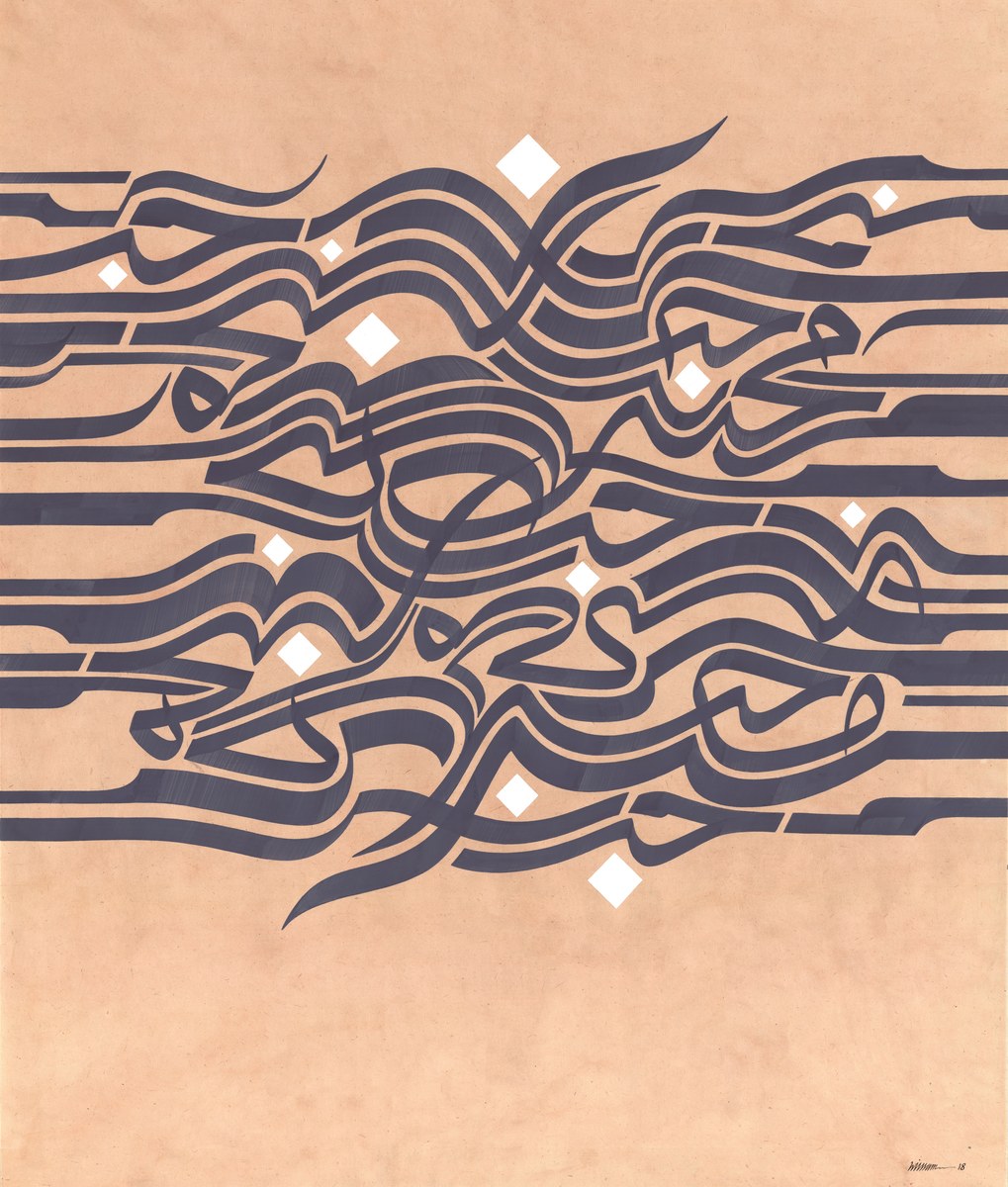


'Lost in Love' by Wissam Shawkat. (Supplied)

The artist’s passion for calligraphy started in 1984, when his art teacher decided to, for a day, teach them the skill instead of drawing, he said. “So, he held the chalk on the side and wrote four letters of Ruqa’a style, which is (a) very basic style in calligraphy, but as a kid this has a very big impact on me,” Shawkat said. It was then Shawkat learned to appreciate the beauty of the Arabic letter — “aalligraphy became an obsession,” he said.


'Quad Love' by Wissam Shawkat. (Supplied)

After training as a civil engineer, Shawkat decide to switch careers and dived into life as a calligraphy artists. And he achieved fame along the way, having worked with the likes of Tiffany & Co. and Hermes.


'Something' by Wissam Shawkat. (Supplied)

“Usually, the traditional way of learning calligraphy comes with the relationship of the master and the student. You have like a master, you study with him, (and) he guides you in certain forms.” But as a child, Shawkat did not have the “luxury” of having an educator. So, according to him, he had to depend on himself to learn the ins and outs of the notoriously laborious and strict art form.
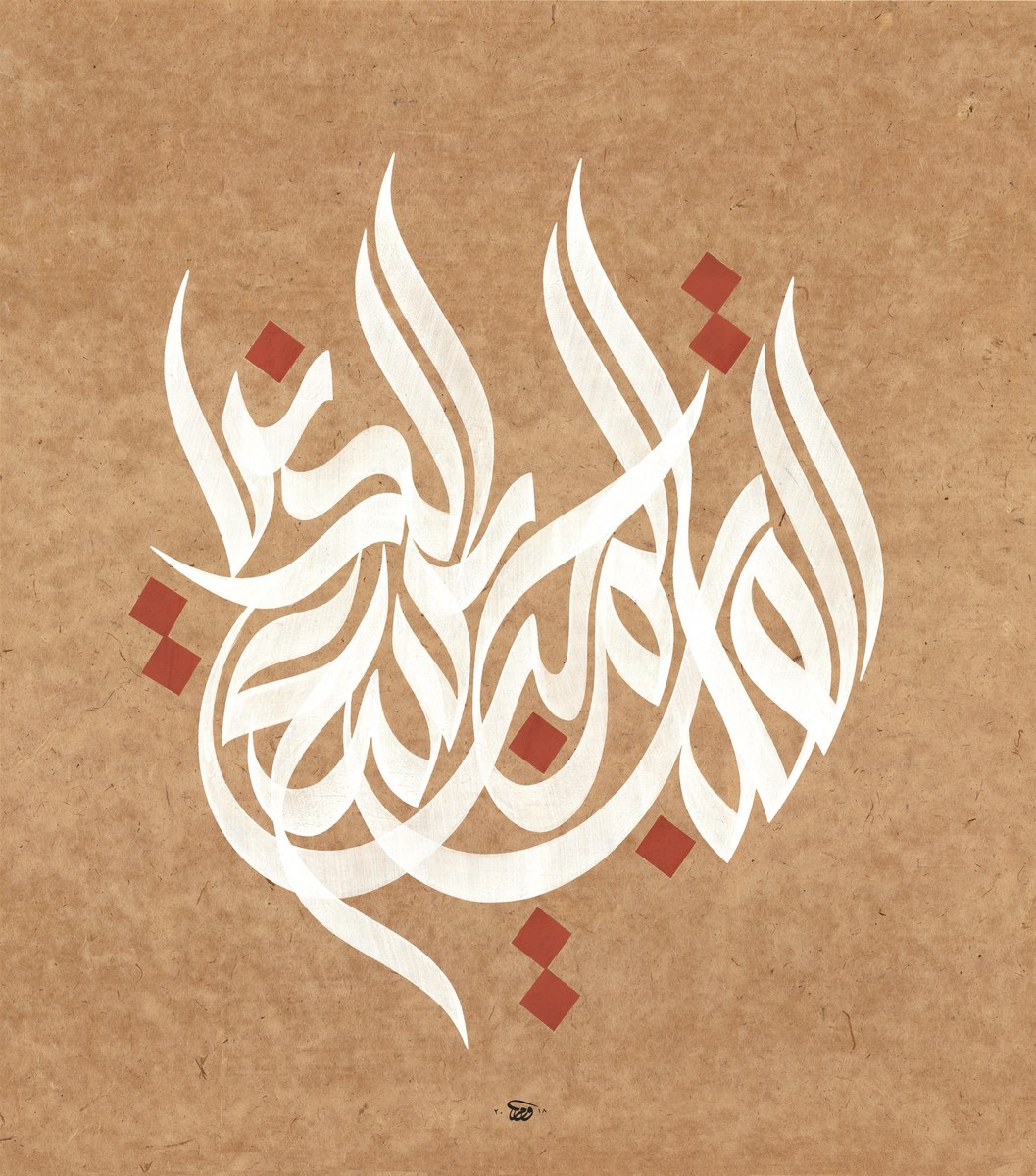


'Loving Heart 3' by Wissam Shawkat. (Supplied)

In 2014, Shawkat broke the mold by creating his own calligraphy style, Al Wissam, which references a number of traditional scripts, including Sunbuli, Jali Diwani, Eastern Kufic and Thuluth.


World of Coffee trade show capitalizes on Gulf’s strong coffee culture

Updated 06 January 2026
Follow

World of Coffee trade show capitalizes on Gulf’s strong coffee culture

DUBAI: Long regarded as the birthplace of coffee brewing, the Middle East is entering a new phase of cafe culture — and the fifth edition of World of Coffee, which takes place in Dubai from Jan. 18-20, will help drive that momentum.

Saudi Arabia alone is home to more than 5,100 branded cafes, with daily coffee consumption exceeding 36 million cups. Coffee is part of the social and cultural fabric, from traditional majlis gatherings to contemporary specialty cafes.

“Saudi Arabia’s coffee sector is evolving rapidly. There is increasing investment in quality, education, and presentation, alongside renewed interest in origin storytelling and cultural context,” said Shouq Bin Redha, exhibition manager for World of Coffee Dubai 2026, where Saudi Arabia will host a national pavilion.

“Saudi coffee has a very distinct identity rooted in heritage, ritual, and hospitality. Its profile is closely tied to traditional preparation methods and regional flavor preferences, which sets it apart on the global stage,” she told Arab News. “The national pavilion reflects this balance between tradition and modernization.”

Organized by DXB LIVE in partnership with the Specialty Coffee Association, World of Coffee Dubai has expanded dramatically, growing from 5,000 sq. meters in 2022 to more than 20,000 sq. meters in 2026. The event brings together producers, traders, roasters, cafe owners and innovators from around the world.

“At its core, the event is about bringing together the full coffee value chain in one place,” Redha said. “We want participants to leave not only having discovered new products or origins, but with stronger partnerships, clearer market insight, and a deeper understanding of how the industry is evolving.”

She added: “The Gulf has become an increasingly attractive market for producers because it combines strong consumer demand with a growing appreciation for quality, origin, and traceability.”

The UAE’s coffee market alone exceeds $3.2 billion, while Dubai continues to strengthen its position as one of the world’s most cafe-dense and diverse cities.

“Dubai, in particular, offers a unique gateway to multiple markets at once. For producers, World of Coffee Dubai provides direct access not only to local buyers, but to an international audience that uses the city as a regional and global trading hub,” Redha said.

When it comes to trends in the Gulf’s coffee scene, Redha said she expected to see “continued diversification in sourcing, with buyers exploring a broader range of origins and flavor profiles. There is also growing interest in coffees that offer greater transparency, whether through direct trade relationships, clearer traceability, or stronger sustainability credentials.”