

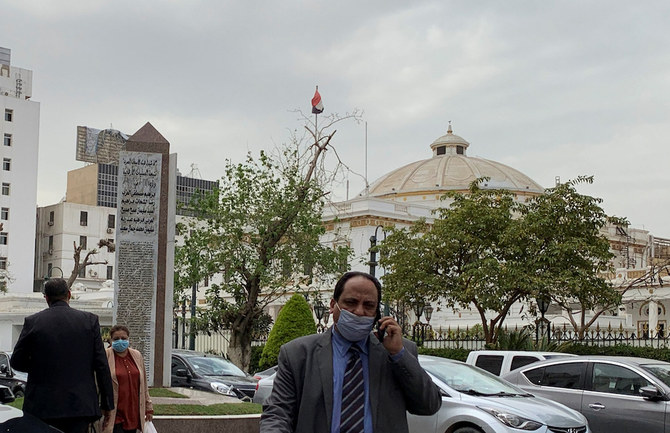

CAIRO: As demand for protective gear to combat the coronavirus disease COVID-19 rises, Egypt is witnessing a concurrent rise in counterfeit face masks and surgical gloves being offered for sale.
Egyptian security officials are in pursuit of a number of people who are attempting to profit from the global crisis by selling fake protective clothing. Officials in Sharqeya governorate, south of Cairo, have announced that they uncovered an unlicensed two-story factory manufacturing medical kits.
Security officials found 1,500 bogus facemasks, 500 pieces of cloth unrelated to factory work and 10 sewing machines.
In Giza governorate, security officials raided a factory producing fake face masks following a tipoff. Police discovered 200,000 face masks of unknown origin and arrested the factory’s two unemployed owners.
Other raids in the Cairo resulted in the detention of a warehouse owner for the bottling of unlicensed sanitizers intended for sale at inflated prices. Police found 17 tons of ethyl alcohol and 2,500 empty bottles “ready to be filled” in the warehouse, all of which were undocumented and of unknown origin.
Elsewhere, five people were detained for renting a workshop in a neighborhood affiliated to Al-Maasara police station in Cairo. They were using the workshop to manufacture unlicensed medical face masks using materials of unknown origin and an unregistered logo to sell them.
Police reportedly discovered 45 meters of cloth for making face masks, 1,500 face masks that had been made in the workshop, “huge numbers” of illegally obtained face masks, and six sewing machines.
The Investigation Unit at the 6 of October police station in Cairo has detained the owner of a medical supply office, the owner of a laundry shop, and a tailor at the same shop for manufacturing medical face masks using cheap materials of unknown origin which do not conform to international standards. The detainees were reportedly packaging the face masks in fake sanitized packages to fool customers.
Parliamentarian Tarek Metwally, a member of the Industry Committee in the House, submitted a request for an examination of such items, saying that face masks and sanitizers of unknown origin have been found in market places. These products have not been manufactured in accordance with proper health standards and had been selling on a large scale, feeding on the public’s fear of COVID-19 and desire to find ways to protect themselves.
Metwally claimed that counterfeit face masks that do not conform to the required standards and could actually transmit the virus. He also suggested that sanitizers made in unlicensed factories are dangerous “because no one knows what they are made of” and that they “might cause skin cancer.”
The cost of face masks has skyrocketed in Egypt, particularly since some private schools — although they are currently shut — had informed parents that they should buy face masks on a daily basis.
Hatem El-Badawy, a member of the Pharmacies Owners Division at the Chambers of Commerce Union, called on authorities to monitor face mask manufacturers to guarantee high-quality products for consumers.
He told Arab News that black-market face masks harm consumers rather than protect them.
By Friday evening, Egypt had reported 495 infections, including 24 deaths, since COVID-19 first appeared in the country in mid-February.


