

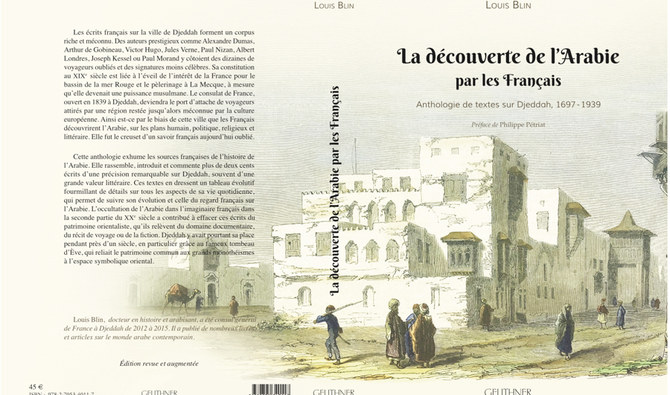
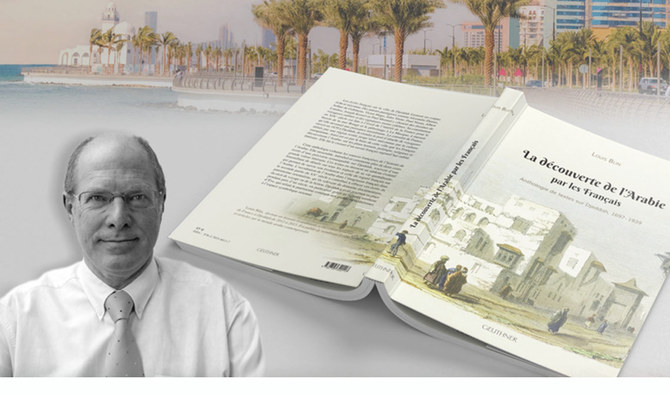

PARIS: In his book “The Discovery of Arabia by the French: Anthology of Texts on Jeddah 1697-1939,” diplomat Louis Blin, a former consul general of France in Jeddah, traces the history and evolution of his nation’s long relationship with, and views on, the city and the region.
He does this by presenting texts by about 50 French authors, works that span more than two centuries, in which they give their impressions of the region, and Jeddah in particular.
The quoted writers include literary giants such as Victor Hugo (“Les Misérables,” “The Hunchback of Notre-Dame”), Alexandre Dumas (“The Three Musketeers”) and Jules Verne (“Twenty Thousand Leagues Under the Sea”). Their writings about the French connection with Jeddah and the region reveal much interesting information that might come as a surprise to many Saudi and French people.
A regular visitor to Saudi Arabia, Blin spoke to Arab News about some of the things he learned while consul general, a posting that coincided with the 175th anniversary of the establishment of the French Consulate in Jeddah.
“The Jeddah Consulate was established in 1839 and was the first French diplomatic post in the Arabian Peninsula,” he said. “Marking that occasion triggered my interest in its history.
“I noticed that for 175 years, many diplomats had written and published articles about their postings and then I realized that, in fact, many other writers, journalists and travelers had done the same because Jeddah had fascinated many French people.”
As he researched more of these works, his plans for presenting the highlights he discovered quickly grew.
“At first, I thought about writing an article, which later became an 800-page book because of the exceptional material that Jeddah provided,” said Blin. “French orientalism is well known for its interest in North Africa and the Levant but it is completely unknown in the Arabian Peninsula.
“However, written texts about Jeddah were not limited to diplomats, many of whom were prominent orientalists. Great French authors such as Victor Hugo, Alexandre Dumas, Jules Verne, (investigative journalism pioneer) Albert Londre, (novelist and journalist) Joseph Kessel and (philosopher and writer) Paul Nizan also wrote about the city.”
The works of these writers and many more provided him with a new perspective on the development of the relationship between France and Jeddah from 1839 on.
“The French wrote a great deal about Jeddah because it is where the first French diplomatic post was established, during a period of Franco-British rivalry in the Red Sea — though neither of those two countries managed to set foot in what is now Saudi Arabia,” said Blin. In those days, the British were in Aden and the French in Djibouti but, in fact, they were able to de-escalate their rivalry in the Red Sea.
“The first Frenchman who was interested in the region was Bonaparte, and the first thing he did after besieging Cairo during his conquest of Egypt was to send a letter to the sharif of Makkah. He wanted the sharif as an ally in his conflict with the UK because he was seeking to reach India, which required him to go via the Red Sea.”
This marked the beginning of political relations between France and the region, which soon began to grow and evolve.

Louis Blin
“Bonaparte’s successor in Egypt, Mohammed Ali, successfully conquered the Hejaz, all the way up to Najd, 15 years after Napoleon’s departure,” said Blin. “He did so with a French-led army because he had the wise idea of recruiting Napoleon’s defeated soldiers. This meant that he had doctors, architects, and engineers in his army and all of them reached Jeddah.
“The Egyptian army that conquered Hejaz was mainly composed of French officers. The first hospital in the Arabian Peninsula, just like the first barracks and the first pharmacy, was built by a Frenchman.
“Even the French adjutant to Ahmad Bacha — Mohammed Ali’s nephew, who was the incompetent commander of the Egyptian army — ended up being the de facto governor of Jeddah for three years before the British and Ottoman empires united to demand the withdrawal of Egyptian troops from the Hejaz. Bacha failed to conquer Asir and had to retreat to Makkah. His armed forces were led by a Frenchman who became governor of Jeddah, which was Mohammed Ali’s capital.”
While Egypt ruled Hejaz, from 1813 until 1840, the French connection with Jeddah therefore continued.
“This is a story that is little known among French or Saudi people, because many believe that Saudi Arabia was an Anglo-Saxon preserve, but in both facts and in texts, the French had more relations with Jeddah than others did,” said Blin.
“Jeddah is the gateway to Saudi Arabia, hence the title of my book ‘The Discovery of Arabia by the French.’ It was through the city that the French discovered the whole region. They did not venture inside (the country), unlike the British who sent explorers several times through Iraq or Syria. The French confined themselves to the Red Sea and the coastline.”


