

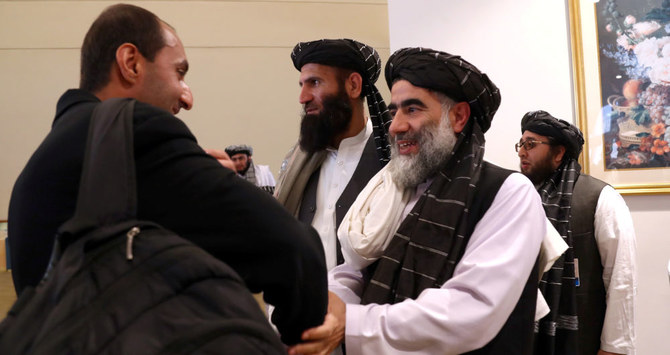
Kabul, Taliban will meet to plan prisoner swap 

The Taliban will guarantee that there will be no threat against any country, including US interests, in areas controlled by the militants
Short Url
Updated 27 March 2020
Follow

Kabul, Taliban will meet to plan prisoner swap 

  • ‘Positive’ deal opens way for crucial peace talks with militants

KABUL: The Afghan government and the Taliban have agreed to a prisoner swap at the end of March as part of the militants’ peace deal with Washington, officials said on Thursday.

The agreement comes after President Ashraf Ghani finalized a list of delegates to begin planning crucial peace talks with the Taliban, the officials said.

The prisoner exchange was secured on Wednesday following a five-way video conference that included officials from the Taliban, the Afghan government, the Red Cross, US and Qatar.

Javid Faisal, a spokesman for Ghani’s national security adviser, said that Taliban and Afghan officials will hold a face-to-face meeting in Afghanistan ahead of the release, which is set to begin on March 31.

Taliban prisoners will be selected for release according to age, health and coronavirus risk, he said.

Individual prisoners and the Taliban will have to provide assurances that freed inmates will not return to battlefield, Faisal told Arab News.

Zabihullah Mujahid, a Taliban spokesman, also confirmed on Thursday that progress has been made on the prisoner exchange, but offered no further details.

On Wednesday, Suhail Shaheen, the Taliban’s spokesman in Qatar, the group’s political headquarters, tweeted a series of comments on the agreement made in the five-way video conference.

“The process of releasing the prisoners will begin on March 31, and (the Taliban) will dispatch its technical team to Bagram prison to determine the identities of its prisoners — to verify the list of the prisoners that was previously endorsed,” he said.

The agreement on the prisoner swap ends the deadlock that threatened the start of the first intra-Afghan talks following Washington’s deal with the Taliban, signed last month following 18 months of secret negotiations.

The deal envisaged the exchange of prisoners before the start of the intra-Afghan talks set for March 10.

It will pave the way for the withdrawal of foreign troops led by the US from Afghanistan within 14 months. In return, the Taliban will guarantee that there will be no threat against any country, including US interests, in areas controlled by the militants.

US envoy Zalmay Khalilzad, who signed the deal with the Taliban, in a tweet described the agreement to release the prisoners in coming days as “a positive development.”

The prisoner deal comes amid heightened tension between Ghani and administration of US President Donald Trump, who is seeking re-election this year and will use the troop withdrawal after 19 years of fighting in Afghanistan to boost his campaign.

It also follows Washington’s decision this week to cut up to $2 billion in aid to Kabul in the coming year because of the dispute between Ghani and his poll rival, Abdullah Abdullah, over the presidency.

Ghani and Abdullah have been at loggerheads since last September over claims of a fraudulent poll. Both announced separate inauguration ceremonies two weeks ago, throwing the country into political chaos.

After Khalilzad failed to convince the two political leaders to agree on a single administration, US Secretary of State Mike Pompeo traveled to Kabul on Monday, but also was unable to deliver a reconciliation.

Washington said that aid can be restored to Kabul if the pair agree on a single government. It also wants an inclusive team lined up for the start of talks with the Taliban.

An official at presidential palace told Arab News that Ghani has drawn up a list of 20 members to hold talks with the Taliban led by former spy chief Masoom Stanekzai, who has held indirect talks with the militants in the past.


Near record number of small boat migrants reach UK in 2025

Updated 59 min 13 sec ago
Follow

Near record number of small boat migrants reach UK in 2025

  • The second-highest annual number of migrants arrived on UK shores in small boats since records were started in 2018, the government was to confirm Thursday

LONDON: The second-highest annual number of migrants arrived on UK shores in small boats since records were started in 2018, the government was to confirm Thursday.
The tally comes as Brexit firebrand Nigel Farage’s anti-immigration party Reform UK surges in popularity ahead of bellwether local elections in May.
With Labour Prime Minister Keir Starmer increasingly under pressure over the thorny issue, his interior minister Shabana Mahmood has proposed a drastic reduction in protections for refugees and the ending of automatic benefits for asylum seekers.
Home Office data as of midday on Wednesday showed a total of 41,472 migrants landed on England’s southern coast in 2025 after making the perilous Channel crossing from northern France.
The record of 45,774 arrivals was recorded in 2022 under the last Conservative government.
The Home Office is due to confirm the final figure for 2025 later Thursday.
Former Tory prime minister Rishi Sunak vowed to “stop the boats” when he was in power.
Ousted by Starmer in July 2024, he later said he regretted the slogan because it was too “stark” and “binary” and lacked sufficient context “for exactly how challenging” the goal was.
Adopting his own “smash the gangs” slogan, Starmer pledged to tackle the problem by dismantling the people smuggling networks running the crossings but has so far had no more success than his predecessor.
Reform has led Starmer’s Labour Party by double-digit margins in opinion polls for most of 2025.
In a New Year message, Farage predicted that if Reform got things “right” at the forthcoming local elections “we will go on and win the general election” due in 2029 at the latest.
Without addressing the migrant issue directly, he added: “We will then absolutely have a chance of fundamentally changing the whole system of government in Britain.”
In his own New Year message, Starmer insisted his government would “defeat the decline and division offered by others.”
Conservative Party leader Kemi Badenoch, meanwhile, urged people not to let “politics of grievance tell you that we’re destined to stay the same.”

- Protests -

The small boat figures come after Home Secretary Mahmood in November said irregular migration was “tearing our country apart.”
In early December, an interior ministry spokesperson called the number of small boat crossings “shameful” and said Mahmood’s “sweeping reforms” would remove the incentives driving the arrivals.
A returns deal with France had so far resulted in 153 people being removed from the UK to France and 134 being brought to the UK from France, border security and asylum minister Alex Norris said.
“Our landmark one-in one-out scheme means we can now send those who arrive on small boats back to France,” he said.
The past year has seen multiple protests in UK towns over the housing of migrants in hotels.
Amid growing anti-immigrant sentiment, in September up to 150,000 massed in central London for one of the largest-ever far-right protests in Britain, organized by activist Tommy Robinson.
Asylum claims in Britain are at a record high, with around 111,000 applications made in the year to June 2025, according to official figures as of mid-November.
Labour is currently taking inspiration from Denmark’s coalition government — led by the center-left Social Democrats — which has implemented some of the strictest migration policies in Europe.
Senior British officials recently visited the Scandinavian country, where successful asylum claims are at a 40-year low.
But the government’s plans will likely face opposition from Labour’s more left-wing lawmakers, fearing that the party is losing voters to progressive alternatives such as the Greens.
