Abu Dhabi banks unveil financial initiatives for consumers, SMEs

The Abu Dhabi Government is implementing a raft of financial incentives to help residents and businesses in the emirate cope with the economic uncertainties. (AFP)
Short Url
Updated 26 March 2020
Follow

Abu Dhabi banks unveil financial initiatives for consumers, SMEs

DUBAI: Several Abu Dhabi banks will implement a comprehensive package of financial incentives to help consumers and businesses in the emirate cope with the economic uncertainties because of the coronavirus outbreak.

Designed to provide for the immediate needs of individuals and small to medium-sized enterprises (SMEs) in Abu Dhabi, these 17 financial initiatives seek to reduce finance-related costs, facilitate the ease of access to financing, and maintain the resilience of the Abu Dhabi economy, state news agency WAM reported.

The measures, a collective effort by First Abu Dhabi Bank, Abu Dhabi Islamic Bank, Abu Dhabi Commercial Bank and the Abu Dhabi government, include 10 banking-related initiatives specifically for individuals, and seven financial initiatives for SMEs.

“Individuals who are impacted by COVID-19 may obtain these benefits, upon request to their banks. Deferred instalments (principal and interest) of existing personal and auto loans, mortgages, and credit cards will be made available for up to three months for eligible customers until the end of June 2020 with no additional bank charges,” WAM said.

“Foreclosures on mortgages will be halted for defaulted customers until 30 June 2020 and there will be a halt in the suspension of bank accounts for retrenched customers until the end of September 2020. Full refunds can be obtained on credit card processing fees on foreign currency transactions committed after 1 January 2020, associated with cancellation of travel plans.
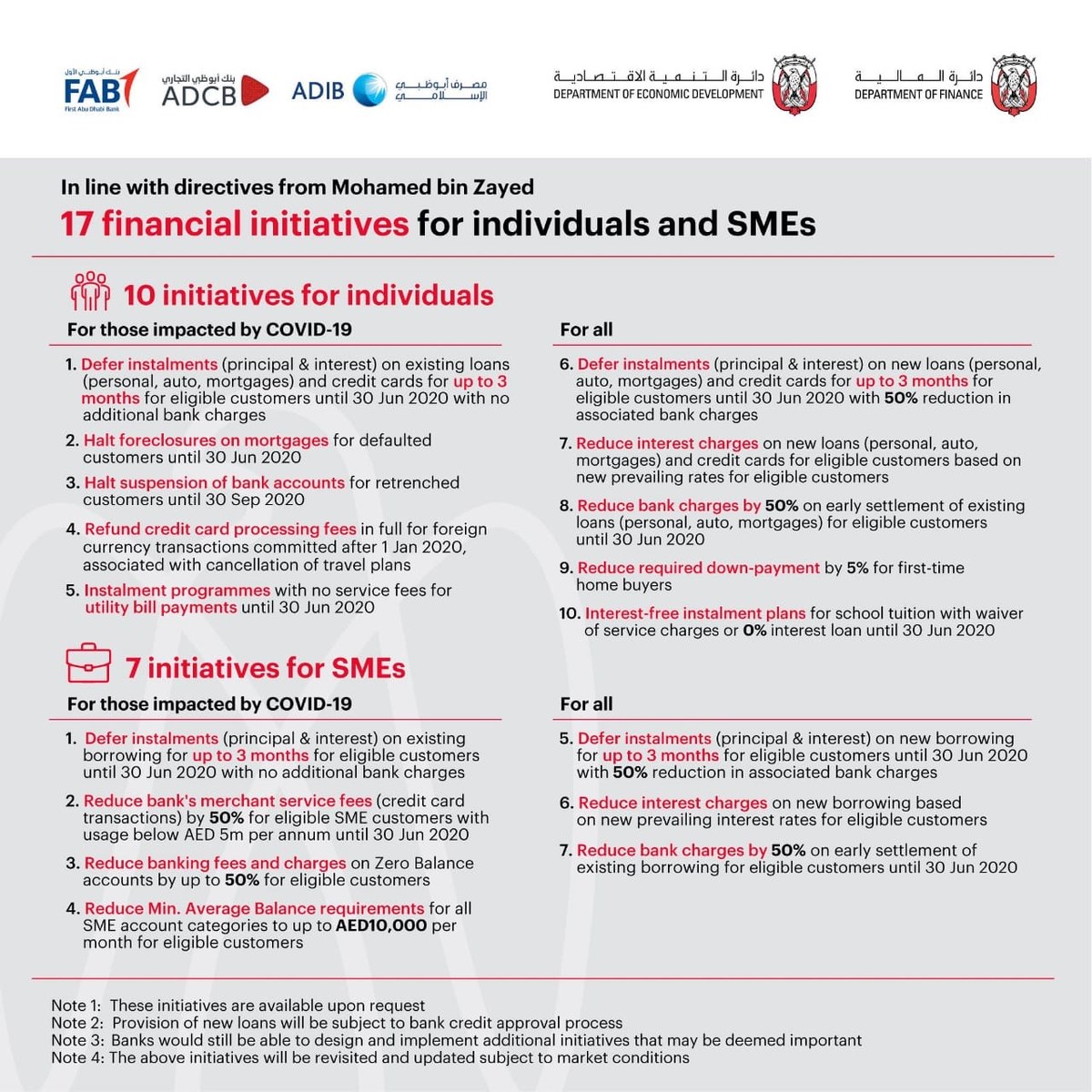
“Lastly, instalment programs will be made available with no service fees for utility bill payments until 30 June 2020.

“All individuals, upon request to their banks, may defer instalments (principal and interest) on new personal and auto loans, mortgages, and credit cards for up to three months for eligible customers until the end of June 2020, along with a reduction of 50 percent in associated bank charges,” WAM reported.

And to encourage customers to avail of an early settlement and refinancing of existing loans, banks would be implementing a 50 percent reduction on associated bank charges for eligible customers until June 30, 2020. There will also be a reduction in interest charges on new loans and credit cards for eligible customers based on new prevailing rates.

“For school tuition fees, interest-free instalment plans with either a waiver of service charges or 0 percent interest loan will also be provided until the end of June 2020. Other measures announced also include reducing the required down-payment by 5 percent for first-time home buyers,” the WAM report said.

For small businesses, the financial incentives geared for them would enable SMEs to mobilize their borrowings and savings more efficiently, while reducing the financial costs of running their businesses, WAM said.

“For those SMEs who have been impacted by COVID-19, upon request to their banks, they may defer instalments on existing borrowings for three months for eligible customers until the end of June 2020 with no additional bank charges.

“Eligible SMEs will also be able to save on selected fees for their banking services. Specifically, bank merchant service fees (credit card transactions) will be reduced by 50 percent for SMEs with below 5 million dirhams usage per annum until June 30. There will also be reduction of up to 50 percent on all banking fees and charges for Zero Balance accounts for eligible customers.

“In addition, the Minimum Average Balance requirements on all SME account categories will be reduced to up to AED 10,000 per month for eligible customers to provide them with more liquidity,” WAM said.

SMEs may also request their banks for instalments to be deferred on new borrowings for up to three months along with a 50 percent reduction in any associated bank charges until the end of June 2020, while those eligible could benefit from a reduction of interest charges on new borrowings based on new prevailing rates.

“Lastly, SMEs may avail a 50 percent reduction in bank charges for early settlements on their existing borrowings until June 30,” WAM said.


US allows countries to buy Russian oil stranded at sea for 30 days

Updated 14 sec ago
Follow

US allows countries to buy Russian oil stranded at sea for 30 days

  • US issues 30-day license for stranded Russian oil purchases
  • Measure the latest by Trump administration to calm energy markets jolted by Iran war

The United States issued ​a 30-day license for countries to buy Russian oil and petroleum products currently stranded at sea in what Treasury Secretary Scott Bessent said was a step to stabilize global energy markets roiled by the Iran war.
The announcement comes a day after the US Energy Department said that the US would be releasing 172 million barrels of oil from the strategic petroleum reserve in an effort to curb sky-rocketing oil prices in the wake of the war in Iran. That release was part of a broader commitment by the 32-nation International Energy Agency to release 400 million barrels of oil. The agency said earlier on Thursday that he war in the Middle East ‌was creating the ‌biggest oil supply disruption in history. Bessent, in a statement on X ​released ‌hours ⁠after benchmark ​oil prices ⁠shot above $100 a barrel, said the measure was “narrowly tailored” and “short-term” and would not provide significant financial benefit to the Russian government.
“The temporary increase in oil prices is a short-term and temporary disruption that will result in a massive benefit to our nation and economy in the long-term,” Bessent said in the statement, echoing President Donald Trump.
Thursday’s license, which authorizes the delivery and sale of Russian crude oil and petroleum products loaded on vessels as of March 12, will remain valid through midnight Washington time on April 11, according to the text of the license posted on ⁠the Treasury Department’s website. The US Treasury previously issued a 30-day waiver on March ‌5 specifically for India, allowing New Delhi to buy Russian oil stuck ‌at sea. Among other measures to tame energy prices, Trump has already ordered ​the US International Development Finance Corporation to provide political ‌risk insurance and financial guarantees for maritime trade in the Gulf and said the US Navy ‌could escort ships in the region. In another attempt to control prices, the Trump administration is considering temporarily waiving a shipping rule known as the Jones Act to ensure energy and agricultural products can move freely between US ports, the White House said. Waiving the rule would allow foreign ships to carry fuel between US ports, potentially lowering costs and speeding deliveries.
“The president ‌is taking every action he can to lower prices ... unsanctioned oil that’s at sea to get that into the market, continuing to push our own ⁠producers to drill and ⁠expand production as fast and as far as they can, providing regulatory relief, and you’re going to see more and more in the days to come,” White House Deputy Chief of Staff Stephen Miller told Fox News’ “Primetime” program on Thursday.
There were about 124 million barrels of Russian-origin oil on water across 30 different locations globally as of Thursday, Fox News reported, adding that the US license would provide around five to six days of supply when taking into account the daily loss of oil from the Strait. Trump said earlier on Thursday the United States stood to make significant money from oil prices driven higher by the war, prompting criticism from some lawmakers who accused him of caring only about rich people.
US and Israeli strikes on Iran and the subsequent response by Tehran have widened regional tensions and paralyzed shipping through the Strait of Hormuz, disrupting vital ​Middle East oil and gas flows and sending energy ​prices higher.
Raising the stakes for the global economy, Iran’s Islamic Revolutionary Guard Corps says it will block oil shipments from the Gulf unless the US and Israeli attacks cease.