Pakistan Ordnance Factories manufactures face masks, hand sanitizers

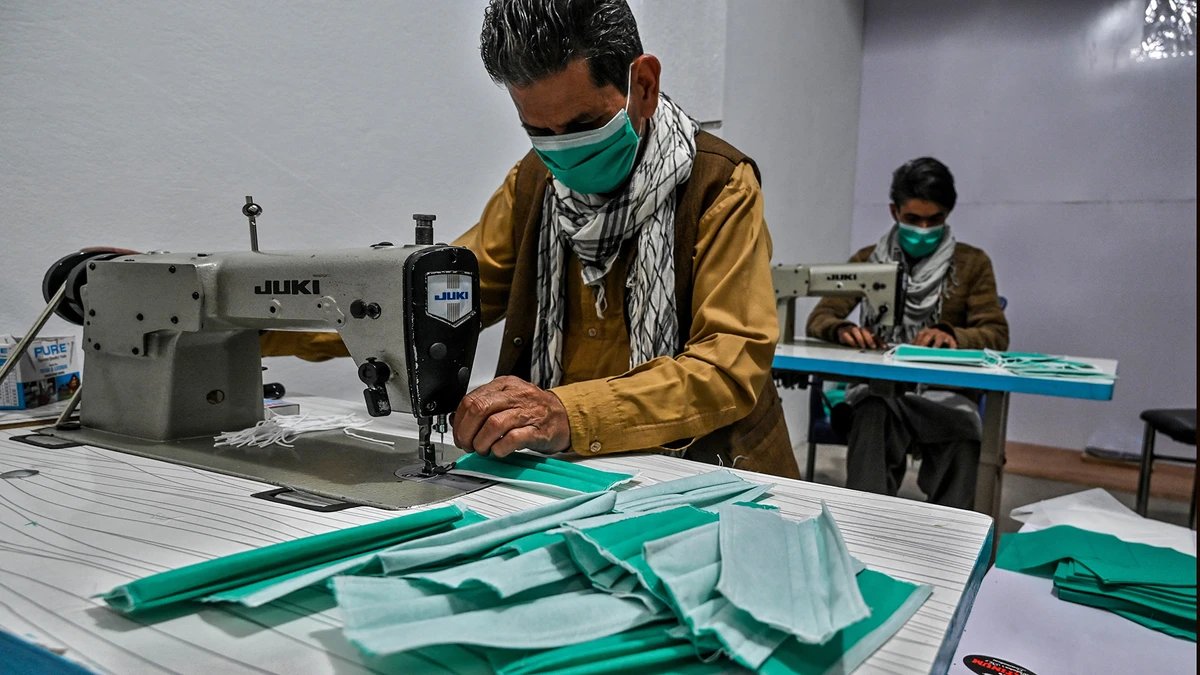
Workers make facemasks with sewing machines at a small factory during a government-imposed lockdown as a preventive measure against the COVID-19 coronavirus, in Rawalpindi on March 24, 2020. (AFP)
Short Url
Updated 26 March 2020
Follow

Pakistan Ordnance Factories manufactures face masks, hand sanitizers

  • In view of the current situation, the country’s defense establishment has shifted focus of its production facilities
  • The ordnance factories are traditionally known for manufacturing weapons and ammunition

ISLAMABAD: As the nation finds itself at war with a deadly pathogen that emerged in a small Chinese town in December 2019 before spreading across the globe and infecting more than a thousand people in Pakistan, the country’s defense establishment on Wednesday announced a shift in the focus of its production facilities, saying that its ordnance factories, which traditionally manufacture weapons and ammunition, have also started making face masks and hand sanitizers.
An official handout released on the instruction of the minister of defense production said that the country’s ordnance factories had “attained the capability to produce 25,000 Face Masks and 10,000 liters of Hand Sanitizers on a daily basis.”
The official statement described its new production potential as “a landmark achievement and a proud moment for the entire nation.”
“Special cloth has been used in production of Face Masks, that makes it re-usable after wash,” the statement said, adding that in view of the current situation, wherein the country was fighting novel coronavirus, Pakistan’s defense related production capability “had been diverted toward mass production of Face Masks and Hand Sanitizers.”
“The laudable efforts by Pakistan Ordnance Factories will indeed complement the ongoing national drive to fight COVID-19,” it continued while promising “further breakthrough” in “the near future.”
Pakistan’s security forces have already been playing their role in preventing the spread of the dreaded virus in the country by activating the network of their hospitals across the country to deal with the problem.
They are also helping the civil administration with countrywide lockdowns that have been announced to implement social distancing.
Pakistan says IMF has not imposed new conditions under $7 billion bailout

Updated 4 sec ago
Follow

Pakistan says IMF has not imposed new conditions under $7 billion bailout

  • Finance ministry says measures cited as ‘new conditions’ are phased extensions of reforms already agreed
  • Media described steps like civil servants’ asset disclosures and sugar industry deregulation as new demands

ISLAMABAD: Pakistan said on Sunday some of the reform measures mentioned in the media and linked to the International Monetary Fund (IMF) bailout program are not “new conditions” imposed by the lender but extensions of commitments already agreed under the arrangement.

Local media and social platforms have described a series of IMF-linked structural benchmarks as fresh conditions under the $7 billion loan for Pakistan in recent weeks. News reports published and broadcast in India also mentioned 11 measures under the loan, describing them as new IMF demands imposed on the country.

“The Ministry of Finance has clarified the intent, context, and continuity of reform measures under Pakistan’s IMF Extended Fund Facility (EFF) program, particularly in response to recent commentary regarding so-called ‘new conditions,’” said an official statement circulated in Islamabad.

“The purpose is to reaffirm that the measures referenced are part of a phased, medium-term reform agenda agreed with the IMF, many of which are extensions or logical progressions of reforms already initiated by the Government of Pakistan,” it added.

The ministry said the EFF is designed to support medium-term structural reforms implemented in a sequenced manner, with each program review building on prior actions to meet policy objectives agreed at the outset.

It provided detailed clarification on 11 measures that had been characterized as new conditions, including public disclosure of asset declarations of civil servants, strengthening the operational effectiveness of the National Accountability Bureau, empowering provincial anti-corruption bodies through access to financial intelligence and facilitating foreign remittances.

Other measures cited included the development of the local currency bond market, deregulation of the sugar industry, a comprehensive reform roadmap for the Federal Board of Revenue, a medium-term tax reform strategy, phased privatization of power distribution companies, regulatory reforms to strengthen corporate compliance and contingency measures to address potential revenue shortfalls.

The ministry said several of these reforms had been embedded in the Memorandum of Economic and Financial Policies (MEFP), a document detailing mutually agreed commitments, dating back to May 2024 and March 2025, including pledges related to tax policy, governance, energy sector restructuring and revenue mobilization.

“During discussions and negotiations with the IMF, the Government of Pakistan presents its planned policy reform initiatives,” the statement added. “Where the IMF assesses that these initiatives contribute to the agreed program objectives, they are incorporated into the MEFP.”

“As a result,” it continued, “many of the structural benchmarks and actions included in the latest MEFP are derived from reforms already undertaken or initiated by the Government of Pakistan, rather than being externally imposed or newly introduced conditions.”

The statement noted the measures outlined in the latest MEFP represent “continuity, sequencing and deepening of Pakistan’s agreed reform agenda” under the IMF loan, rather than the “imposition of abrupt or unprecedented conditions.”