

Saudi Arabia records second coronavirus death/node/1647296/saudi-arabia
Saudi Arabia records second coronavirus death
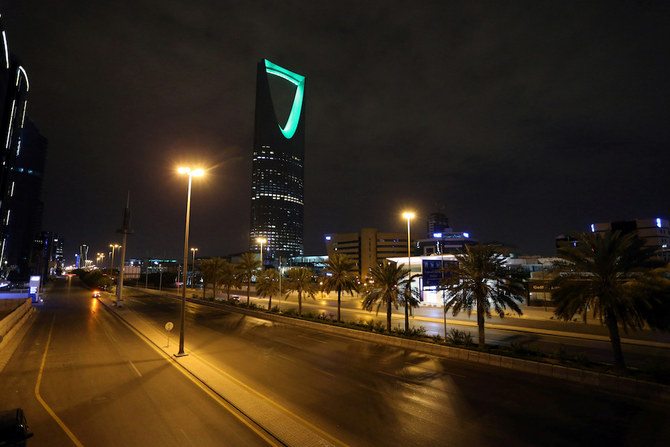
A general view shows an empty street after a curfew was imposed to prevent the spread of the coronavirus disease (COVID-19), in Riyadh, Saudi Arabia March 24, 2020. Picture taken March 24, 2020. (Reuters)
The Kingdom reported 133 new coronavirus cases on Wednesday
Updated 25 March 2020
Arab News
RIYADH: Saudi Arabia’s health ministry reported on Wednesday the Kingdom’s second coronavirus related death.
The ministry said the total number of infections had now reached 900.
The deceased was a resident from Makkah.
The ministry said 133 new cases had emerged since Tuesday and 29 people have recovered from the virus so far.
Spokesperson Dr. Mohammed Al-Abd Al-Aly, renewed the government’s call to halt gatherings, including those at home.
“If it is necessary to remain in one place, and must keep a distance of one meter or one and a half meters between people,” he said.
Interior ministry spokesperson, Talal Al-Shalhoub, praised the major commitments to the curfew so far and said that an extended curfew will be implemented in Riyadh, Makkah and Madinah starting from 3 p.m. on Thursday, according to measures approved by King Salman.
Al-Shalhoub said security officials will monitor violations in the streets, and will take in to account those exempted from the curfew, adding that the violation would apply to the individual and not the vehicle.
Saudi Arabia started a nationwide curfew on Monday, stopping people going outside from 7 p.m. until 6 a.m. for 21 days.
On Wednesday, King Salman announced further measures prohibiting people from entering and leaving Riyadh, Makkah and Madinah
Meanwhile, Saudi Arabia’s General Presidency for the Affairs of the Two Holy Mosques announced on Wednesday that construction of the third expansion of the Grand Mosque in Makkah will be halted temporarily over coronavirus fears.
Aloula partners with Saudi Music Hub to amplify young voices
2-month vocal program places children in spotlight
Program culminates in performance of Saudi national anthem
Updated 4 sec ago
Nada Hameed
JEDDAH: A new choral initiative launched by Aloula, in partnership with the Saudi Music Hub, has brought youngsters aged 9-18 into a structured vocal training program that will culminate in a performance of the Saudi national anthem.
The two-month initiative, which was launched in November, is one of the first children’s choral programs led by a nonprofit organization in Saudi Arabia.
In the rehearsal room, 75 children are learning how to sing the Saudi national anthem “Aash Al-Maleek,” and “Watani Al Habib” in a full choral arrangement.
Among the singers is 14-year-old Nawaf Al-Qahtani, who said the experience had helped him grow as a performer. (Supplied)
Participants attend vocal training sessions three times a week, from Monday to Wednesday, focusing on technique, listening skills, and ensemble performance.
Speaking to Arab News, Abir Abusulayman, the CEO of Aloula, said the project was designed to include children more directly in the Kingdom’s cultural transformation.
She said: “The Kingdom is living a beautiful cultural moment right now, and we didn’t want our children to watch it from the sidelines; we wanted them to be part of it.
HIGHLIGHTS
• The two-month initiative, launched by Aloula in partnership with the Saudi Music Hub, is one of the first children’s choral programs in Saudi Arabia.
• Abeer Ibrahim, a vocal and singing instructor at the Saudi Music Hub, is among the educators working closely with the group.
“It felt like the perfect way to bring them together, build their confidence, and let them experience something joyful and memorable.”
Founded in 1962, Aloula works with children and families through early-intervention programs to strengthen academic, creative, and social skills. The initiative reflects the organization’s broader focus on confidence-building and participation through creative experience.
Aloula children rehearsing the Saudi national anthem with instructor Abeer at the Saudi Music Hub. (Supplied)
Abusulayman said music offered lessons that extended beyond performance, and added: “Music opens something special inside a child. It teaches them to listen, to express themselves, to work as a team, and to trust their own voice. These creative experiences help children feel seen and give them skills that stay with them far beyond the classroom.”
Abusulayman said the benefits of the venture extended well beyond the final performance.
She said: “Academically, music helps with focus and memory. Socially, it teaches them to work together and support one another. And on a personal level, it gives them a moment in their lives where they feel proud, capable, and celebrated. Many of these children have never been on a stage before; this can be the spark that pushes them to dream bigger.”
The Saudi Music Hub, an education and training institution affiliated with the Music Commission under the Ministry of Culture, was established in 2022. (Supplied)
Abeer Ibrahim, a vocal and singing instructor at the Saudi Music Hub, is among the educators working closely with the group. A graduate of the Egyptian Conservatory, Ibrahim specializes in vocal training and music theory for young singers.
“This experience gave me very beautiful feelings and emotions while working with children,” Ibrahim told Arab News.
“From the very beginning they showed clear enthusiasm and joy, and I discovered wonderful talents and voices despite their young age. That small voice gave me a very powerful feeling, and I am extremely happy with it. We will present even better work in the future.”
Ibrahim also noted the significance of working with the national anthem, and she said: “Performing the Saudi national anthem instills in children a deep sense of belonging and pride in their country and culture,” adding that it helped young participants understand their role within the larger community.
Among the singers is 14-year-old Nawaf Al-Qahtani, who said the experience had helped him grow as a performer.
He described the experience as transformative, and said: “What I liked most was the interaction with the instructor, and we learned many things that will benefit us in the future.”
He added: “I learned how to control my vocal range, how to sing properly, how to face an audience, and I learned about the vocal ranges of the national anthem.”
Ibrahim described Al-Qahtani as one of the program’s strongest voices, noting that the anthem’s arrangement was adapted to suit his vocal range.
The initiative is part of Aloula’s wider portfolio of educational and creative programs. These include a robotics program, in which children design interactive projects, as well as community exploration activities that introduce participants to major cultural and sporting events in Jeddah.
The Saudi Music Hub, an education and training institution affiliated with the Music Commission under the Ministry of Culture, was established in 2022.
With headquarters in Riyadh and branches in Jeddah and Alkhobar, the hub provides musical instrument instruction, choir training, and performance workshops, with a focus on developing local talent.
For Abusulayman, the partnership reflects the value of collaboration between cultural and social organizations.
“When we combine our strengths, we create opportunities that our children may not otherwise have,” she said. “I truly believe this kind of collaboration can open new doors for the whole nonprofit sector.”