

US Congress, negotiators reach deal on $2tn coronavirus aid package

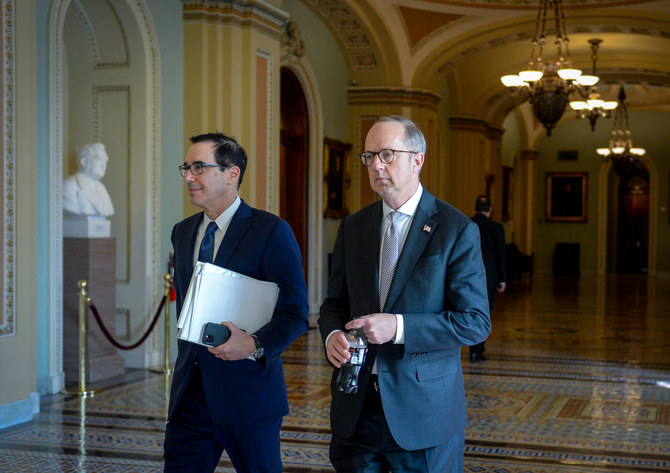
White House Director of Legislative Affairs Eric Ueland and Treasury Secretary Steve Mnuchin walk through the U.S. Capitol between meetings to wrap up work on coronavirus economic aid legislation, during the coronavirus disease (COVID-19) outbreak, in Washington, U.S., March 22, 2020. (Reuters)
Short Url
Updated 25 March 2020
Follow

US Congress, negotiators reach deal on $2tn coronavirus aid package

  • The Senate’s Republican majority leader, Mitch McConnell, was expected to speak on the Senate floor shortly about the agreement
  • The text of the pact was not expected to be available until later on Wednesday

WASHINGTON: US senators and Trump administration officials have reached an agreement on a massive economic stimulus bill to alleviate the economic impact of the coronavirus outbreak, White House official Eric Ueland said early on Wednesday.

“We have a deal,” Ueland told reporters after days of negotiations on the package, expected to be worth $2 trillion.

The Senate’s Republican majority leader, Mitch McConnell, was expected to speak on the Senate floor shortly about the agreement.

The text of the pact was not expected to be available until later on Wednesday.

US Senate Democratic leader Sen Schumer said the coronavirus bill provides over $130 billion to aid hospitals. He added that $150 billion provided to aid state and local governments.

The package had been expected to include a $500 billion fund to help hard-hit industries and a comparable amount for direct payments of up to $3,000 to millions of US families, as well as $350 billion for small-business loans, $250 billion for expanded unemployment aid and $75 billion for hospitals.

It aims to cushion the economic blow from a pandemic that has killed more than 660 people in the United States and sickened more than 50,000, shuttered thousands of businesses, thrown millions out of work and led states to order 100 million people — nearly a third of the population — to stay at home.

The money at stake in the stimulus legislation exceeds what the US government spends on national defense, scientific research, highway construction and other discretionary programs.


US judge blocks Trump admin from detaining refugees in Minnesota

Updated 4 sec ago
Follow

US judge blocks Trump admin from detaining refugees in Minnesota

MINNEAPOLIS: A US federal judge temporarily blocked the administration of President Donald Trump Wednesday from detaining refugees in Minnesota awaiting permanent resident status and ordered the release of those in detention.
Trump has sent thousands of federal immigration agents to the Democratic state as part of a sweeping crackdown that has sparked outrage over two civilian deaths at the hands of officers.
Authorities launched a program this month to re-examine the legal status of the approximately 5,600 refugees in Minnesota who have not yet been given green cards.
In his order Wednesday, US District Judge John Tunheim said that the Trump administration could continue to enforce immigration laws and review refugees’ status, but that it must do so “without arresting and detaining refugees.”
“Refugees have a legal right to be in the United States, a right to work, a right to live peacefully — and importantly, a right not to be subjected to the terror of being arrested and detained without warrants or cause in their homes or on their way to religious services or to buy groceries,” Tunheim wrote.
“At its best, America serves as a haven of individual liberties in a world too often full of tyranny and cruelty. We abandon that ideal when we subject our neighbors to fear and chaos.”
The order drew a quick rebuke from White House Deputy Chief of Staff Stephen Miller, a powerful figure who leads Trump’s hard-line immigration policy.
“The judicial sabotage of democracy is unending,” Miller wrote on X.
Tunheim’s order requires any refugee detained under the Minnesota status review, known as Operation PARRIS, to be “immediately released from custody.”
Refugees awaiting their permanent resident status “have undergone rigorous background checks and vetting, been approved by multiple federal agencies for entry, been given permission to work, received support from the government, and been resettled in the United States,” Tunheim wrote.
“These individuals were admitted to the country, have followed the rules, and are waiting to have their status adjusted to lawful permanent residents of the United States.”