

Iran turns away Medecins Sans Frontieres coronavirus hospital

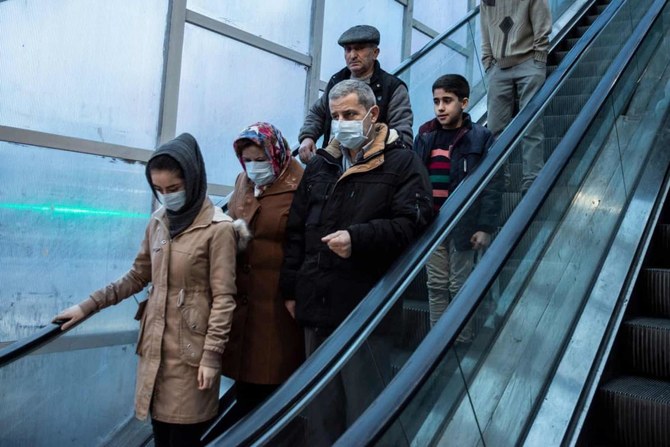
People wear face masks to protect against the coronavirus in Rasht, Gilan province, Iran. (Shutterstock)
Short Url
Updated 25 March 2020
Follow

Iran turns away Medecins Sans Frontieres coronavirus hospital

  • Medecins Sans Frontieres (MSF), a global medical charity, had sent a mobile 50-bed hospital and team of medics to Isfahan
  • MSF said it was incomprehensible that Iran had turned down the help after an agreement had been made

LONDON: Iran has turned away a major international aid operation to help the country treat coronavirus cases.

Iran is being crippled by one of the worst Covid-19 outbreaks in the world, with the regime’s figures claiming 1,934 people had died as of Tuesday.

Medecins Sans Frontieres (MSF), a global medical charity, had sent a mobile 50-bed hospital and team of medics to Isfahan to help hospital workers there handle the huge volume of cases.

On Tuesday, MSF said it was incomprehensible that Iranian health ministry officials had removed approval for the organization to help manage severe cases after the team nd equipment had already arrived in Tehran.

“We are deeply surprised to learn that the approval for the deployment of our treatment unit has been revoked,” said Michel Olivier Lacharite, manager of the MSF Emergency programmes in Paris. “The need for this intervention, and the authorisations needed to start it, were discussed and agreed with relevant Iranian authorities during the past weeks. Our teams were ready to start medical activities at the end of this week.”

The announcement came after an Iranian health ministry adviser said on Monday that the country did not need MSF’s help.

“We currently do not have a need for hospital beds set up by foreign forces,” Alireza Vahabzadeh tweeted.

Earlier, MSF said the operation involved an inflatable hospital and a nine-person team of emergency and intensive care doctors and logistics personnel to treat patients critically ill with the virus.

The hospital had been flown from France and was to be set up inside the compound of Amin hospital in Isfahan.

“Iran is by far the hardest hit country in the region, and Isfahan the second worst-affected province in Iran,” says Julie Reverse, MSF’s representative in Iran. “We hope our assistance will relieve at least some of the pressure on the local health system.”

Iran’s Supreme Leader Ayatollah Ali Khamenei, on Sunday turned down a US offer of humanitarian assistance, saying “they could be giving medicines to Iran that spread the virus or cause it to remain permanently in Iran.”

The outbreak has swept through Iran where the government has been criticized for its slow response and covering up the true extent of those infected.

Last week officials conceded that someone was dying from Covid-19 every 10 minutes in the country.


Aid workers find little life in El-Fasher after RSF takeover

Updated 10 sec ago
Follow

Aid workers find little life in El-Fasher after RSF takeover

  • First UN visit to the devastated Sudanese city finds traumatized civilians in ‘unsafe conditions’

PORT SUDAN: Traumatized civilians left in Sudan’s El-Fasher after its capture by paramilitary forces are living without water or sanitation in a city haunted by famine, UN aid coordinator Denise Brown said on Monday.
El-Fasher fell to the paramilitary Rapid Support Forces in October after more than 500 days of siege, and last Friday, a small UN humanitarian team was able to make its first short visit in almost two years.
Mass atrocities, including massacres, torture, and sexual violence, reportedly accompanied the capture of the city. Satellite pictures reviewed by AFP show what appear to be mass graves.

FASTFACT

From a humanitarian point of view, UN aid coordinator Denise Brown said, El-Fasher remains Sudan’s ‘epicenter of human suffering’ and the city — which once held more than a million people — is still facing a famine.

Brown described the city as a “crime scene,” but said human rights experts would carry out investigations while her office focuses on restoring aid to the survivors.
“We weren’t able to see any of the detainees, and we believe there are detainees,” she said.
From a humanitarian point of view, she said, El-Fasher remains Sudan’s “epicenter of human suffering” and the city — which once held more than a million people — is still facing a famine.
“El-Fasher is a ghost of its former self,” Brown said in an interview.
“We don’t have enough information yet to conclude how many people remain there, but we know large parts of the city are destroyed. The people who remain, their homes have been destroyed.”
“These people are living in very precarious situations,” warned Brown, a Canadian diplomat and the UN’s humanitarian coordinator in Sudan.
“Some of them are in abandoned buildings. Some of them ... in very rudimentary conditions, plastic sheeting, no sanitation, no water. So these are very undignified, unsafe conditions for people.”
Since April 2023, Sudan has been gripped by a conflict between the regular army and its former allies, the RSF, which has triggered a humanitarian catastrophe.
Brown said the team “negotiated hard with the RSF” to obtain access and managed to look around, visit a hard-pressed hospital, and some abandoned UN premises — but only for a few hours.
Their movements were also limited by fears of unexploded ordnance and mines left behind from nearly two years of fighting.
“There was one small market operating, mostly with produce that comes from surrounding areas, so tomatoes, onions, potatoes,” she said.
“Very small quantities, very small bags, which tells you that people can’t afford to buy more.”
“There is a declared famine in El-Fasher. We’ve been blocked from going in. There’s nothing positive about what’s happened in El-Fasher.
“It was a mission to test whether we could get our people safely in and out, to have a look at what remains of the town, who remains there, what their situation is,” she said.
The war in Sudan has killed tens of thousands of people, driven 11 million from their homes, and caused what the UN has declared “the world’s worst humanitarian disaster.”