Thailand declares emergency, approves $3.3bn stimulus to ease coronavirus impact

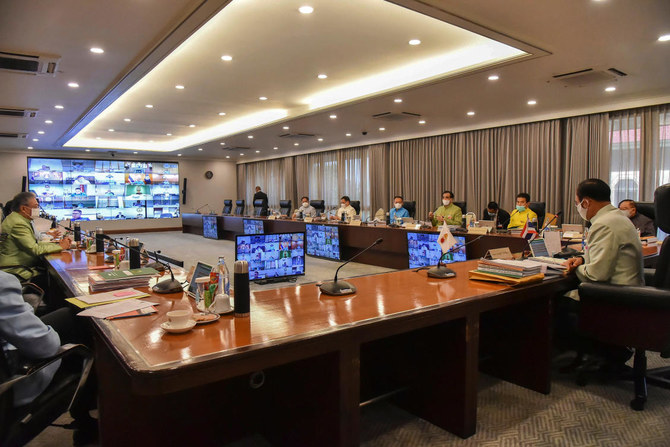
Thailand’s Prime Minister Prayuth Chan-ocha wears a protective face mask due to the coronavirus outbreak during a teleconference for a weekly cabinet meeting with his ministers on March 24, 2020. (Thailand Government House via Reuters)
Short Url
Updated 24 March 2020
Follow

Thailand declares emergency, approves $3.3bn stimulus to ease coronavirus impact

  • Measures include cash handouts, soft loans, emergency loans and tax breaks
  • Thailand reported three deaths and 106 new coronavirus cases on Tuesday

BANGKOK: Thailand will be in an emergency mode from March 26 for a month to deal with the coronavirus outbreak, Prime Minister Prayuth Chan-ocha told a news conference on Tuesday.
Thailand’s cabinet on Tuesday also approved additional stimulus measures worth 107 billion baht ($3.25 billion) in a bid to mitigate the impact of the coronavirus outbreak. The measures include cash handouts, soft loans, emergency loans and tax breaks.
The emergency decree will mean the prime minister will have the executive power to declare further measures to contain the virus, including giving extra authority to officials and allowing the setting up of checkpoints to reduce people movements, Prayuth said.
He said details of the measures will be announced later.
Thailand reported three deaths and 106 new coronavirus cases on Tuesday. The country now has 827 cases and four fatalities since the outbreak began.


Trump invites Colombia’s Petro to White House after earlier threat of military action

Updated 08 January 2026
Follow

Trump invites Colombia’s Petro to White House after earlier threat of military action

  • Relations between Trump and Petro have been frosty since the Republican returned to the White House in January 2025

WASHINGTON/BOGOTA: Days after threatening Colombia with military action, US ​President Donald Trump on Wednesday said arrangements were being made for the country’s President Gustavo Petro to visit the White House, following a call between the two leaders. Trump and Petro said they discussed relations between the two countries in their first call since the US president on Sunday said that a US military operation focused on Colombia’s government “sounds good” to him. That threat followed Trump ordering the US capture of the president of neighboring Venezuela, who ‌was flown to ‌the US to face drug and weapons charges.
“It ‌was ⁠a ​great honor ‌to speak with the President of Colombia, Gustavo Petro, who called to explain the situation of drugs and other disagreements that we have had. I appreciated his call and tone, and look forward to meeting him in the near future,” Trump wrote on social media.
Trump added “arrangements are being made” for a meeting in Washington between himself and Petro, Colombia’s first leftist president, but gave no specific ⁠date for a meeting.
“We have spoken by phone for the first time since he became president,” Petro ‌told supporters gathered at a rally in ‍Bogota meant to celebrate Colombia’s sovereignty, ‍adding he had requested a restart of dialogue between the two countries.
A ‍source in Petro’s office told Reuters the call was “cordial” and “respectful.”
Relations between Trump and Petro have been frosty since the Republican returned to the White House in January 2025.
Trump has repeatedly accused the administration of Petro, without evidence, of enabling a steady ​flow of cocaine into the US, imposing sanctions on the Colombian leader in October.
On Sunday Trump referred to Petro as “a sick ⁠man, who likes making cocaine and selling it to the United States.”
The US in September had revoked Petro’s visa after he joined a pro-Palestinian demonstration in New York following a meeting of the United Nations General Assembly and called on US soldiers to “disobey the orders of Trump.”
Petro, who has been a vocal opponent of Israel’s war in Gaza, had accused Trump of being “complicit in genocide” in Gaza and called for “criminal proceedings” over US missile attacks on suspected drug-running boats in Caribbean waters.
The Trump administration has carried out more than 30 strikes against suspected drug boats since September, in a campaign that has killed at least ‌110 people.