Amputee cricketer outplays fate with innovation

1 / 2
Altaf Ahmad is standing in front of a bowling machine he designed to continue cricket training after leg amputation, Rawalpindi, March 10, 2020. (AN Photo by Saba Rehman)
2 / 2
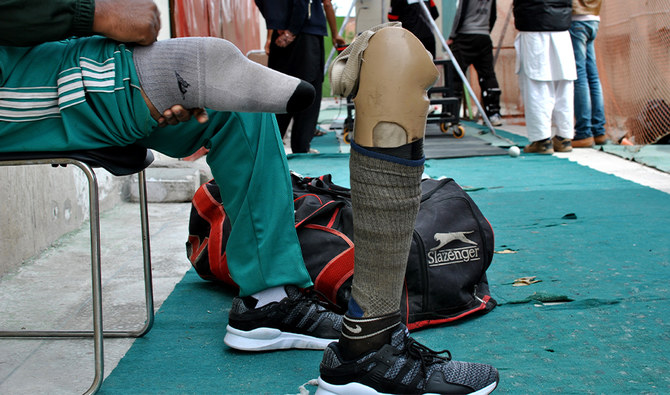
Amputee athlete Altaf Ahmad lost his right leg to a shooting incident in 2008. Photo taken in Rawalpindi on March 10, 2020. (AN Photo by Saba Rehman)
Short Url
Updated 23 March 2020
Follow

Amputee cricketer outplays fate with innovation

  • Altaf Ahmad designed his own bowling machine to be able to train despite disability
  • Dozens of players, some as young as four years of age, come for training sessions in his cricket academy

RAWALPINDI: Altaf Ahmad attaches his artificial leg as trainees gather at a cricket school in Rawalpindi, waiting for him to teach them batting.

“I promised myself that I would never find weakness in my disability,” he told Arab News, as he narrated how he underwent amputation 12 years ago after being shot in the leg in an attempted robbery. 

He succeeded in getting over initial depression, and in the new situation discovered his superpower: Innovativeness.

The 38-year-old government employee has always been a good cricketer and used to represent his department at various tournaments. Once a person develops a passion for cricket, it stays forever. Ahmad knew disability could not stop him and devised a machine that would allow him to continue training.
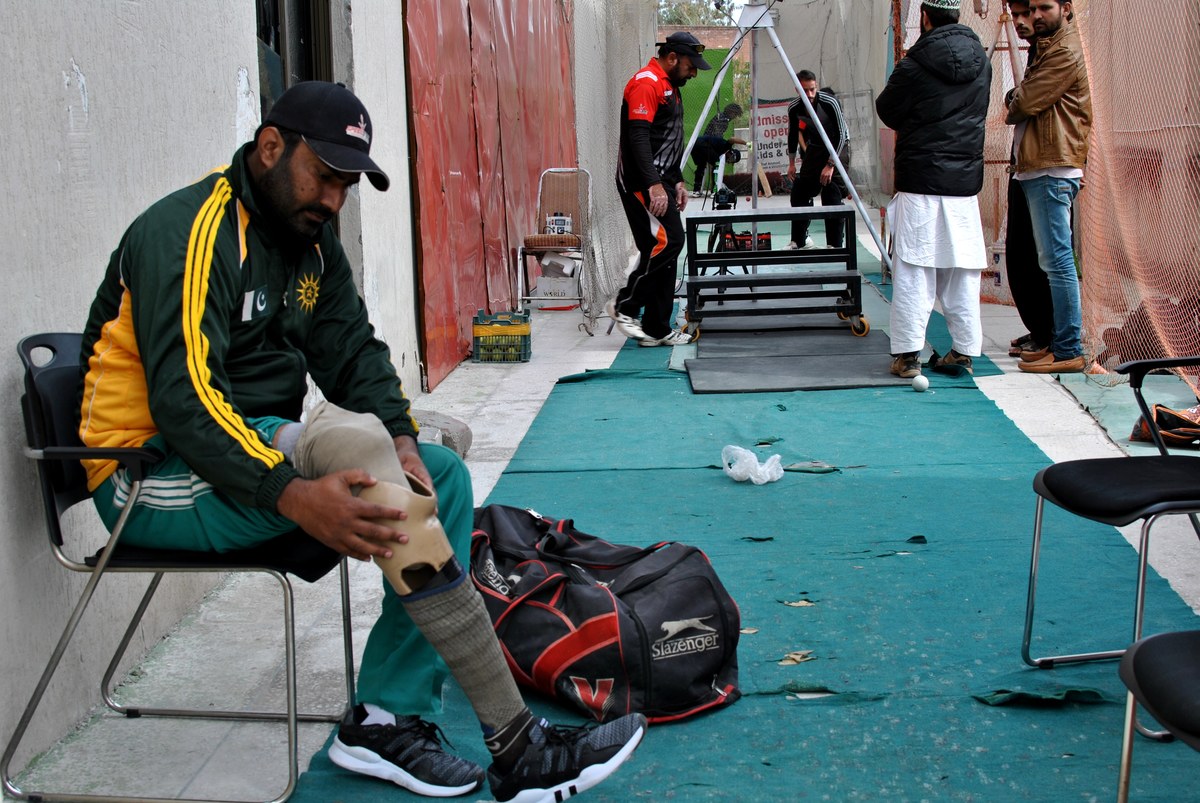


Altaf Ahmad attaches his prosthetic leg before training at the Speedster cricket school in Rawalpindi on March 10, 2020 (AN Photo by Saba Rehman)

“After I was shot, I was thinking about my future life, and suddenly it came to my mind to make a bowling machine. I bought all that was needed to construct it and in six months I had it ready,” he said, recalling how people would laugh at him for spending large sums to see his concept materialize. 

“The result was like I planned it, which made me really excited, and then I started to make new, better machines.”


Amputee cricketer Altaf Ahmad is teaching his trainees how to bat at his indoor cricket school in Rawalpindi, March 10, 2020 (AN Photo by Saba Rehman)

He could train again, without depending on others, and soon joined Pakistan’s disabled cricked team, with which he remained for some six years, representing the country at international matches. 

But later decided to make more use out of his machines to also serve others. 


Altaf Ahmad puts balls into a bowling machine of his own design at the Speedster cricket school in Rawalpindi, March 10, 2020. (AN Photo by Saba Rehman)

In 2015, Ahmad opened Speedster Cricket Academy — an indoor cricket school in Rawalpindi — with a mission “to polish talent.”

Dozens of players, some of them aged as little as four years, come for each training session, he said. 

Innovativeness paved for Ahmad a completely new path, he said.

“I started a new life, and now I am even earning decent money to support my family.”


Pakistan’s national space agency says Ramadan likely to begin from Feb. 19

Updated 4 sec ago
Follow

Pakistan’s national space agency says Ramadan likely to begin from Feb. 19

  • In Pakistan, Ruet-e-Hilal Committee is tasked with sighting moon for new Islamic months
  • Space agency says the chances of moon sighting with naked eye are ‘very bright’ on Feb. 18

ISLAMABAD: Pakistan’s national space agency has announced that the Ramadan crescent is likely to be visible in Pakistan on Feb. 18 and consequently, the first of the holy fasting month is expected to fall on Feb. 19 in the South Asian country.

In Pakistan, the Ruet-e-Hilal Committee is tasked with sighting the moon for new Islamic months. Dates for Ramadan and Eid festivals are confirmed by the committee through visual observations and based on testimonies received of the crescent being sighted from several parts of the country.

The Pakistan Space and Upper Atmosphere Research Commission (SUPARCO) said on Friday the Ramadan crescent is expected to be born on Feb 17 at 17:01 Pakistan Standard Time, adding that the age of the new moon will be approximately 25 hours and 48 minutes at the time of sunset on Feb. 18.

“Based on astronomical parameters, the chances of sighting of the new moon with naked eye are very bright in the evening of 18 Feb 2026,” SUPARCO said.

“Consequently, the 1st of Ramazan may likely to fall on 19 Feb 2026.”

However, it said the final announcement regarding the beginning of the holy fasting month will be made by the Ruet-e-Hilal Committee, which is the “sole competent authority,” based on credible witness testimonies from across the country.

Fasting during the holy month of Ramadan is one of the five pillars of Islam, where Muslims abstain from food, drink and sexual activities from sunrise to sunset. This is followed by the sighting of the new moon and is marked by Eid-ul-Fitr, a religious holiday and celebration that is observed by Muslims across the world.