ISLAMABAD: Pakistan has 447 confirmed cases of coronavirus, reveal the official data on a newly launched government website, while five people have recovered from the infection that has claimed three lives in the country.
The government on Thursday launched a website to provide authentic information to people regarding the confirmed number of coronavirus cases in the country.
The portal – www.covid.gov.pk – gives area-wise statistics of infections and also specify the number of new cases and virus-related deaths within a span of the last 24 hours.
It may be recalled that Prime Minister Imran Khan warned the nation in a televised speech on Tuesday that coronavirus was going to spread further, adding that even developed countries with greater financial resources and better medical facilities where struggling to deal with the pandemic.
Khan also emphasized the importance of social distancing and good hygiene practices to prevent the possibility of contracting the virus. While such precautionary measures have also been highlighted by experts and public figures, there are still plenty of rumors and misinformation about the outbreak in the country.
By setting up the website with recent and reliable information, the government is trying to address that problem, hoping that this information will also trickle down to those with little or no access to the Internet.


Official statistics reveal Pakistan has nearly 450 confirmed coronavirus cases

https://arab.news/2v255
Official statistics reveal Pakistan has nearly 450 confirmed coronavirus cases

- The government is relying on Internet to supply authentic information on the global pandemic that has engulfed the country
- The official portal about the outbreak has been launched at a time when there is plenty of misinformation about the virus
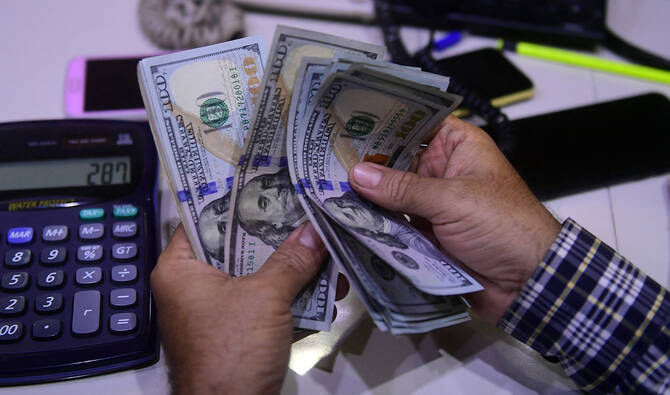
Pakistan reports current account surplus in Jan. owing to improved trade, remittances
- Pakistan’s exports crossed the $3 billion mark in Jan. as the country received $3.5 billion in remittances
- Last month, IMF urged Pakistan to accelerate pace of structural reforms to strengthen economic growth
ISLAMABAD: Pakistan recorded a current account surplus of more than $120 million in January, the country’s finance adviser said on Tuesday, attributing it to improved trade balance and remittance inflows.
Pakistan’s exports rebounded in January 2026 after five months of weak performance, rising 3.73 percent year on year and surging 34.96 percent month on month, according to data released by the country’s statistics bureau.
Exports crossed the $3 billion mark for the first time in January to reach $3.061 billion, compared to $2.27 billion in Dec. 2025. The country received $3.5 billion in foreign remittances in Jan. 2026.
Khurram Schehzad, an adviser to the finance minister, said Pakistan reported a current account surplus of $121 million in Jan., compared to a current account deficit of $393 million in the same month last year.
“Improved trade balance in January 2026, strong remittance inflows, and sustained momentum in services exports (IT/Tech) continue to reinforce the country’s external account position,” he said on X.
Pakistan has undergone a difficult period of stabilization, marked by inflation, currency depreciation and financing gaps, and international rating agencies have acknowledged improvements after Islamabad began implementing reforms such as privatizing loss-making, state-owned enterprises (SOEs) and ending subsidies as part of a $7 billion International Monetary Fund (IMF) loan program.
Late last month, the IMF urged Pakistan to accelerate the pace of these structural reforms to strengthen economic growth.
Responding to questions from Arab News at a virtual media roundtable on emerging markets’ resilience, IMF’s director of the Middle East and Central Asia Jihad Azour said Islamabad’s implementation of the IMF requirements had been “strong” despite devastating floods that killed more than 1,000 people and devastated farmland, forcing the government to revise its 4.2 percent growth target to 3.9 percent.
“What is important going forward in order to strengthen growth and to maintain the level of macroeconomic stability is to accelerate the structural reforms,” he said at the meeting.
Azour underlined Pakistan’s plans to privatize some of the SOEs and improve financial management of important public entities, particularly power companies, as an important way for the country to boost its capacity to cater to the economy for additional exports.
“This comes in addition to the effort that the authorities have made in order to reform their tariffs, which will allow the private sector of Pakistan to become more competitive,” the IMF official said.


