UK urges end to ‘non-essential’ contact, travel to curb coronavirus spread

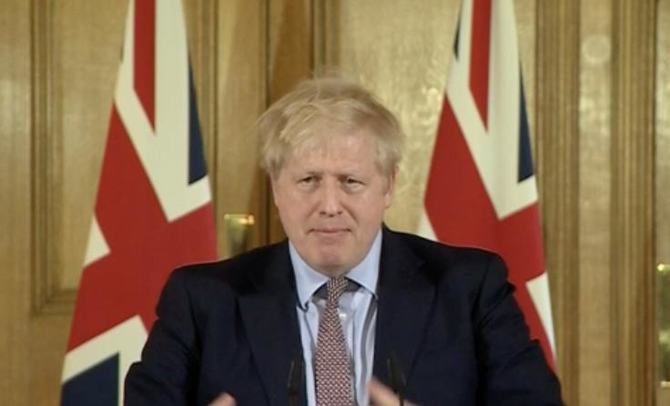
The UK’s prime minister on Monday recommended tougher social distancing measures to curb the spread of the coronavirus outbreak, including household isolation, home-working and an end to mass gatherings. (Screenshot/BBC)
Short Url
Updated 16 March 2020
Follow

UK urges end to ‘non-essential’ contact, travel to curb coronavirus spread

  • The UK may need to close schools to slow the spread of the virus
  • Covid-19, as the virus is known, is spreading faster in London

LONDON: Britain on Monday recommended tougher social distancing measures to curb the coronavirus outbreak, including household isolation, home-working and an end to mass gatherings.

Prime Minister Boris Johnson said more stringent restrictions were needed as more cases were detected, to slow infection rates and protect the elderly and most vulnerable in society.

In a three-pronged approach, the first recommendation is for all household members to stay at home for 14 days if anyone displays symptoms of the disease — a persistent new cough or fever.

The second advises an end to close social contact to protect people aged 70 and over, pregnant women and those with underlying health conditions.

The third recommends an end to mass gatherings — such as sporting — events from Tuesday, despite the risk of transmission among large crowds being “relatively low,” he added.

“Now is the time for everyone to stop non-essential contact with others and non-essential travel,” Johnson said at the first of his planned daily news conferences on the outbreak.

“We need people to start working from home where they possibly can. You should avoid pubs, clubs, theaters and other such social venues,” he added.

Johnson, flanked by chief scientific adviser Patrick Vallance and chief medical officer for England Chris Whitty, said the UK was “approaching the fast growth part of the upward curve.”

He acknowledged the disruption it would cause but said it was important to act at the right time, and promised even tougher measures in the coming days.

That includes isolating people with the most serious health conditions from social contact for 12 weeks to ensure “maximum protection coincides with the peak of the disease.”

The prime minister added that the government was asking for “very substantial change in the way we want people to lead their lives,” adding it was “unprecedented” in peacetime.

Vallance suggested the 12-week period “may be a little longer.”

Britain’s approach contrasts sharply with that of other countries, particularly its nearest neighbors on mainland Europe, many which have sealed borders and closed schools. 

But Johnson stood firm, again resisting calls for schools to be closed, assessing that “on balance it’s much better if we can keep schools open.”

Britain, which had 1,543 confirmed cases as of 9:00 am (0900 GMT) on Monday, with 35 deaths, is currently only testing people who have been taken to hospital suffering from severe symptoms.

Whitty said more than 44,000 people have been tested so far and expected testing to be increased in the coming weeks.

Last week, Vallance suggested between 5,000 and 10,000 people may have COVID-19 without knowing it.

But on Monday he declined to give an estimate, saying only “the epidemic is expected to double every five days.”

“The absolutely key thing is testing, ramping up our ability to test... who has had the disease rather than who has got it,” he told reporters.

“How many people have had it and been asymptomatic, that is the biggest unknown worldwide.”

He said restrictions will remain in place for some time.

“We stressed right from the beginning, it’s going to be a marathon not a sprint.”


Brazil’s Lula urges Trump to treat all countries equally

Updated 6 sec ago
Follow

Brazil’s Lula urges Trump to treat all countries equally

NEW DELHI: Brazil’s President Luiz Inacio Lula da Silva urged Donald Trump on Sunday to treat all countries equally after the US leader imposed a 15 percent tariff on imports following an adverse Supreme Court ruling.
“I want to tell the US President Donald Trump that we don’t want a new Cold War. We don’t want interference in any other country, we want all countries to be treated equally,” Lula told reporters in New Delhi.
The conservative-majority Supreme Court ruled six to three on Friday that a 1977 law Trump has relied on to slap sudden levies on individual countries, upending global trade, “does not authorize the President to impose tariffs.”
Lula said he would not like to react to the Supreme Court decisions of another country, but hoped that Brazil’s relations with the United States “will go back to normalcy” soon.
The veteran leftist leader is expected to travel to Washington next month for a meeting with Trump.
“I am convinced that Brazil-US relation will go back to normalcy after our conversation,” Lula, 80, said, adding that Brazil only wanted to “live in peace, generate jobs, and improve the lives of our people.”
Lula and Trump, 79, stand on polar opposite sides when it comes to issues such as multilateralism, international trade and the fight against climate change.
However, ties between Brazil and the United States appear to be on the mend after months of animosity between Washington and Brasilia.
As a result, Trump’s administration has exempted key Brazilian exports from 40 percent tariffs that had been imposed on the South American country last year.

‘Affinity’ 

“The world doesn’t need more turbulence, it needs peace,” said Lula, who arrived in India on Wednesday for a summit on artificial intelligence and a bilateral meeting with Prime Minister Narendra Modi.
Ties between Washington and Brasilia soured in recent months, with Trump angered over the trial and conviction of his ally, the far-right former Brazil president Jair Bolsonaro.
Trump imposed sanctions against several top officials, including a Supreme Court judge, to punish Brazil for what he termed a “witch hunt” against Bolsonaro.
Bolsonaro was sentenced to 27 years in prison for his role in a botched coup bid after his 2022 election loss to Lula.
Lula said that, as the two largest democracies in the Americas, he looked forward to a positive relationship with the United States.
“We are two men of 80 years of age, so we cannot play around with democracy,” he said.
“We have to take this very seriously. We have to shake hands eye-to-eye, person-to-person, and to discuss what is best for the US and Brazil.”
Lula also praised Modi after India and Brazil agreed to boost cooperation on critical minerals and rare earths and signed a raft of other deals on Saturday.
“I have a lot of affinity with Prime Minister Modi,” he said.
Lula will travel to South Korea later on Sunday for meetings with President Lee Jae Myung and to attend a business forum.