

World heads for lockdown as virus chaos grows

1 / 3
2 / 3
Police secure an area where Turkish citizens repatriated from the "umrah" pilgrimage in Saudi Arabia are to be placed in quarantine in university dormitories outside Ankara, on March 15, 2020, as part of measures to limit the spread of COVID-19. (AFP / Adem Altan)
3 / 3
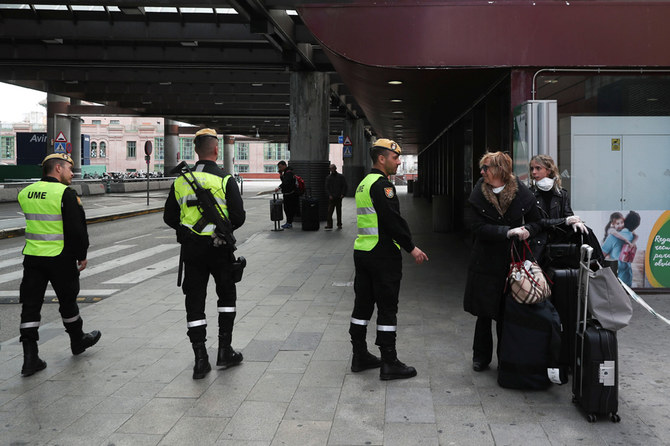
Spanish soldiers talk with women at Atocha train station during partial lockdown as part of a 15-day state of emergency to combat the coronavirus spread in Madrid, Spain, on March 15, 2020. (REUTERS/Susana Vera)
Short Url
Updated 16 March 2020
Follow

World heads for lockdown as virus chaos grows

  • Global travel bans, Saudi Arabia closes malls, restaurants, public parks
  • Security forces were deployed on Lebanon’s corniche to disperse crowds

JEDDAH: The world was on the brink of global lockdown on Sunday as country after country imposed tough new travel restrictions, quarantined visitors or closed their borders completely in the face of the greatest threat to human health in more than a century.

Authorities in the Middle East, Europe and the Americas were forced to appeal for calm as the death toll from COVID-19, the disease caused by the new coronavirus, reached more than 5,800, with at least 156,000 people infected worldwide.

New travel, flight and quarantine regulations were declared in Australia, Austria, Argentina, China, Colombia, France, Germany, Italy, South Korea, Lebanon, Mexico the Netherlands, the Philippines, Spain and Turkey, added to the countries that have already tightened their borders and curbed freedom of movement.

They include Saudi Arabia, which has taken the most comprehensive steps among the Gulf states by halting international passenger flights, canceling Umrah pilgrimages and locking down the eastern Qatif region.

Saudi Arabia on Sunday ordered the closure of malls, restaurants, coffee shops and public parks and gardens. Supermarkets, pharmacies and food delivery are exempt. 

There are 118 confirmed cases of the virus in Saudi Arabia. Three patients have made a full recovery and are in good health, with the third discharged on Sunday from Dammam Medical Complex.

In Lebanon, President Michel Aoun declared a medical state of emergency, and closed the border with Syria except for fruit and vegetable deliveries. “Each of us is called upon to continue his work, from home, in the way he sees appropriate,” Aoun said in a TV address. Banks are expected to close until March 29.

Security forces were deployed on Beirut’s corniche to disperse crowds. 

Elsewhere, Turkey quarantined 10,000 pilgrims who had returned from Saudi Arabia, Al-Aqsa Mosque in occupied East Jerusalem was closed indefinitely, and Palestinian officials said President Mahmoud Abbas, 85, who has age-related health issues, was no longer receiving guests.

Iran, where most Middle East virus cases originate and 724 people have died, admitted on Sunday that the pandemic could overwhelm its health care system. 

“If the trend continues, there will not be enough capacity,” said Ali Reza Zali, the health official leading the campaign against the outbreak.


Peru Congress to debate impeachment of interim president

Updated 6 sec ago
Follow

Peru Congress to debate impeachment of interim president

LIMA: Peru’s Congress is set to consider Tuesday whether to impeach interim president Jose Jeri, the country’s seventh head of state in 10 years, accused of the irregular hiring of several women in his government.
A motion to oust Jeri, 39, received the backing of dozens of lawmakers on claims of influence peddling, the latest of a series of impeachment bids against him.
The session, set for 10:00 am local time (1500 GMT), is expected to last several hours.
Jeri, in office since October, took over from unpopular leader Dina Boluarte who was ousted by lawmakers amid protests against corruption and a wave of violence linked to organized crime.
Prosecutors said Friday they were opening an investigation into “whether the head of state exercised undue influence” in the government appointments of nine women on his watch.
On Sunday, Jeri told Peruvian TV: “I have not committed any crime.”
Jeri, a onetime leader of Congress himself, was appointed to serve out the remainder of Boluarte’s term, which runs until July, when a new president will take over following elections on April 12.
He is constitutionally barred from seeking election in April.
The alleged improper appointments were revealed by investigative TV program Cuarto Poder, which said five women were given jobs in the president’s office and the environment ministry after visiting with Jeri.
Prosecutors spoke of a total of nine women.
Jeri is also under investigation for alleged “illegal sponsorship of interests” following a secret meeting with a Chinese businessman with commercial ties with the government.

- Institutional crisis -

The speed with which the censure process is being handled has been attributed by some political observers as linked to the upcoming presidential election, which has over 30 candidates tossing their hat into the ring, a record.
The candidate from the right-wing Popular Renewal party, Rafael Lopez Aliaga, who currently leads in polls, has been among the most vocal for Jeri’s ouster.
If successfully impeached, Jeri would cease to exercise his functions and be replaced by the head of parliament as interim president.
But first a new parliamentary president would have to be elected, as the incumbent is acting in an interim capacity.
“It will be difficult to find a replacement with political legitimacy in the current Congress, with evidence of mediocrity and strong suspicion of widespread corruption,” political analyst Augusto Alvarez told AFP.
Peru is experiencing a prolonged political crisis, which has seen it burn through six presidents since 2016, several of them impeached or under investigation for wrongdoing.
It is also gripped by a wave of extortion that has claimed dozens of lives, particularly of bus drivers — some shot at the wheel if their companies refuse to pay protection money.
In two years, the number of extortion cases reported in Peru jumped more than tenfold — from 2,396 to over 25,000 in 2025.