

Iraq officials: Rocket attack hits base housing US troops

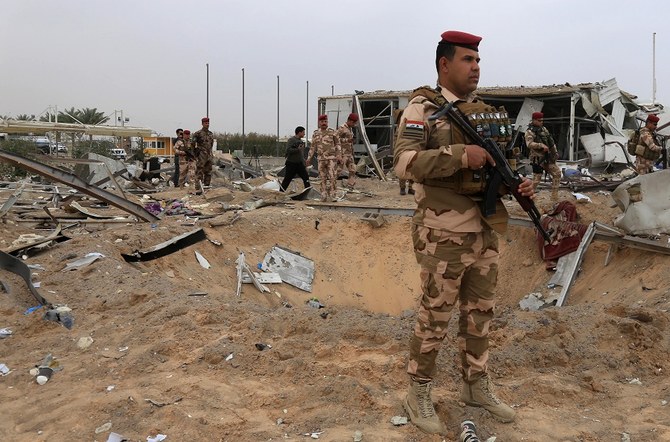
On Wednesday, three servicemen, including two Americans, were killed when the base was attacked. (File/AFP)
Short Url
Updated 14 March 2020
Follow

Iraq officials: Rocket attack hits base housing US troops

  • On Wednesday, three servicemen, including two Americans, were killed when the base was attacked

BAGHDAD: A barrage of rockets hit a base housing US and other coalition troops north of Baghdad, Iraqi security officials said Saturday, just days after a similar attack killed three servicemen, including two Americans.
The attack was unusual because it occured during the day. Previous assaults on military bases housing US troops typically occurred overnight.

Two of the three US troops wounded in the latest rocket attack in Iraq are seriously injured and are being treated at a military hospital in Baghdad, the Pentagon said on Saturday, in its first confirmation that Americans were injured.
Pentagon spokesman Jonathan Hoffman declined to speculate on potential US responses but, in a statement, cited Defense Secretary Mark Esper's warning last week: "You cannot attack and wound American Service Members and get away with it, we will hold them to account."
Hoffman added that Iraqi security forces had made an initial arrest and added the United States was assisting with the investigation into the attack, the second in less than a week at Camp Taji, north of Baghdad. Iraqi forces were also injured.
An earlier attack against Camp Taji on Wednesday prompted American airstrikes Friday against what US officials said were mainly weapons facilities belonging to Kataib Hezbollah, the Iran-backed militia group believed to be responsible.
However, Iraq’s military said those airstrikes killed five security force members and a civilian.
Iran-backed Shiite militia groups vowed to exact revenge for Friday’s US strikes, signalling another cycle of tit-for-tat violence between Washington and Tehran that could play out inside Iraq.
Wednesday’s attack on Camp Taji was the deadliest to target US troops in Iraq since a late December rocket attack on an Iraqi base. That attack killed a US contractor and set in motion a series of attacks that brought Iraq to the brink of war.
After the contractor was killed, American airstrikes targeting the Kataib Hezbollah led to protests at the US Embassy in Baghdad.
A US drone strike in Baghdad then killed Iranian Gen. Qassem Soleimani, a top commander responsible for expeditionary operations across the wider Mideast. Iran struck back with a ballistic missile attack on US forces in Iraq, the Islamic Republic’s most direct assault on America since the 1979 seizing of the US Embassy in Tehran.
The US and Iran stepped stepped back from further attacks after the Soleimani incident. A senior US official said in late January, when US-Iran tensions had cooled, that the killing of Americans constituted a red line that could spark more violence.


Iran says can fight intense war for months

Updated 08 March 2026
Follow

Iran says can fight intense war for months

  • Iran’s security chief accuses Trump administration of seeking to replicate a scenario similar to Venezuela
  • Analysts warn there is still no clear path to ending a conflict that could last a month or longer

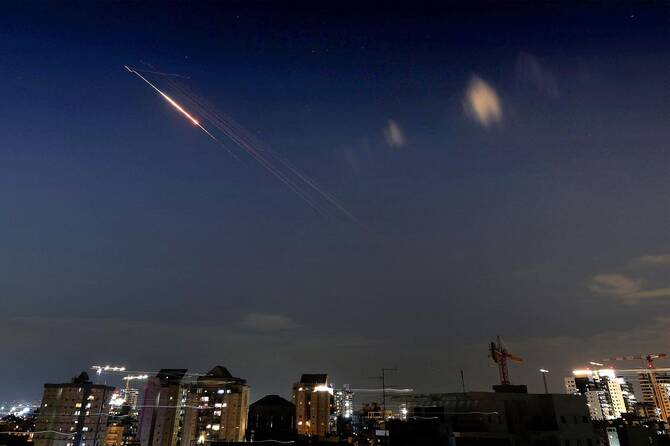
TEHRAN: Iran’s Revolutionary Guards said Sunday that the country’s forces could fight an intense war for six months against the United States and Israel.
Israeli Prime Minister Benjamin Netanyahu has vowed to press on with the war against Iran “with all our force,” with a plan to eradicate the country’s leadership after joint US-Israeli raids killed supreme leader Ayatollah Ali Khamenei last week, sparking the regional conflict.
Despite the threat, the Revolutionary Guards said Sunday that the Islamic republic’s forces could wage an “intense war” for six months at the current speed of fighting.
Guards spokesman Ali Mohammad Naini said Iran had so far used “first and second generation” missiles, but will use “advanced and less-used long-range missiles” in the coming days.
‘Trapped’
The widening reach of the war and Iran’s ability to inflict damage and harm were underscored by US President Donald Trump attending the return of six American service members killed in a drone strike on a US base in Kuwait last Sunday.
Iran’s security chief Ali Larijani accused the Trump administration of seeking to replicate a scenario similar to Venezuela where it ousted leader Nicolas Maduro.
“Their perception was that it would be like Venezuela — they would strike, take control and it would be over — but now they are trapped,” he said in a pre-recorded interview broadcast on state TV on Saturday.
Iran’s hardline judiciary chief Gholamhossein Mohseni Ejei also warned Middle East neighbors which are “openly and covertly at the disposal of the enemy” that “the heavy attacks on these targets will continue.”
Iranian President Masoud Pezeshkian said Sunday that Tehran “will be forced to respond” if a neighboring country were to be used as a launchpad for any attack or invasion attempt.
Tehran had vowed to go after US assets in the region, and Saudi Arabia, Qatar, the United Arab Emirates and Kuwait on Sunday all reported new attacks.
No clear way out
Analysts warn there is still no clear path to ending a conflict that US and Israeli officials say could last a month or longer.
Trump has suggested Iran’s economy could be rebuilt if a leader “acceptable” to Washington replaces the late supreme leader, which Tehran has rejected.
China and Russia have largely stayed on the sidelines despite close ties with Tehran.
China’s top diplomat Wang Yi said on Sunday that the war in the Middle East should “never have happened.”
“This is a war that should never have happened,” he told a press conference in Beijing, adding that “a strong fist does not mean strong reason. The world cannot return to the law of the jungle.”