

Qatar Airways CEO doubts existence of coronavirus, says aviation shouldn’t be halted

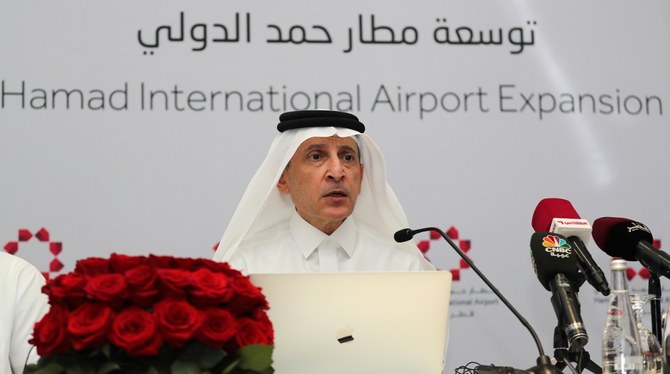
Qatar Airways chief Akbar Al-Baker, probably the airline industry’s most colorful character, has been known to make controversial comments in the past. (AFP)
Short Url
Updated 14 March 2020
Follow

Qatar Airways CEO doubts existence of coronavirus, says aviation shouldn’t be halted

  • ‘There is no scientific evidence for that. It is just, you know, a fear factor’

DUBAI: Akbar Al-Baker, chief executive of Qatar Airways, has doubted the existence of coronavirus currently affecting 126 countries and territories and has infected more than 132,000 individuals.

“During the incubation period, they say that this virus can be transmitted. There is no scientific evidence for that. It is just, you know, a fear factor,” the controversial airline chief said in an interview with Bloomberg, which was aired February 5 but resurfaced recently when it went viral among social media users.

“For them to do what they did to the Chinese cabin crew ... whoever goes to China cannot now go anywhere else in these countries for the next 14 days. They don’t realize the operational impact it would create on an airline,” Baker said.

“What evidence [do] you have that on every single airplane you do not have three or four people with contagious disease sitting next to you?”

Qatar on Wednesday said 238 new coronavirus cases had been discovered among expatriates quarantined in a residential compound, bringing the total to 262.

The Qatar Airways chief, probably the airline industry’s most colorful character, has been known to make controversial comments in the past, including claims that unions “made companies and institutions uncompetitive and bringing them to a position of not being efficient.”

Baker also received flak when he claimed the Doha-based airline’s contracts were not restrictive, particularly against women. Qatar Airways earlier faced accusations its female cabin crew members experienced discrimination, including being banned from marriage during the first five years of their contract and routinely being fired if they became pregnant.


Aramco’s 13% rally helps Saudi stocks post second weekly gain

Updated 12 March 2026
Follow

Aramco’s 13% rally helps Saudi stocks post second weekly gain

RIYADH: Saudi Aramco extended its year-to-date rally to nearly 13 percent on Thursday, helping the Kingdom’s benchmark stock index secure a second straight weekly gain despite a weaker final trading session.  

Saudi Aramco shares, which carry the heaviest weighting on the Saudi Exchange, closed at SR26.86 ($7.16), leaving the stock 12.72 percent higher since the start of 2026. The stock also remained 3.09 percent above last week’s close, even after falling 1.1 percent in Thursday’s session.

The rise in energy shares came as escalating tensions in the Middle East pushed oil prices above $100 a barrel, after attacks on tankers in the Gulf and the Strait of Hormuz heightened concerns over supply disruptions.

The Tadawul All Share Index maintained its weekly uptrend, rising nearly 1.07 percent week on week to close at 10,778.32, despite falling 0.45 percent in Thursday’s session. Compared with the first trading day of the year, the index has gained 4.01 percent.

Total trading turnover on the benchmark index reached SR5.05 billion at Thursday’s close, with 88 stocks advancing and 176 declining.

Aramco’s performance continued to anchor sentiment after the company reported adjusted net income of $104.7 billion for 2025 earlier this week, while net profit fell 12.1 percent year on year to $93.39 billion, compared with $106.25 billion in 2024, as lower crude prices weighed on earnings despite higher sales volumes across oil, gas and refined products.

On a March 10 earnings call, Aramco CEO Amin Nasser warned that prolonged disruption in the Strait of Hormuz could have severe implications for global energy markets. Roughly 20 percent of the world’s oil normally passes through the waterway each day, but shipments have been largely blocked.

“There would be catastrophic consequences for the world’s oil markets and the longer the disruption goes on ... the more drastic the consequences for the global economy,” he said.

“While we have faced disruptions in the past, this one by far is the biggest crisis the region’s oil and gas industry has faced.”

Saudi equities showed mixed performance in Thursday’s session. The MSCI Tadawul Index fell 5.99 points, or 0.40 percent, to close at 1,476.76.

The Kingdom’s parallel market Nomu gained 132.47 points, or 0.6 percent, to close at 22,370.4, with 38 stocks advancing and 34 declining.

On March 11, the International Energy Agency announced the release of 400 million barrels of oil from its reserves, the largest such move in its history. As part of that, the US said it would release 172 million barrels starting next week.