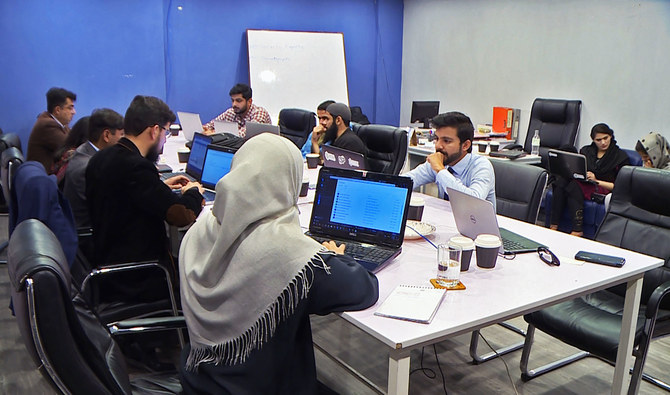
ISLAMABAD: Pakistan Information Security Association (PISA) on Wednesday participated in the annual cyberwarfare drill organized by the Asia Pacific Computer Emergency Response Team (APCERT) to test the capability of leading Computer Security Incident Response Teams (CSIRT) in the Asia Pacific and other regions of the world.
The exercise simulated real incidents and issues that exist on the Internet, informed an official statement released by the regional body, adding that the participants handled a case of a local business affected by malware infection triggered by data breach.
“This cyber drill is a competition between 25 countries to test their cyber capabilities,” said PISA President Ammar Jaffri while talking to Arab News. “There are tests called artifacts [products developed into different phases of software testing life cycle] and [the simulation is] like cyberwarfare or cyber games.”
“The people taking part in the cyber drill have to tell what was the pattern of the attack, what was the area of the attack, how much damage has been incurred, and how the damage has been mitigated,” Jaffri, a veteran cyber security expert who founded the Federal Investigation Agency’s National Response Center for Cyber Crime (NR3C) in 2007, continued.
He added that his team secured the third position in the cyber competition drill last year. However, the result of this year’s ranking is scheduled to be announced on March 13.
Experts have frequently pointed out that Pakistan lacks a comprehensive cybersecurity policy. In November last year, a European nonprofit organization, EU DisinfoLab, uncovered a huge Indian network of 265 fake media outlets spread across 65 countries that designed content “to influence [the policymaking processes of] the European Union and the United Nations by repeatedly criticizing Pakistan.” However, the country lacked the institutional mechanism to deal with the problem and only became aware of its magnitude after the EU DisinfoLab reported its findings.
Meanwhile, Pakistan has introduced special cyber laws to police the internet and social media platforms to block content that is deemed against local sensitivities.
Jaffri said that Pakistan needed to devise a policy framework and develop an institutional mechanism to handle online challenges since the country was gradually moving toward digital economy.
“Cyberspace is by default global,” he noted, “so we have to respond to the global initiatives as a country.”

Pakistani organization participates in cyberwarfare exercise
https://arab.news/phrz7
Pakistani organization participates in cyberwarfare exercise
- The country’s gradual shift to digital economy has made it more vulnerable to online threats
- The cyber drill is a competition between 25 countries to test their cyber capabilities
Pakistan’s deputy PM says country will not send forces to Gaza to disarm Hamas
- Ishaq Dar says Pakistan open to peacekeeping but Gaza’s internal security is Palestinian responsibility
- Pakistan’s top religious clerics from different schools have warned against sending forces to Palestine
ISLAMABAD: Deputy Prime Minister Ishaq Dar said on Saturday Pakistan was willing to contribute to an international peacekeeping force in Gaza, though it would not deploy troops to disarm or de-weaponize Hamas.
The statement follows media reports saying Washington views Pakistan as a potentially significant contributor given its battle-hardened military and wants it to be part of International Stabilization Force (ISF), which is part of United States President Donald Trump’s 20-point framework for a Gaza peace plan.
The plan announced by Trump at the White House on September 29 was formally adopted at the Sharm El-Sheikh Peace Summit in October. Co-chaired by Trump and Egyptian President Abdel Fattah El-Sisi, the summit brought together leaders from 27 countries to sign the “Trump Declaration for Enduring Peace and Prosperity.”
Deployment of troops from Muslim-majority countries during a transitional stabilization phase is a key part of the plan before the war-ravaged Palestinian territory moves toward reconstruction and a longer-term political settlement.
“If they say that we should go and start fighting, disarm Hamas, de-weaponize them, and go and destroy the tunnels that Hamas has built until now, that is not our job,” Dar, who is also the country’s foreign minister, told reporters during a year-end briefing in Islamabad.
He emphasized there was clarity between Pakistan’s civil and military leadership over the matter.
“We have a very complete understanding on this matter that we cannot do that kind of work,” he added.
The deputy prime minister said Pakistan had been using the term “peacekeeping” and had never used the phrase “peace enforcement” while discussing the force.
“I have been very clear: Pakistan will be happy to join if the mandate is not peace enforcement and disarming and de-weaponizing Hamas.”
The government’s stance comes amid growing domestic pressure over the issue.
On Monday, a group of Pakistan’s top religious leaders, chaired by prominent scholar Mufti Taqi Usmani, warned the government against yielding to what they described as international pressure to send forces to Gaza.
In a joint statement from Karachi, the clerics — representing Deobandi, Barelvi, Ahl-e-Hadees and Shia schools of thought — said that Washington wanted Muslim countries to send their forces to Gaza to disarm Hamas.
“Several Muslim governments have already refused this, and pressure is being increased on Pakistan,” it added.
Addressing such concerns, Dar said Pakistan would not land its forces in Palestine to “fight Muslims.”
Israel has repeatedly called for the disarmament of Hamas as a precondition for any long-term settlement, and the United Nations Security Council has also endorsed the ISF framework in November.
However, Dar maintained during the media briefing the internal security of Gaza was the Palestinian responsibility.
“The Palestinian Authority, their government, it is their job, it is the job of their law enforcement agency,” he said
The deputy prime minister also highlighted Pakistan’s involvement in the “Arab Islamic Group of Eight,” including Saudi Arabia, Jordan, Egypt, the United Arab Emirates, Qatar, Turkiye and Indonesia, which has been coordinating on the crisis.
He said the efforts of these countries had brought some peace to Palestine and reduced bloodshed.
“Our declared policy is that there should be an independent two-state solution,” he continued while calling for pre-1967 borders.


