


FRANKFURT, Germany: Staring recession in the face, European leaders are lining up an array of tax breaks, financial support for companies and central bank measures to prevent the coronavirus outbreak from dealing long-term economic damage.
Expectations have grown that European Central Bank officials will announce more monetary stimulus when they meet on Thursday, including an interest rate cut and corporate bond purchases aimed at supporting business borrowing.
And the European Commission says it plans to bring forward existing funding to create a €25 billion ($28 billion) investment fund to support health care systems, businesses and labor market measures.
Yet any such actions will likely be more damage limitation than cure. Monetary stimulus and government spending can spur demand for goods. But the coronavirus deals a shock from the supply side by closing businesses and making people stay home, highlighted by Italy’s dramatic decision this week to limit travel and public gatherings across the country. Lower interest rates or tax cuts cannot solve that.
Meanwhile, action to help the 19 countries that use the euro currency faces constraints from the lack of a large central treasury, a hurdle other large economies like the US and China do not face.
FASTFACT
187 million
The number of people going through European airports is expected to fall by 187 million this year.
“The world is facing a medical emergency that monetary and fiscal policy cannot fix,” said Holger Schmieding, chief economist at Berenberg private bank.
The best policymakers can do for the economy is to prevent the virus from dealing prolonged damage even after the outbreak ends, to keep small- and medium-sized companies that provide most of the jobs in the economy from going out of business due to a short-term issue beyond their control.
Among the most affected are companies involved in travel. The number of people going through European airports is expected to fall by 187 million this year. Lufthansa said it would cut up to half of its flights from April. Ryanair suspended all flights to and from Italy. Exhibition centers have seen trade fairs postponed, hitting hotels, restaurants and cabdrivers. Football matches are taking place in empty stadiums.
The investment fund announced Tuesday by EU Commission President Ursula von der Leyen is drawn from the existing EU budget. The €25 billion size of the fund is only around 0.1 percent of the annual €18.8 trillion $20.7 trillion) EU economy.
Von der Leyen said national leaders including German Chancellor Angela Merkel and French President Emmanuel Macron agreed during a video conference to “use all the tools at our disposal so that the European economy weathers this storm.” That includes being flexible in EU rules limiting debt and coming up with clear guidelines on permissible state aid to companies.
“We will make sure that state aid can flow to the companies that need it,” she said.
At the national level, Italy, which has been hit hardest by far by the virus outbreak, has already announced a €7.5 billion ($8.5 billion) package of measures including tax credits for companies that report a 25 percent drop in revenues.
Economists at Berenberg expect the UK, not a member of the eurozone but an important trade partner, to announce fiscal stimulus of about 1 percent of gross domestic product (GDP).
Even Germany is softening its longstanding opposition to increasing government spending to boost growth. The cabinet has discussed a package of measures including €3.1 billion in extra investment spending per year from 2021 to 2024. That is only 0.1 percent of GDP but experts say it is a step in the right direction and can always be scaled up.

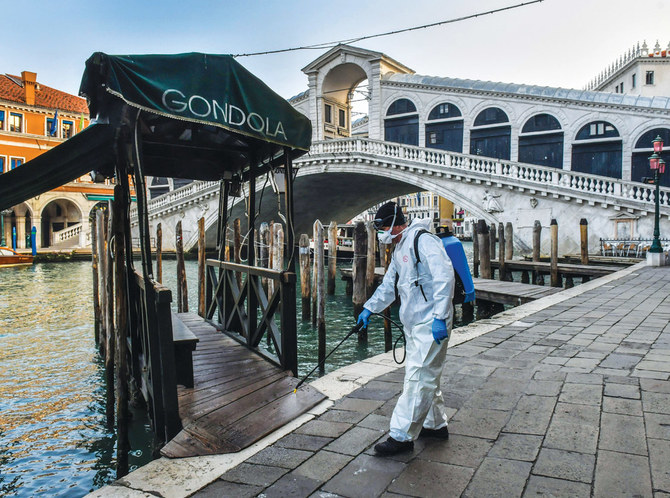
The economic fallout from the coronavirus is being felt worldwide with the focus now shifting from China to Europe. (AFP)
The German government meanwhile agreed to make it easier for companies to put workers on shortened hours. The short-time work program is credited with limiting job losses during the Great Recession in 2009 and with speeding the rebound afterward, since companies kept their workers on and did not need to reassemble a trained factory workforce. The government is also considering tax relief for companies if their sales fall suddenly.
The European Central Bank, which didn’t join the Federal Reserve in an emergency rate cut on March 3, is now expected to change course at a meeting of its 25-member governing council on Thursday. It could cut its deposit rate deeper into negative territory, to minus 0.6 percent from minus 0.5 percent, effectively pushing banks to lend more money.
The ECB could also raise its current program of bond purchases from €20 billion ($22 billion) a month to as much as €40 billion ($44 billion) a month and focus more on bonds issued by companies, which would directly try to lower borrowing costs for the private sector. The central bank could also issue more cheap, long-term credit to banks on the condition the money is loaned to businesses.
Yet all this can only “limit the damage to demand,” said Schmieding. He estimates that the eurozone economy could shrink 0.4 percent in the first quarter and 0.5 percent in the second, putting it in recession. A rebound in the second half would still leave the economy slightly smaller for the year.
Oliver Rakau, chief German economist at Oxford Economics, said Europe might be only beginning to face the need for new investment and financial aid.
“This is a broadly right and a welcome response limiting the hit to household incomes and firm profits,” he said. “But we continue to think that more will be needed, once the fallout from the current economic shock becomes clearer.”


