

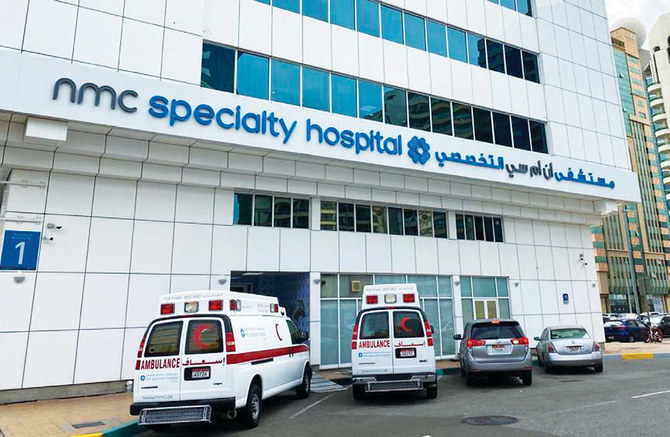
NMC debts could be higher than $5 billion, advisers fear

NMC Health has identified it has an additional $2.7 billion of debt. (Reuters)
Short Url
Updated 12 March 2020
Follow

NMC debts could be higher than $5 billion, advisers fear

DUBAI: NMC Health, the troubled UAE-based hospitals group, is investigating at least $2.7 billion of new borrowings that have been uncovered by its new team of financial advisers and lawyers amid fears total debts could be considerably higher than $5 billion.

One adviser, who asked not to be named, said: “It’s really difficult to know the bottom of this at the moment. We are uncovering new items all the time.”

In a statement to the London Stock Exchange, where NMC shares were traded until they were suspended last month, the company said that the new borrowings — more than double its previously assumed level of debt — had not been “disclosed to or approved” by its board of directors.

It added that some of the cash “could have been utilized for non-group purposes,” but was still trying to “understand the exact nature and quantum” of the undisclosed facilities.

The revelation that NMC debts may be far higher than the previously disclosed $2 billion, and that there could still be other liabilities so far uncounted, is a major problem for the group as it seeks to continue operating while the UAE and other countries try to get to grips with the coronavirus.

FASTFACT

20,000

NMC employs 22,000 staff at 200 facilities in 19 countries.

NMC said that it had finally completed salary payments for last month to its 22,000 doctors and other medical staff at 200 facilities in 19 countries. Most of its business is in the UAE, where it accounts for about 30 percent of medical facilities. It also has a presence in Saudi Arabia via a joint venture signed last year as well as hospitals in Jeddah and Al Khobar.

“NMC is fully focused on safeguarding its operational liquidity to continue funding existing operations,” it added.

The business, founded by Indian entrepreneur BR Shetty in the 1970s, got into trouble last December when a report from US activist investor Muddy Waters alleged financial irregularities on a large scale.

NMC denied the allegations in the report, but the shares collapsed as further revelations emerged about over-valuation of assets, levels of debt and related party transactions.

In addition to Shetty, two UAE entrepreneurs — Khaleefa Butti Omair Al-Muhairi and Saeed Mohamed Butti Mohamed Khalfan Al-Qebaisi — controlled the company after it listed shares in London in 2012.

Advisers to Shetty said that he was in India on urgent family business, but was expected to return to the UAE when that was concluded.

The higher-than-expected level of debt will cloud attempts by the Abu Dhabi authorities to find a buyer for the business.


First EU–Saudi roundtable on critical raw materials reflects shared policy commitment

Updated 16 January 2026
Follow

First EU–Saudi roundtable on critical raw materials reflects shared policy commitment

RIYADH: The EU–Saudi Arabia Business and Investment Dialogue on Advancing Critical Raw Materials Value Chains, held in Riyadh as part of the Future Minerals Forum, brought together senior policymakers, industry leaders, and investors to advance strategic cooperation across critical raw materials value chains.

Organized under a Team Europe approach by the EU–GCC Cooperation on Green Transition Project, in coordination with the EU Delegation to Saudi Arabia, the European Chamber of Commerce in the Kingdom and in close cooperation with FMF, the dialogue provided a high-level platform to explore European actions under the EU Critical Raw Materials Act and ResourceEU alongside the Kingdom’s aspirations for minerals, industrial, and investment priorities.

This is in line with Saudi Vision 2030 and broader regional ambitions across the GCC, MENA, and Africa.

ResourceEU is the EU’s new strategic action plan, launched in late 2025, to secure a reliable supply of critical raw materials like lithium, rare earths, and cobalt, reducing dependency on single suppliers, such as China, by boosting domestic extraction, processing, recycling, stockpiling, and strategic partnerships with resource-rich nations.

The first ever EU–Saudi roundtable on critical raw materials was opened by the bloc’s Ambassador to the Kingdom, Christophe Farnaud, together with Saudi Deputy Minister for Mining Development Turki Al-Babtain, turning policy alignment into concrete cooperation.

Farnaud underlined the central role of international cooperation in the implementation of the EU’s critical raw materials policy framework.

“As the European Union advances the implementation of its Critical Raw Materials policy, international cooperation is indispensable to building secure, diversified, and sustainable value chains. Saudi Arabia is a key partner in this effort. This dialogue reflects our shared commitment to translate policy alignment into concrete business and investment cooperation that supports the green and digital transitions,” said the ambassador.

Discussions focused on strengthening resilient, diversified, and responsible CRM supply chains that are essential to the green and digital transitions.

Participants explored concrete opportunities for EU–Saudi cooperation across the full value chain, including exploration, mining, and processing and refining, as well as recycling, downstream manufacturing, and the mobilization of private investment and sustainable finance, underpinned by high environmental, social, and governance standards.

From the Saudi side, the dialogue was framed as a key contribution to the Kingdom’s industrial transformation and long-term economic diversification agenda under Vision 2030, with a strong focus on responsible resource development and global market integration.

“Developing globally competitive mineral hubs and sustainable value chains is a central pillar of Saudi Vision 2030 and the Kingdom’s industrial transformation. Our engagement with the European Union through this dialogue to strengthen upstream and downstream integration, attract high-quality investment, and advance responsible mining and processing. Enhanced cooperation with the EU, capitalizing on the demand dynamics of the EU Critical Raw Materials Act, will be key to delivering long-term value for both sides,” said Al-Babtain.

Valere Moutarlier, deputy director-general for European industry decarbonization, and directorate-general for the internal market, industry, entrepreneurship and SMEs at European Commission, said the EU Critical Raw Materials Act and ResourceEU provided a clear framework to strengthen Europe’s resilience while deepening its cooperation with international partners.

“Cooperation with Saudi Arabia is essential to advancing secure, sustainable, and diversified critical raw materials value chains. Dialogues such as this play a key role in translating policy ambitions into concrete industrial and investment cooperation,” she added.