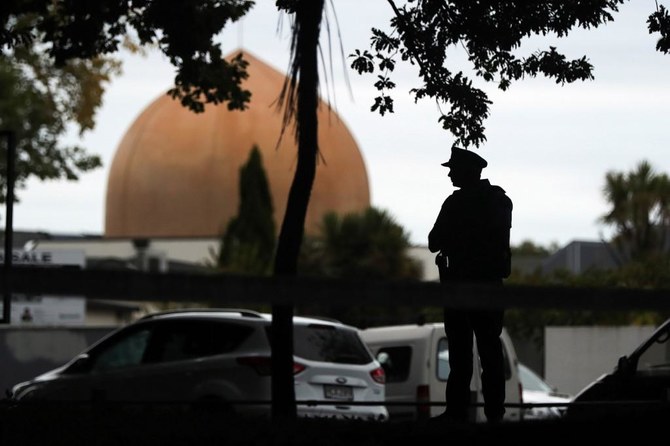
WELLINGTON: Days before the first anniversary of a shooting in Christchurch that killed 51 Muslim worshippers, a post appeared on an encrypted messaging app showing a balaclava-clad man outside one of the attacked mosques with a threat and a gun emoji.
The message was the latest in a number of threats against minorities in New Zealand, evidence of what experts say is an increase in hate crime and xenophobia since the mosque massacre by a suspected white supremacist on March 15 last year.
The gunman, armed with semi-automatic weapons, attacked Muslims attending Friday prayers in the South Island’s largest city, broadcasting New Zealand’s worst mass shooting live on Facebook.
Brenton Tarrant, an Australian national, faces 92 charges in relation to the attacks on Al Noor and Linwood mosques. He has pleaded not guilty and faces trial in June.
New Zealand’s extraordinary outpouring of love and compassion for the Muslim community after the attack was led from the front by Prime Minister Jacinda Ardern. She swiftly introduced new gun laws and started a global movement to stamp out online hate in a response that was hailed as a model for other leaders.
But the attack also inspired far right nationalists and anti-immigration campaigners to be more active both online and offline, according to Muslim leaders, activists and experts.
“The attack certainly emboldened people who want to spread hate,” said Anjum Rahman from the Islamic Women’s Council of New Zealand.
The council has repeatedly alerted the government in the past year about the rise of the extreme right and the growing threat felt by Muslim women in New Zealand.
Rahman reported the latest threat against the Al Noor mosque to police after she was shown the image which was being shared on the encrypted social media messaging app Telegram.
Police said a 19-year-old man was charged with failing to assist police with a search warrant in relation to the incident and would appear in court later this month.
Local media reports have linked the man to a white nationalist group called Action Zealandia, which was formed in July 2019, just months after the Christchurch attack. On its website it says it is focused on “building a community for European New Zealanders.”
In response to the incident, Action Zealandia said in a statement on Twitter the alleged actions of the accused are not within its code of conduct and was “immature and unproductive as we do not use violence to reach our goals.”
Police said they were working to ensure they have an in-depth knowledge of individuals and groups whose actions pose a threat but did not comment on any specific group.
In a parliamentary committee meeting chaired by Ardern last month, New Zealand’s spy chief laid down the growing challenge since the attack.
“It (the attack) has given encouragement to some people, it has been inspirational to other people, and so it remains still quite a fluid picture,” NZ Security Intelligence Service Director-General Rebecca Kitteridge told the committee, according to transcripts of the meeting seen by Reuters.
“We have got more information about more people who are expressing extremist views than we had before 15 March, and some of those people existed beforehand, and then there is the impact of the attacks themselves afterwards,” she said.
Between 30 and 50 people are being actively investigated by the agency at any given moment for posing a terror threat, a higher number than in previous years.
Kitteridge said between March 15 and the end of June 2019 the spy agency received leads about people who had expressed racist, Nazi, identitarian, or white supremacist views.
A survey by online safety agency Netsafe in December showed hate speech online increased in New Zealand in the last 12 months, with about 15 percent of the adult population targeted with online hate.
Offline too, white supremacist posters have appeared in Auckland universities in the past few weeks leading up to the March 15 memorial.
There are about 60 to 70 groups and somewhere between 150 and 300 core right-wing activists in New Zealand, said Paul Spoonley, from Massey University, who has been researching far-right extremism for decades.
Proportionate to population the number was similar in size to far-right activists in Germany, he said.
“New Zealand is now part of an international far-right ecosystem in a way that you can’t have said 20 years ago,” Spoonley said.
“We do well on the league tables for tolerance, but that does not mean there are no extreme elements,” he said.
Ardern said she was “devastated” by the latest threats against Al Noor mosque and it indicated that more the work needed to be done.
“We have to get back to the basics of why is it that people would feel that they can make those kinds of threats against other people’s lives,” she told reporters.
A big part of the problem was that unlike the United States or Britain, New Zealand has never recorded specific hate crime offenses, raising questions about what signs security agencies may have missed.
Police have now started recording instances of offenses that appear to be motivated by hate, Justice Minister Andrew Little told Reuters.
The ministry is also reviewing the country’s hate speech laws, although these plans have been challenged by groups who say free speech would be curtailed by such laws.
“Further work is needed on where the line on free speech is drawn. But I anticipate a balanced approach will be taken when the review process is complete,” Little said.
A decision is expected within months.

One year after mosque massacre, New Zealand is fighting rising hate
Short Url
https://arab.news/9v5h3
One year after mosque massacre, New Zealand is fighting rising hate
- Brenton Tarrant, an Australian national, faces 92 charges in relation to the attacks on Al Noor and Linwood mosques
- Attack inspired far right nationalists and anti-immigration campaigners to be more active both online and offline
C. Africa’s displaced youth bet on vote for brighter future
BIRAO: Amani Abdramane bustled around her donkey in the makeshift camp where she lives in the Central African Republic.
In this northern part of the country, on the edge of the Sahel, the sun is scorching and sand is swallowing the last traces of vegetation.
The 18-year-old adjusted a pink scarf covering her head and shoulders and pondered what she wanted from Sunday’s general election that will choose local and regional officials, members of parliament and a new president.
“I hope the person I vote for brings peace,” she said of the seven candidates vying to become head of state.
They include President Faustin-Archange Touadera, who is seeking a third consecutive term.
Displaced by decades of conflict, young people like Abdramane who live in camps around the town of Birao in the far northeast, see the elections as a chance for a better future.
Abdramane fled ethnic violence in El-Sisi, her home village seven kilometers (four miles) from Birao, in 2015 with her mother and eight siblings.
Her father had been killed a few months earlier.
“I just want my brothers, sisters and me to be able to go to school,” she said.
- First-time voters -
Abdramane had just completed her second year of school, aged eight, when her family had to flee.
She has not returned to lessons since.
Now the teenager and other young people are counting on the elections to bring them peace, education and opportunities beyond life as displaced persons.
The last polls were in 2020 but lack of security meant even those old enough to vote at the time were unable to do so.
There is a crowd outside the community radio station in the Korsi neighborhood of Birao, which serves as a distribution center for voter registration cards.
Marina Hajjram, also 18, will be voting for the first time.
“I’m so happy,” she told AFP, clutching her voter card.
Behind her in the queue, 25-year-old Issa Abdoul agreed the elections were essential “to continue the reconstruction of our country.”
Korsi is home to thousands of internally displaced persons, as well as many refugees from neighboring Sudan.
Across CAR, there were 416,000 internally displaced persons as of November, the vast majority of whom are under 25 and will be voting for the first time this weekend.
- A brighter future -
For them, the mere act of obtaining a voter registration card is a challenge.
First they must produce an identity document. But many lost everything when they fled, including ID papers for those who had them.
Three quarters of people in the CAR are under 35, according to a 2018 report by the United Nations Population Fund.
And peace is one of the things these young people most want.
Although the situation has improved in much of the country, particularly in cities, violence persists in the northeast on the border between the two Sudans.
This is mainly due to incursions by Sudanese armed forces, who are waging war in a region already plagued by abuses blamed on rebel groups.
Issene Abdoulkasim, 23, only made it to the third year of primary school.
Now he wants to become a tailor so he can afford to study again.
“I dream of studying so I can become a member of parliament. Because as an MP I’ll be able to bring peace and development,” he said.
“I want to put an end to conflicts, tensions and everything that is destroying our country.”
In this northern part of the country, on the edge of the Sahel, the sun is scorching and sand is swallowing the last traces of vegetation.
The 18-year-old adjusted a pink scarf covering her head and shoulders and pondered what she wanted from Sunday’s general election that will choose local and regional officials, members of parliament and a new president.
“I hope the person I vote for brings peace,” she said of the seven candidates vying to become head of state.
They include President Faustin-Archange Touadera, who is seeking a third consecutive term.
Displaced by decades of conflict, young people like Abdramane who live in camps around the town of Birao in the far northeast, see the elections as a chance for a better future.
Abdramane fled ethnic violence in El-Sisi, her home village seven kilometers (four miles) from Birao, in 2015 with her mother and eight siblings.
Her father had been killed a few months earlier.
“I just want my brothers, sisters and me to be able to go to school,” she said.
- First-time voters -
Abdramane had just completed her second year of school, aged eight, when her family had to flee.
She has not returned to lessons since.
Now the teenager and other young people are counting on the elections to bring them peace, education and opportunities beyond life as displaced persons.
The last polls were in 2020 but lack of security meant even those old enough to vote at the time were unable to do so.
There is a crowd outside the community radio station in the Korsi neighborhood of Birao, which serves as a distribution center for voter registration cards.
Marina Hajjram, also 18, will be voting for the first time.
“I’m so happy,” she told AFP, clutching her voter card.
Behind her in the queue, 25-year-old Issa Abdoul agreed the elections were essential “to continue the reconstruction of our country.”
Korsi is home to thousands of internally displaced persons, as well as many refugees from neighboring Sudan.
Across CAR, there were 416,000 internally displaced persons as of November, the vast majority of whom are under 25 and will be voting for the first time this weekend.
- A brighter future -
For them, the mere act of obtaining a voter registration card is a challenge.
First they must produce an identity document. But many lost everything when they fled, including ID papers for those who had them.
Three quarters of people in the CAR are under 35, according to a 2018 report by the United Nations Population Fund.
And peace is one of the things these young people most want.
Although the situation has improved in much of the country, particularly in cities, violence persists in the northeast on the border between the two Sudans.
This is mainly due to incursions by Sudanese armed forces, who are waging war in a region already plagued by abuses blamed on rebel groups.
Issene Abdoulkasim, 23, only made it to the third year of primary school.
Now he wants to become a tailor so he can afford to study again.
“I dream of studying so I can become a member of parliament. Because as an MP I’ll be able to bring peace and development,” he said.
“I want to put an end to conflicts, tensions and everything that is destroying our country.”
© 2025 SAUDI RESEARCH & PUBLISHING COMPANY, All Rights Reserved And subject to Terms of Use Agreement.


