A quarter of Iranian oil rigs idle as US sanctions bite into production

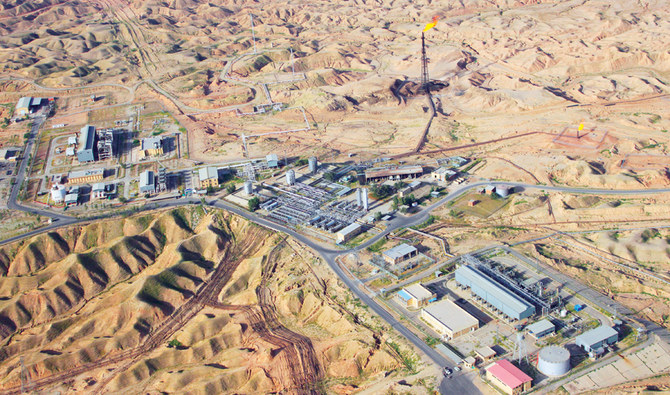
Falling exports have deepened Iran’s recession. (Shutterstock)
Short Url
Updated 11 March 2020
Follow

A quarter of Iranian oil rigs idle as US sanctions bite into production

  • The sharp fall in oil prices in 2020 — due to the impact of the coronavirus epidemic on global demand — will exacerbate the pain for Iran’s economy, which is also dealing with one of the biggest outbreaks of the disease outside China

LONDON: At least a quarter of Iran’s oil rigs are out of action as US sanctions strangle the Islamic Republic’s vital oil industry, according to a Reuters review of financial documents and industry sources, dealing a potentially long-term blow to its oil industry.
The lack of rig activity could damage the OPEC member’s capacity to produce oil from older fields, which require continuous pumping to maintain pressure and output. That would make it difficult for Iran to raise production back to pre-sanction levels if tensions ease with the US.
The US sanctions aim to curtail Tehran’s nuclear ambitions and regional influence. They have forced Iran to slash its oil output by half since early 2018 to less than 2 million barrels per day (bpd) because refineries worldwide have stopped buying its oil.
Plummeting production and exports have deepened a recession in Iran and choked the government of its main source of income. Reduced activity has forced mass layoffs in its oil sector.

FASTFACT

Tehran has slashed oil output by half since 2018.

The sharp fall in oil prices in 2020 — due to the impact of the coronavirus epidemic on global demand — will exacerbate the pain for Iran’s economy, which is also dealing with one of the biggest outbreaks of the disease outside China.
Some of Iran’s oil rigs are out of action because they cannot be repaired. Sanctions have also made it more difficult and expensive for it to buy and import spare parts.Iran relies entirely on imported parts for its rigs, said Mohsen Mihandoust, a director at Iran’s Society of Petroleum Engineers.
 In a decade of work in oil and gas drilling in Iran, Mihandoust has never seen a spare part that was not imported, and most came from the US or Europe.
“We are still dependent on other countries,” he said. “It is like learning to work with a TV remote control, but still having no clue how a television is made.”
Sanctions had driven up the costs of spare parts as much as five-fold, making it not feasible to repair the rigs, he said.
Iran bought dozens of new and second-hand Chinese rigs in the past decade, but the core parts of those were still American, two industry sources said.


Global investors commit more than $3bn to King Salman Park as Saudi giga-project secures new deals

Updated 10 March 2026
Follow

Global investors commit more than $3bn to King Salman Park as Saudi giga-project secures new deals

RIYADH: The King Salman Park Foundation has secured more than $3.8 billion in new private-sector commitments at the MIPIM 2026 real estate conference, including a landmark $3 billion fund backed by international investors to develop a major mixed-use district in the heart of Riyadh.

According to a press release, the announcements bring total committed investment in the 17.2 sq. kilometers urban regeneration project to over $5.3 billion across five major packages.

Launched in 2019 under Saudi Vision 2030, the development is designed to be the world’s largest city park and aims to boost green space, improve quality of life, and feature over 1 million trees and extensive leisure facilities.

A $3 billion metro-connected district

The largest of the two packages, designated Package 5, will see a consortium led by Kolaghassi Development Co. deliver a residential-led district with a total built-up area exceeding 1 million sq. meters. 

It will provide approximately 3,700 residential units, a K–12 school, around 300 hospitality keys and more than 100,000 sq m of Grade A office space alongside a wide variety of retail and dining offerings.

The development is supported by a Saudi-domiciled, Capital Market Authority-regulated fund managed by Mulkia Investment Co. that has attracted leading investors from the Kingdom and across the world.

Kolaghassi Development Co. will lead the project alongside Al Othaim Investment, one of the Kingdom’s real estate players, and RXR, a New York-headquartered real estate investor and operator.

“Securing investment of this scale, supported by international capital and expertise, is an important milestone for King Salman Park,” said George Tanasijevich, CEO of King Salman Park Foundation. 

$850 million cultural district package

In a separate announcement, the Foundation confirmed the award of Package 4 to a consortium led by Retal Urban Development Co., with support from a fund managed by SAB Invest.

The project has a total value exceeding $850 million and will host more than 600 residential units, over 140 hotel keys, and almost 50,000 sq m of Grade A office space, alongside curated retail and food and beverage experiences.

“This opportunity reflects the maturity of Saudi Arabia’s real estate investment landscape and our confidence in culture-led, mixed-use urban destinations as a driver of sustainable returns,” said Abdullah Al-Braikan, CEO and founder of Retal Urban Development Co.

Ali Al-Mansour, CEO of SAB Invest, said the fund structure brings together “long-term capital, experienced development partners, and a shared commitment to place-making excellence” while contributing to Riyadh’s cultural vibrancy and the Kingdom’s quality-of-life ambitions under Vision 2030.