50 Pakistani fighters killed in Turkish strikes in Syria — Pakistan officials

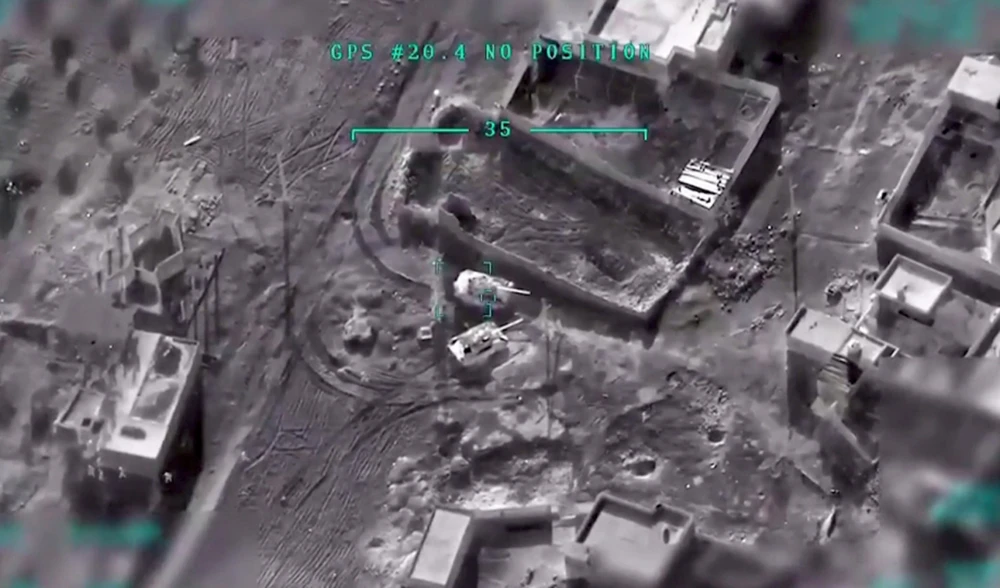
A screengrab taken from a video released by the Turkish Defence Ministry on March 1, 2020 shows an airstrike by the Turkish military on Syrian regime positions. (Handout/Turkish Defence Ministry via AFP)
Short Url
Updated 07 March 2020
Follow

50 Pakistani fighters killed in Turkish strikes in Syria — Pakistan officials

  • The deceased likely belong to Zainebiyoun Brigade, a militant group comprising Pakistani Shias fighting in Syria and Iran
  • Iranian news agency said 21 members of Fatemiyoun and Zainebiyoun brigades killed in recent military action

KARACHI: Up to 50 Pakistani fighters have been killed in military action by the Turkish army and Syrian regime forces in Syria’s last major rebel stronghold in the northwest of the country, officials told Arab News this week.
Fighting has escalated dramatically in recent days in Idlib in northwest Syria, where Turkey has sent thousands of troops and military vehicles in the last month to counter Syrian government forces’ advances in the last remaining bastion held by rebels. On the opposite side in Syria’s nine-year conflict is Russia, which supports President Bashar Assad and has also carried out airstrikes in recent days.
On Thursday, Turkey and Russia agreed to a cease-fire deal after talks in Moscow to contain a conflict that has displaced nearly a million people in three months.
“The number of those [Pakistanis] killed is more than 50,” an official told Arab News on condition of anonymity as he was not authorized to speak to the media about the issue.
Another government official confirmed that 50 Pakistanis had been killed.
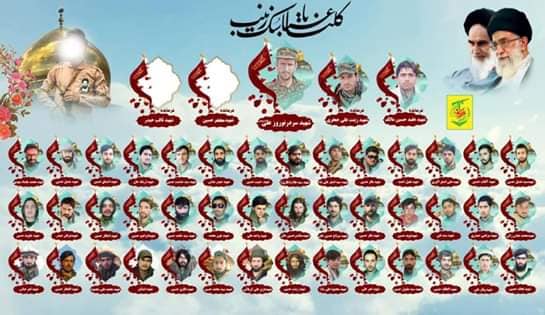


A poster showing 47 Pakistani militiamen associated with Zainebiyoun Brigade is being shared by Zainebiyoun on its Facebook page on March 1, 2020 with an Urdu caption that reads “today is Shabb-e-Jumma (Night of Juma) Surah Fateh for the martyrs of Zainebiyoun). (Photo courtesy: Zainebiyoun/Facebook)

Pakistan’s foreign office did not respond to Arab News queries when contacted to comment on this news.
The deceased likely belong to Zainebiyoun Brigade, a militant group that was placed on the US Treasury’s financial blacklist in January 2019 and comprises Pakistani Shias fighting in Syria and Iran.
According to media reports, Zainebiyoun Brigade has over 800 Pakistanis fighting in Syria. The group’s fighters are allegedly trained by Iran’s Quds Force, the military unit responsible for projecting Iran’s influence via proxies across the Middle East.
“Following the clashes in Syria’s Idlib [region], 21 members of Fatemiyoun and Zainebiyoun brigades were martyred,” Iran’s Hawzah News Agency reported on Sunday, adding that 18 of the deceased belonged to the Zainebiyoun Brigade.
“This is not the first incident where Pakistanis have been killed in Syria,” Pakistani security analyst Muhammad Amir Rana said, adding that Pakistani militants fighting for both Daesh and Assad’s forces, had been killed in Syria in the past. He said many Pakistanis had also been arrested upon their return from Syria but could not provide an exact number of fatalities.
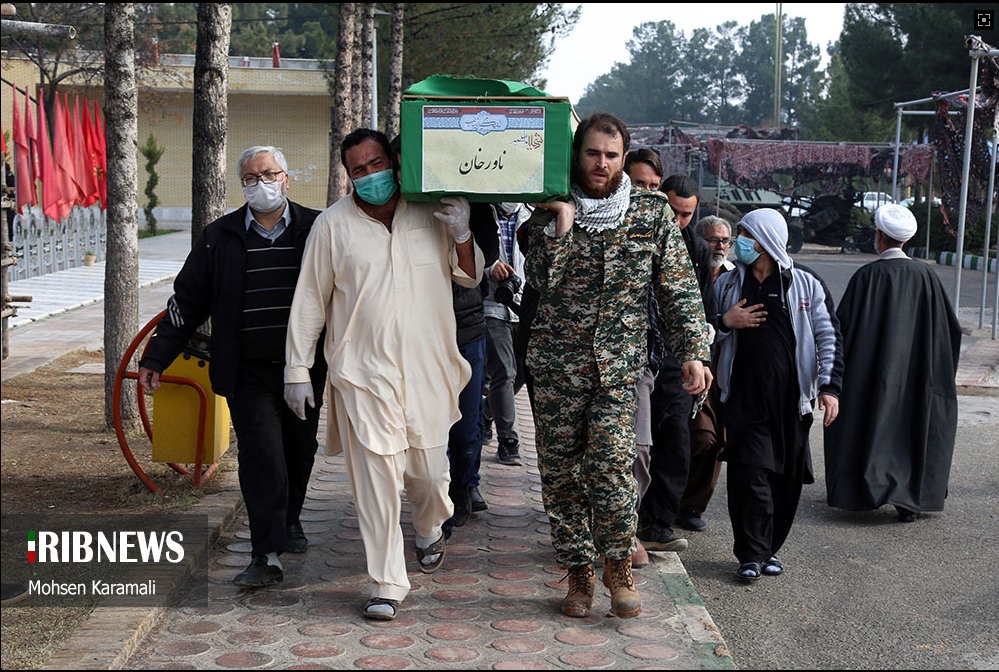


Coffin of Naver Khan, a Pakistani militiaman of Zainebiyoun Brigade, is being taken for funeral at Qom city of Iran on March 1, 2020. (Photo courtesy: IRIB News)

Defense analyst Brig. (R) Mahmood Shah said a small number of Sunni militants had also gone to Syria to join Daesh.
“People from the Shia community have religious affinity with Iran, Iraq and Syria and sacred places over there, so their number may be high,” Shah told Arab News. “With war intensifying in the coming days, more deaths [of Pakistanis] are expected.
Last month, Pakistani police claimed to have arrested an important member of the Zainebiyoun brigade from the port city of Karachi.

Pakistan PM calls PIA privatization ‘vote of confidence’ as government pushes reforms

Updated 24 December 2025
Follow

Pakistan PM calls PIA privatization ‘vote of confidence’ as government pushes reforms

  • The loss-making national flag carrier was sold to a Pakistani consortium for $482 million after two failed attempts
  • Finance minister vows to continue economic reforms, engage international partners through trade and investment

KARACHI: Prime Minister Shehbaz Sharif said on Tuesday the privatization of state-owned Pakistan International Airlines marked a “vote of confidence” in the country’s economy, as the government presses ahead with structural reforms aimed at easing pressure on public finances and attracting investment.

The sale of the loss-making national carrier by a Pakistani consortium, which secured a 75 percent stake for Rs135 billion ($482 million), follows two previous attempts to privatize PIA. The development comes as Pakistan seeks to build on macroeconomic stabilization after a prolonged balance-of-payments crisis, with authorities trying to shift the economy toward export-led growth and policy continuity.

“It was our firm commitment to the people of Pakistan that speedy and concrete steps would be taken to privatize loss-making state-owned enterprises that have been a burden on the economy,” Sharif said in a post on X. “The successful completion of the transparent and highly competitive bidding process for the privatization of PIA marks an important milestone in fulfilling that commitment.”

“The strong participation of our leading business groups and some of Pakistan’s most seasoned and respected investors is a powerful vote of confidence in our economy and its future,” he added.

The government has made privatization of state-owned enterprises a key pillar of its reform agenda, alongside changes to taxation, energy pricing and trade policy, as it seeks to stabilize the economy and restore investor confidence.

Meanwhile, Finance Minister Muhammad Aurangzeb told an international news outlet Pakistan had reached a critical turning point, with macroeconomic stability and sustained reforms helping shift the economy from stabilization toward growth.

“Macroeconomic stability, sustained reforms and policy continuity are restoring confidence, shifting the economy from stabilization to export-led growth,” he said in an interview with USA Today, according to a statement issued by the finance ministry, adding that the government was opening new opportunities for domestic and global investors.

Aurangzeb said inflation had eased sharply, external balances had improved and foreign exchange reserves had risen above $14.5 billion, while Pakistan had recorded both a primary fiscal surplus and a current account surplus for the first time in several years.

The finance minister noted that economic growth remained insufficient to meet the needs of a fast-growing population, pointing out the importance of continuing structural reforms and encouraging investment in sectors such as agriculture, minerals, information technology and climate resilience.

Despite ongoing risks from global commodity prices, debt pressures and political uncertainty, Aurangzeb said the government remained committed to staying the reform course and engaging international partners through trade and investment.