

Pakistan struggles to combat devastating locust plague

In this picture taken on February 23, 2020, a farmer tries to chase away locusts in Pipli Pahar village in Pakistan's central Punjab province. (AFP)
Short Url
Updated 04 March 2020
Follow

Pakistan struggles to combat devastating locust plague

  • Government has declared a nationwide emergency, appeals for international help
  • FAO set up meetings between India and Pakistan to prevent locust swarms from spreading

PIPLI PAHAR: Pakistan’s farmers are struggling to combat the worst locust plague in nearly three decades as insect swarms decimate entire harvests in the country’s agricultural heartlands and send food prices soaring.
Heavy rains and cyclones sparked “unprecedented” breeding and the explosive growth of locust populations on the Arabian peninsula early last year, according to the United Nations.
The insects have since fanned out and wreaked havoc on farms from East Africa to India before making their way into Pakistan from the desert on the country’s southwestern border with Iran.


In this picture taken on February 23, 2020, a farmer tries to chase away locusts in Pipli Pahar village in Pakistan's central Punjab province. (AFP)

The crisis is so severe that the government has declared a nationwide emergency and urgently appealed for help from the international community.
Officials in southern Sindh province fear the infestation will devastate the supply of cotton, the local cash crop, ahead of its harvest in the coming months.
Local surveys of the damage are continuing, but the Sindh Chamber of Agriculture says nearly half of all crops have been destroyed near the port city of Karachi.
“I have not seen an infestation like this one in my career,” said Shehbaz Akhtar, an agricultural official charged with locust eradication efforts in the village of Pipli Pahar in central Punjab province.
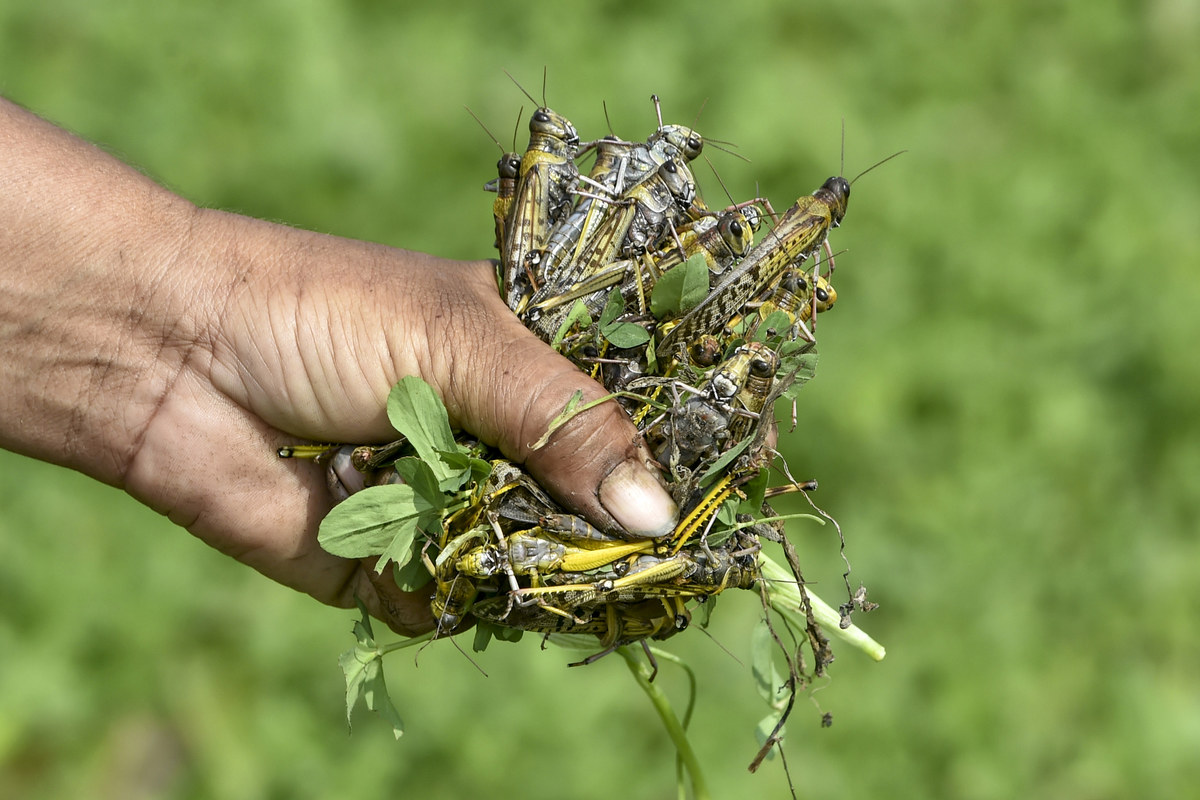


In this picture taken on February 23, 2020, a farmer holds locusts in Pipli Pahar village in Pakistan's central Punjab province. (AFP)

Local authorities had “launched a combat operation” to clear the area of infestation with pesticide sprays, he said.
Clouds of the noxious gas envelop the nearby fields each morning, where villagers gather the husks of dead insects for an official bounty of 20 rupees (13 cents) per kilogram bag.
“We spray twice a day here,” says Fayyaz Azeem, clad in a face mask and thick industrial gloves on top of a tractor discharging pesticide into rows of crops.
But the process is slow and time-consuming, and by the time locusts are killed off in one field they have often already destroyed the next.
The pesticides used by officials are also dangerous for consumption, so even when the locusts are dead the remaining crops have to be discarded.
Some farmers have been forced to opt for more desperate solutions while waiting for their fields to be sprayed and have attempted to scare off the swarms by shouting and banging pots.
A team of Chinese experts has arrived in Pakistan to survey the crisis, food security ministry chief Muhammad Hashim Popalzai told AFP.
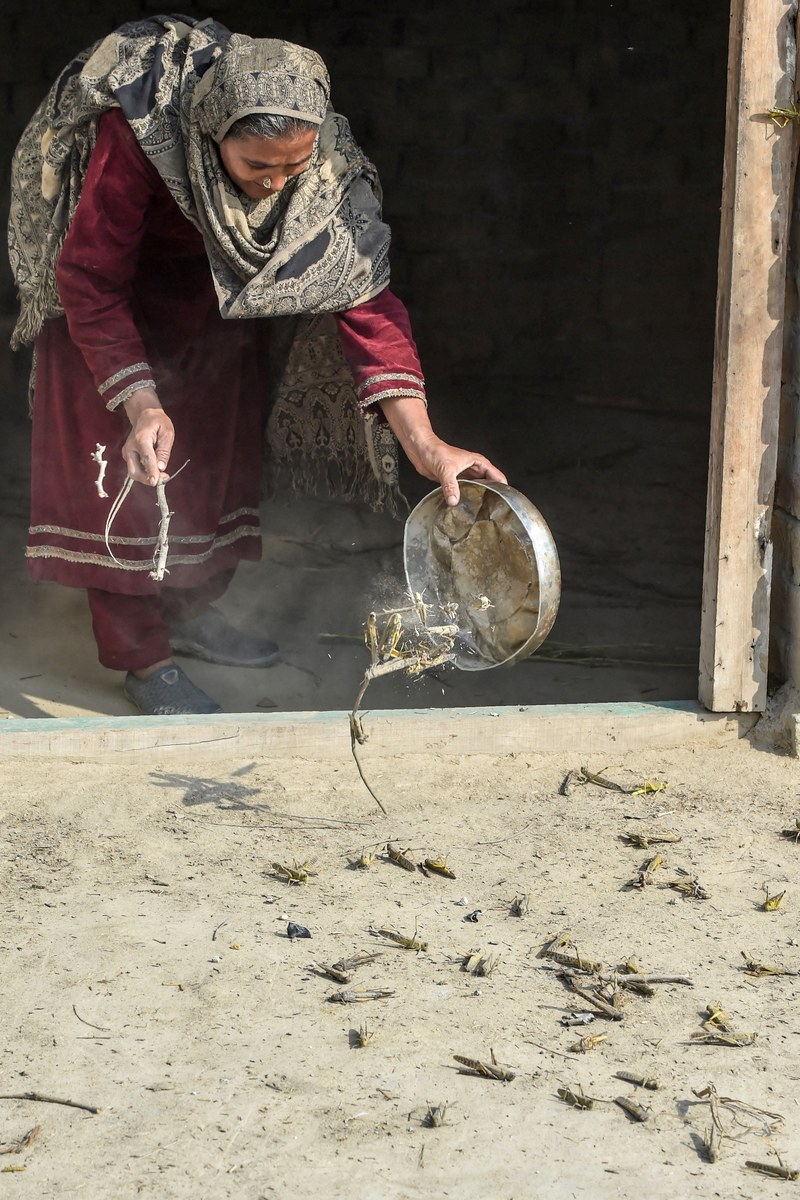


In this picture taken on February 23, 2020, a farmer throws dead locusts from her home in Pipli Pahar village in Pakistan's central Punjab province. (AFP)

Beijing could also offer aerial spraying — a much faster and more efficient method of pest control — and Pakistan may also import pesticides from China.
Earlier reports circulating online suggested China was planning to send thousands of ducks to Pakistan to devour the scourge. Pakistani officials said no such plans were being considered.
The UN Food and Agriculture Organization has also set up meetings between India and Pakistan to prevent the swarms from spreading, Popalzai said.

Agriculture accounts for 20 percent of Pakistan’s GDP but the sector has already struggled for years in the face of drought and dwindling water supplies.
The country is also experiencing 12-year inflation highs, with the cost of sugar nearly doubling and flour prices jumping 15 percent in the past year.
Years without a locust attack meant the government “had become complacent” about the risks of a new infestation, said Pakistan Farmers Bureau president Zafar Hayyat.
Though he applauded the steps being taken to fight the plague, Hayyat warned of the risk that swarms would return mid-year after the next locust breeding season.
For many farmers in Pipli Pahar, the extermination campaign has already come too late.
Sitting in the corner of a wheat field with her cow, Rafiya Bibi watches the flurry of pesticide spraying around her.
The locusts have already destroyed her crops of canola, sunflower, chili, and tobacco, which she had bought after borrowing 45,000 rupees from the government.
With no harvest, she has no way to repay the loan.
“What can I do?” she said. “All I can do is cry, what else can I do?“


In Pakistan’s Bannu, people start their day with a sugar rush

Updated 5 sec ago
Follow

In Pakistan’s Bannu, people start their day with a sugar rush

  • While much of Pakistan favors savory breakfasts, residents of Bannu prefer a sweet, caramelized halwa
  • People line up before sunrise at the decades-old Speen Sar restaurant to cherish its signature dish

BANNU, Pakistan: Before sunrise, the narrow lane outside Speen Sar, a modest restaurant, fills with customers waiting for halwa, a dense sweet made from wheat starch, sugar and clarified butter, that serves as breakfast for many people in this northwestern city.

Inside the restaurant’s kitchen, the morning air is thick with the scent of caramelized sugar and heated ghee. A chef leans over a large metal vat, dissolving sugar into the hot fat before adding a slurry of flour and water. With rhythmic, heavy strokes, he stirs the mixture until it thickens into a glossy halwa.

He pours the sweet onto a tray and rushes toward the counter, where a crowd of patrons has already gathered. Three cooks work in quick succession to keep pace with demand, turning out batch after batch during the breakfast rush in Bannu, a city in Pakistan’s Khyber Pakhtunkhwa province.

While halwa is widely eaten as a dessert or festival sweet across South and Central Asia and the Middle East, Bannu stands apart for turning it into a morning staple. Across most of Pakistan, breakfast tends to be savory, typically consisting of omelets, parathas or puris, and in some places nihari, a slow-cooked meat stew. Here, however, halwa is not a side dish but the meal itself, eaten plain or with bread before the workday begins.

“We open the shop at the time of morning prayer, and after prayer, we start preparing,” says Zahid Khan, whose grandfather Akbar Ghulam opened the restaurant over six decades ago.

The shop’s name, Speen Sar — Pashto for “white-haired man” — dates back to its earliest days. Khan said the business began as a small stall run by his grandfather. As he grew older and his hair turned white, customers began directing others to the “speen sar” shop, the place where the white-haired man sold halwa. The nickname endured, eventually becoming the shop’s official identity.

Speen Sar relies on a labor-intensive process of extracting starch from wheat flour.

“In our halwa, we use ghee, sugar, flour and other ingredients. From the flour, the starch that comes out is what we use to make the halwa,” Khan explained before examining the cooking process in his kitchen.

Bannu sits at the crossroads between Pakistan’s former tribal areas and the settled plains of the northwest, and the halwa shop serves as a rare social equalizer, drawing laborers, traders, students and travelers to the same counter each morning. For many passing through the city, stopping for halwa is not optional.

“Whenever I come from Waziristan ... the first thing I do is start with halwa,” says Irafullah Mehsud, an expatriate worker. “I eat the halwa first, and only then move on to other things.”

The popularity of the dish is partly due to its shelf life and to what the owners call good quality. At Rs500 ($1.80) per kilogram, it is an affordable luxury as well.

“Our halwa is widely consumed with breakfast, and it does not spoil quickly. If you want, that you will eat it tomorrow, you can even set some aside for the next day,” Khan said, pointing to a tray of nishasta halwa, a variety made by extracting wheat starch before cooking.

While the region offers variations including sohan halwa, milk-based recipes, and carrot-infused batches, this halwa offered by Speen Sar remains the undisputed king of the breakfast table in this city.

“This is a tradition of the people of Bannu. Early in the morning, everyone eats it and comes here,” says Razaullah Khan, a student at a local college. “Eating halwa is a common practice here ... but this one is the most popular. People eat it for breakfast.”

For the elders of the city, the habit is as much about routine as it is about flavor.

“This tradition has been going on for the past forty to fifty years ever since I can remember,” says Sakhi Marjan, a local elder in his late sixties. “We first come to the Azad Mandi market and then come here to eat halwa. We really enjoy this halwa. It is delicious.”

As the sun rises over Bannu, this ‘sweet’ trade shows no sign of slowing. For those like Gul Sher, a regular from Jani Khel, a town in a neighboring tribal district, a day without the local sweet is a day started wrong.

“As soon as I step into Bannu, I start my day with halwa. After that, the rest of the day goes well,” Sher said before finishing his plate of halwa.

“It is a sweet dish, and it makes the day better. It is a good thing.”