KUALA LUMPUR: Malaysia’s new prime minister Muhyiddin Yassin has postponed the start of parliamentary proceedings by two months, the speaker said on Wednesday, amid opposition efforts to challenge his government with a confidence vote.
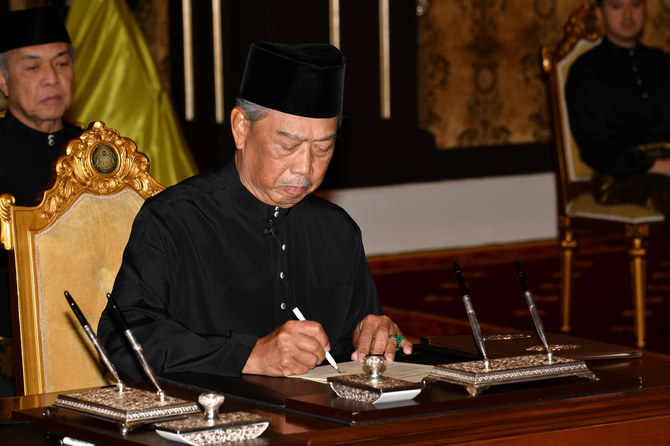
Muhyiddin was sworn in on Sunday after a week of political turmoil triggered by the abrupt resignation of 94-year-old Mahathir Mohamad.
King Sultan Abdullah Sultan Ahmad Shah appointed Muhyiddin as the prime minister, saying he believed Muhyiddin possibly had the support of a majority in parliament.
But Mahathir’s coalition has said they have the majority and vowed to bring a confidence vote in parliament when it reconvened on March 9.
Speaker Mohamad Ariff Md. Yusof said in a statement that he has received a letter from Muhyiddin stating the session will instead start on May 18.
Muhyiddin, a former interior minister in Mahathir’s cabinet, joined hands with the UMNO party — which lost federal power in the 2018 election — and Islamist party PAS to form a new coalition.
His move came after the resignation of Mahathir, who then tried out to form a national unity government that would have given him greater powers but got little support from politicians.
Mahathir went back to partner with his old rival Anwar Ibrahim to stop Muhyiddin but the king’s decision to appoint the latter put an end to the efforts.


![]()


Malaysia’s new prime minister delays parliament session by two months
Short Url
https://arab.news/mxvca
Malaysia’s new prime minister delays parliament session by two months
- Muhyiddin Yassin was sworn in on Sunday after a week of political turmoil
- But there are opposition efforts to challenge his government with a confidence vote


UN to approve sanction exemptions on North Korea aid projects: sources
SEOUL: The UN Security Council sanctions committee on North Korea is to give exemptions for humanitarian aid projects in the impoverished country, diplomatic sources in Seoul told AFP on Friday.
The nuclear-armed country is under multiple sets of sanctions over its weapons programs and has long struggled with its moribund state-managed economy and chronic food shortages.
The 17 humanitarian assistance projects are all being implemented by major international organizations such as UNICEF, or by NGOs from South Korea and the United States, the sources said.
Analysts say the move would allow those groups to provide humanitarian aid, such as nutritional supplements, medical equipment and water purification systems, to North Korea.
A foreign ministry official said Seoul has made “various efforts” to ensure that humanitarian aid reaches the North, regardless of politics.
“We hope that North Korea will respond positively to our government’s efforts for peaceful coexistence on the Korean Peninsula,” the official said.
The sources spoke hours after a senior South Korean official said “new progress” on North Korea could come within days.
The foreign ministry official’s comments came while discussing US President Donald Trump’s scheduled trip to China in April.
Trump made repeated overtures to Pyongyang’s leader Kim Jong Un during a barnstorming tour of Asia last year, saying he was “100 percent” open to a meeting.
He even bucked decades of US policy by conceding that North Korea was “sort of a nuclear power.”
North Korea did not respond to Trump’s offer, and has repeatedly said it will never give up its nuclear weapons.
Trump met North Korea’s Kim three times during his first term, once famously declaring that they were “in love,” in an effort to reach a denuclearization deal.
- Landmark congress -
However, a planned summit in Hanoi in 2019 fell through over differences about what Pyongyang would get in return for giving up its nuclear weapons, and no progress has been made between the two countries since then.
Seoul and Washington reaffirmed their commitment this week to North Korea’s “complete denuclearization” and cooperation on Seoul’s nuclear-powered submarine plan, a move that has previously drawn an angry response from the North.
Pyongyang has also drawn much closer to Moscow, with its deployment of troops to aid Russia’s war against Ukraine.
It has sent thousands of troops to fight for Moscow and analysts say Russia is giving North Korea military technology, food and energy supplies in return, allowing it to sidestep tough international sanctions.
North Korea is set to hold a landmark congress of its ruling party soon, its first in five years.
Kim ordered the “expansion” and modernization of the North’s missile production ahead of the gathering.
The nuclear-armed country is under multiple sets of sanctions over its weapons programs and has long struggled with its moribund state-managed economy and chronic food shortages.
The 17 humanitarian assistance projects are all being implemented by major international organizations such as UNICEF, or by NGOs from South Korea and the United States, the sources said.
Analysts say the move would allow those groups to provide humanitarian aid, such as nutritional supplements, medical equipment and water purification systems, to North Korea.
A foreign ministry official said Seoul has made “various efforts” to ensure that humanitarian aid reaches the North, regardless of politics.
“We hope that North Korea will respond positively to our government’s efforts for peaceful coexistence on the Korean Peninsula,” the official said.
The sources spoke hours after a senior South Korean official said “new progress” on North Korea could come within days.
The foreign ministry official’s comments came while discussing US President Donald Trump’s scheduled trip to China in April.
Trump made repeated overtures to Pyongyang’s leader Kim Jong Un during a barnstorming tour of Asia last year, saying he was “100 percent” open to a meeting.
He even bucked decades of US policy by conceding that North Korea was “sort of a nuclear power.”
North Korea did not respond to Trump’s offer, and has repeatedly said it will never give up its nuclear weapons.
Trump met North Korea’s Kim three times during his first term, once famously declaring that they were “in love,” in an effort to reach a denuclearization deal.
- Landmark congress -
However, a planned summit in Hanoi in 2019 fell through over differences about what Pyongyang would get in return for giving up its nuclear weapons, and no progress has been made between the two countries since then.
Seoul and Washington reaffirmed their commitment this week to North Korea’s “complete denuclearization” and cooperation on Seoul’s nuclear-powered submarine plan, a move that has previously drawn an angry response from the North.
Pyongyang has also drawn much closer to Moscow, with its deployment of troops to aid Russia’s war against Ukraine.
It has sent thousands of troops to fight for Moscow and analysts say Russia is giving North Korea military technology, food and energy supplies in return, allowing it to sidestep tough international sanctions.
North Korea is set to hold a landmark congress of its ruling party soon, its first in five years.
Kim ordered the “expansion” and modernization of the North’s missile production ahead of the gathering.
Latest updates


© 2026 SAUDI RESEARCH & PUBLISHING COMPANY, All Rights Reserved And subject to Terms of Use Agreement.