

Arab alliance headed for further gains in Israel vote

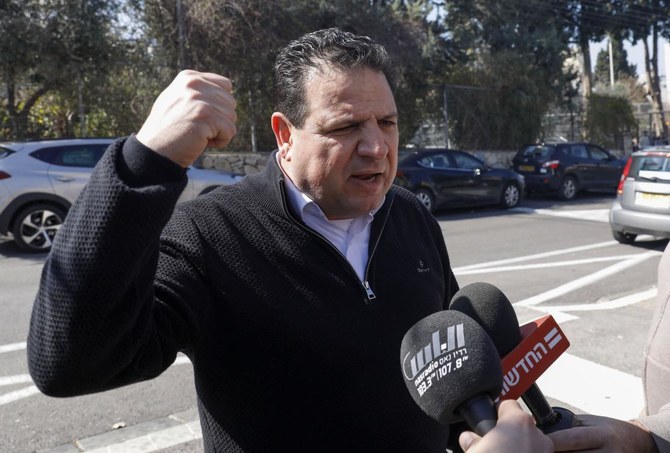
Head of Israel's predominantly Arab Joint List coalition Ayman Odeh talks to reporters in the northern Israeli city of Haifa, a day after the Israeli general elections. (AFP)
Short Url
Updated 03 March 2020
Follow

Arab alliance headed for further gains in Israel vote

  • Ayman Odeh calls for partnership between leftist Arabs and Jews
  • Israelis voted yesterday in their third election in less than a year, and first since the US-Israel peace plan was unveiled

Haifa: Israel’s largely Arab Joint List alliance was on track for its best-ever electoral performance, near-complete results showed Tuesday, consolidating its place as the third largest parliamentary bloc.
With 90 percent of votes counted, the Joint List was slated to take 15 of 120 seats in the Knesset — Israel’s parliament — up from 13 following elections in September.
But it may yet fall short of its chief goal of blocking Prime Minister Benjamin Netanyahu’s re-election, with his right-wing Likud and its allies expected to control 59 seats — just two short of a majority.
The Joint List’s solid performance came after it campaigned heavily for the votes of Jewish leftists disenchanted by the demise of Israel’s historic left-wing parties, notably Labour.
The success of that strategy remains unclear, pending a breakdown of voter patterns.
But Joint List chairman, Ayman Odeh, made no secret of his wish to become the face of the Israeli left — for both Arabs and Jews.

“I want to congratulate our public, both the Arab and the many Jewish voters who supported the Joint List,” Odeh told reporters Tuesday morning.
“This is the beginning of strengthening the true left,” he said.
“I call on leftists to not despair or do any soul-searching, but to think about a partnership... real democracy, real equality between Jews and Arabs in the country and social justice for the weak.”
To get out its core Arab vote, the Joint List also focused on US President Donald Trump’s controversial peace plan, detested and feared by Arabs, who make up around 20 percent of Israel’s population.
They are particularly alarmed by a clause that would place some Israeli Arab towns and villages under the sovereignty of a future Palestinian state.
If implemented, that could see some Arab Israelis have their citizenship changed against their will.
Monday’s election was the third in less than a year, after inconclusive votes in April and September.
The Centrist Blue and White alliance, Likud’s main challenger, slid to 32 seats from 33 in September, while an alliance of the Labour party, left-wing Meretz and centrist Gesher spiralled from 11 seats running separately in the last election to seven together.
The Joint List’s member parties include conservative Islamists and Arab nationalists.
They are united by demanding the end of Israel’s occupation of Palestinian territories and the establishment of a Palestinian state, a position regarded as left-wing in Jewish Israeli society.
Its manifesto also includes “workers’ rights and social and environmental justice.”
In September, the list backed Gantz to form a government, but for political reasons he was loath to form a coalition with what is an anti-Zionist group.
The list’s parliamentary numbers, however, blocked Netanyahu and his right-wing allies from attaining power.


UN chief condemns Israeli law blocking electricity, water for UNRWA facilities

Updated 01 January 2026
Follow

UN chief condemns Israeli law blocking electricity, water for UNRWA facilities

  • The agency provides education, health and aid to millions of Palestinians in Gaza, the West Bank, Jordan, Lebanon and Syria

United Nations Secretary General Antonio Guterres condemned on Wednesday a move by Israel to ban electricity or water to facilities owned by the UN Palestinian refugee agency, ​a UN spokesperson said.
The spokesperson said the move would “further impede” the agency’s ability to operate and carry out activities.
“The Convention on the Privileges and Immunities of the United Nations remains applicable to UNRWA (United Nations Relief and Works Agency for Palestine Refugees in the Near East), its property and assets, and to its officials and other personnel. Property used ‌by UNRWA ‌is inviolable,” Stephane Dujarric, spokesman for the ‌secretary-general, ⁠said ​while ‌adding that UNRWA is an “integral” part of the world body.
UNRWA Commissioner General Phillipe Lazzarini also condemned the move, saying that it was part of an ongoing “ systematic campaign to discredit  UNRWA and thereby obstruct” the role it plays in providing assistance to Palestinian refugees.
In 2024, the Israeli parliament passed a law banning the agency from operating in ⁠the country and prohibiting officials from having contact with the agency.
As a ‌result, UNRWA operates in East Jerusalem, ‍which the UN considers territory occupied ‍by Israel. Israel considers all Jerusalem to be part ‍of the country.
The agency provides education, health and aid to millions of Palestinians in Gaza, the West Bank, Jordan, Lebanon and Syria. It has long had tense relations with Israel but ties have deteriorated ​sharply since the start of the war in Gaza and Israel has called repeatedly for UNRWA to ⁠be disbanded, with its responsibilities transferred to other UN agencies.
The prohibition of basic utilities to the UN agency came as Israel also suspended of dozens of international non-governmental organizations working in Gaza due to a failure to meet new rules to vet those groups.
In a joint statement, Canada, Denmark, Finland, France, Iceland, Japan, Norway, Sweden, Switzerland and the United Kingdom said on Tuesday such a move would have a severe impact on the access of essential services, including health care. They said one in ‌three health care facilities in Gaza would close if international NGO operations stopped.