Pakistan’s largest city shuts schools for two weeks over virus fears

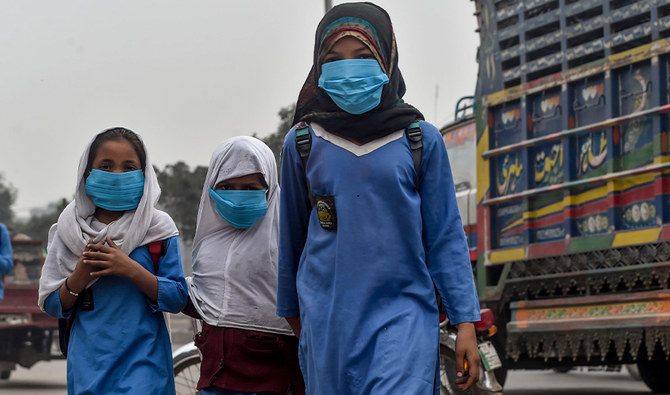
Students wear masks as they go to school in Lahore on November 14, 2019. (AFP)
Short Url
Updated 15 March 2020
Follow

Pakistan’s largest city shuts schools for two weeks over virus fears

  • Schools in Sindh have been closed since Thursday, after the first case in Karachi tested positive
  • Pakistan has confirmed four cases of coronavirus, three of them recently having traveled to Iran

KARACHI, Pakistan, March 2 : Pakistan’s southern province of Sindh extended the closure of all educational institutions following the confirmation of a second coronavirus case in Karachi, the country’s largest city.
Pakistan has confirmed four cases of coronavirus, three of them involving people who had traveled to neighboring Iran, one of the countries hardest hit by the outbreak that began in China in December.
While two of the confirmed cased were in the southern port city of Karachi, the other two were in the capital Islamabad.
Schools in Sindh have been closed since Thursday, after the first case in Karachi was confirmed.
“The Sindh government has decided to keep the schools closed till March 13, so the isolation period of the suspect cases could be completed,” Saeed Ghani, provincial education minister told Reuters on Monday. “We don’t want to take any risk.”
Schools in Islamabad have remained open, but the thinly populated western province of Baluchistan, which borders Iran, closed its schools last week.
Pakistan suspended all flights with Iran and closed the land border last week.
Health Minister Zafar Mirza has said that government is gradually allowing pilgrims to return from Iran, after holding them in quarantine at the border for 14 days.
Around 700 pilgrims arrived in Karachi from Iran over the weekend, the Sindh chief minister’s office said in a statement.


Pakistan disburses record $9.2 billion agricultural loans in FY25, central bank says

Updated 5 sec ago
Follow

Pakistan disburses record $9.2 billion agricultural loans in FY25, central bank says

  • State Bank says farm lending rose 16 percent year-on-year to Rs2.58 trillion
  • Inflation eased to 5.8 percent in January as GDP growth hits 3.7 percent in Q1 FY26

KARACHI: Pakistan disbursed a record Rs2.58 trillion ($9.2 billion) in agricultural loans during fiscal year 2024–25, a 16 percent increase from the previous year, State Bank of Pakistan (SBP) Governor Jameel Ahmad said on Thursday while chairing a meeting of the Agricultural Credit Advisory Committee (ACAC).

Agricultural financing is considered critical to Pakistan’s rural economy, where farming contributes nearly one-fifth of GDP and employs a large share of the workforce. The government has repeatedly emphasized expanding credit access to small farmers as part of broader efforts to boost productivity, stabilize food supply and support economic recovery under an IMF-backed reform program.

According to official data shared at the meeting, agricultural credit disbursement reached Rs2.58 trillion in FY25, marking a record high. In the first half of FY26 alone, banks disbursed Rs1,412 billion in agricultural loans, while the number of borrowers increased to 2.97 million.

“During fiscal year 2025, record agricultural loans of Rs2.58 trillion were disbursed, reflecting an annual growth of 16 percent,” the State Bank governor said, according to a statement issued after the meeting.

He added that Pakistan had regained macroeconomic stability and that the economy was moving toward sustainable growth.

The governor said GDP growth in the first quarter of FY26 stood at 3.7 percent, while full-year growth was projected between 3.75 percent and 4.75 percent.

He also noted that headline inflation had declined to 5.8 percent in January 2026.

The committee reviewed measures to further expand credit access, including greater use of the central bank’s Zarkhez-e scheme to facilitate agricultural lending. Members also discussed promoting electronic warehouse receipt financing to enhance post-harvest liquidity and reduce distress sales of crops.

The statement said the purpose of electronic warehouse receipt financing was to “reduce forced sales of crops and strengthen linkages within the agricultural market.”

Agricultural lending has been a focus of Pakistan’s financial inclusion strategy, particularly as policymakers seek to improve rural incomes, stabilize food prices and strengthen export-oriented crop production amid broader economic reforms.