

What you need to know about America’s ‘Super Tuesday’

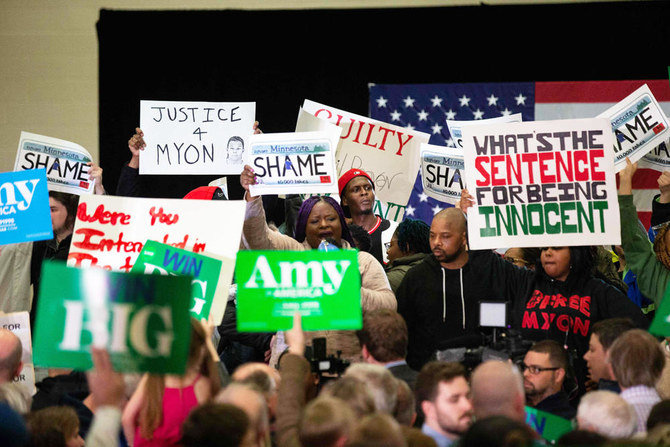
Protesters take over the stage before the start of a now cancelled rally for Democratic presidential hopeful Minnesota Senator Amy Klobuchar on March 1, 2020 in St. Louis Park, west of Minneapolis, Minnesota. (AFP / Kerem Yucel)
Short Url
Updated 02 March 2020
Follow

What you need to know about America’s ‘Super Tuesday’

WASHINGTON: Americans eager to know which Democrat will face President Donald Trump in November’s election may have a clearer view after “Super Tuesday” — sure to be a defining moment in the race.
Four of the country’s 50 states have already voted, but March 3 is the biggest day of the entire presidential primary process, with tens of millions of Americans eligible to cast ballots.
It could be a turning point when frontrunner Bernie Sanders secures an insurmountable lead — or former vice president Joe Biden secures a dramatic comeback.
Success on Super Tuesday requires a tremendous ground game, top-notch fundraising and serious momentum.
Elizabeth Warren and Amy Klobuchar will likely have to face a daunting choice Wednesday morning: defy the odds and keep going, or bow out.
Here are a few things to watch for on Super Tuesday:

Tabulation
The states in play span the nation, from sparsely populated northeasternmost Maine to California, the progressive west coast powerhouse whose population of 40 million is the country’s largest.
The southern state of Texas, with 29 million, is another top prize. Virginia, North Carolina, Alabama and Colorado also cast ballots.
The other states in play are Arkansas, Massachusetts, Minnesota, Oklahoma, Tennessee, Utah and Vermont.
With the 14 states — plus American Samoa and Democrats living abroad — reflecting the nation’s social and economic diversity, Super Tuesday provides opportunity for candidates to demonstrate their ability — or weakness — to draw from a broad swathe of voters from different backgrounds and across different regions.
Tabulating votes could take all night.

Absolute majority
A third of the delegates who will formally pick the Democratic presidential nominee are up for grabs, making it a critical point in the US electoral calendar.
Earning the party’s nomination requires a candidate to win an absolute majority of delegates — 1,991 — who are assigned proportionally according to results in each primary or caucus.
A whopping 1,357 delegates are available Tuesday, compared to just 155 that have been allocated so far.
Sanders is leading polls in crown jewel California (415 delegates) and Texas (228), and the firebrand leftist could strike a hammer blow against rivals if he does well there.
Candidates must meet a party-imposed threshold of 15 percent of the vote in order to win delegates.

Michael Bloomberg
The billionaire former mayor of New York, Michael Bloomberg, sat out the four early contests but has already spent a record $500 million in campaign advertising.
Voters will see if his unconventional gambit pays off in Super Tuesday states, where he is on the ballot for the first time.
A miserable debut debate performance in mid-February and an unconvincing second appearance last Tuesday lowered his trend line in polling, but he still remains in third place nationally, behind Sanders and Biden.

“Super-delegates”
The party’s top contender will be formally nominated at the Democratic National Convention, set for July 13-16 in Milwaukee, Wisconsin.
But the prospects of a bitter nomination battle on the convention floor are increasingly real.
Sanders argues that the candidate who heads into the convention with the delegate lead, regardless of whether he or she has an outright majority, should be declared the nominee.
His rivals demand the party stick to its rules, which state that if no candidate wins a majority-plus-one during the primary race, the pledged delegates become free to vote for another candidate on the convention’s second ballot.
In addition, some 771 “super-delegates” — party committee officials and leaders, along with Democratic members of Congress — will be eligible to vote on the second ballot.
Given that super-delegates are usually members of the party establishment, their involvement could tilt the result away from Sanders.


Trump signals interest in easing tensions, but Minneapolis sees little change on the streets

Updated 29 January 2026
Follow

Trump signals interest in easing tensions, but Minneapolis sees little change on the streets

  • Immigration enforcement operations and confrontations with activists continued Wednesday in Minneapolis and St. Paul

MINNEAPOLIS: President Donald Trump seemed to signal a willingness to ease tensions in Minneapolis after a second deadly shooting by federal immigration agents, but there was little evidence Wednesday of any significant changes following weeks of harsh rhetoric and clashes with protesters.
The strain was evident when Trump made a leadership change by sending his top border adviser to Minnesota to take charge of the immigration crackdown. That was followed by seemingly conciliatory remarks about the Democratic governor and mayor.
Trump said he and Gov. Tim Walz, whom he criticized for weeks, were on “a similar wavelength” following a phone call. After a conversation with Mayor Jacob Frey, the president praised the discussion and declared that “lots of progress is being made.”
But on city streets, there were few signs of a shift. Immigration enforcement operations and confrontations with activists continued Wednesday in Minneapolis and St. Paul.
A group of protesters blew whistles and pointed out federal officers in a vehicle on a north Minneapolis street. When the officers’ vehicle moved, a small convoy of activists followed in their cars for a few blocks until the officers stopped again.
When Associated Press journalists got out of their car to document the encounter, officers with the federal Bureau of Prisons pushed one of them, threatened them with arrest and told them to get back in their car despite the reporters’ identifying themselves as journalists. Officers from multiple federal agencies have been involved in the enforcement operations.
From their car, the AP journalists saw at least one person being pepper sprayed and one detained, though it was unclear if that person was the target of the operation or a protester. Agents also broke car windows.
Attorney General Pam Bondi, who is visiting Minnesota, said 16 people were arrested Wednesday on charges of assaulting, resisting or impeding law enforcement in the state. She said more arrests were expected.
“NOTHING will stop President Trump and this Department of Justice from enforcing the law,” Bondi said in a social media post.
Messages seeking comment were left with Immigration and Customs Enforcement and the Border Patrol.
Woman tells agents: ‘They’re good neighbors’
On Wednesday afternoon in the Minneapolis suburb of Brooklyn Center, half a dozen agents went to a house in a small residential neighborhood.
One agent knocked on the door of the home repeatedly. Another told the AP they were seeking a man who had been twice deported and was convicted of domestic abuse. The agent said the man had run into the home and the agents lacked a judicial warrant to get inside.
Some federal immigration officers have asserted sweeping power to arrest someone considered illegally present or otherwise deportable using an administrative warrant but without a judge’s warrant. The key difference in the two warrants is whether agents can forcibly enter a private property to make an arrest, as they were captured on video doing in Minneapolis earlier this month.
A handful of activists blew whistles at the agents in Brooklyn Center. One agent said: “They’d rather call the police on us than to help us. Go figure.”
As the agents were preparing to leave, a woman called out to them saying, “You need to know they’re good neighbors.”
Kari Rod told the AP that she didn’t know these neighbors well, but they had come to her garage sale, kept their yard clean and waved hello when she drove by. She didn’t believe enforcement agents to be speaking the truth about whom they arrest, including another neighbor whom she said was deported to Laos last summer.
“I don’t trust a single thing they said about who they are,” Rod said. “From my interactions, I know them way better than anyone else does, any one of those federal agents.”
Immigrants are ‘still very worried’
Many immigrant families are still fearful of leaving their homes, and Latino businesses are still closed, said Daniel Hernandez, who owns the Minneapolis grocery store Colonial Market. He also runs a popular Facebook page geared toward informing the Hispanic community in the Twin Cities.
While Colonial Market is open, all but one of the dozen immigrant-run businesses that rented space inside have closed since late December, and none has plans to reopen, Hernandez said.
“The reality is the community is still very worried and afraid,” Hernandez said.
Hernandez referenced Border Patrol commander Gregory Bovino, who helped lead the administration’s crackdown in the Twin Cities and who has reportedly been assigned elsewhere.
Bovino “was removed, but the tactics so far are still the same,” Hernandez said. “Nobody now is trusting the government with those changes.”
The federal enforcement extended to the city’s Ecuadorian consulate, where a federal law enforcement officer tried to enter before being blocked by employees.
Judge warns ICE about not complying with federal orders
In Minnesota federal court, the issue of ICE not complying with court orders came to the fore as Chief Judge Patrick Schiltz said the agency had violated 96 court orders in 74 cases since Jan. 1.
“This list should give pause to anyone — no matter his or her political beliefs — who cares about the rule of law,” he wrote. “ICE has likely violated more court orders in January 2026 than some federal agencies have violated in their entire existence.”
Schiltz earlier this week ordered ICE’s acting director to personally appear in his courtroom Friday after the agency failed to obey an order to release an Ecuadorian man from detention in Texas. The judge canceled the order after the agency freed the man.
The judge, who was appointed by President George W. Bush, warned ICE that future noncompliance may result in future orders requiring the personal appearances of Acting Director Todd Lyons or other government officials.
ICE didn’t immediately respond to an email seeking comment.
Veteran visits sidewalk memorial
Elsewhere on Wednesday, Donnie McMillan placed a cardboard sign reading “In remembrance of my angel” at the makeshift memorial where Alex Pretti was shot.
The Vietnam veteran knelt to pay his respects and saluted to honor the nurse whom he said he remembered seeing during his frequent visits to the Veterans Affairs hospital where Pretti worked.
“I feel like I’ve lost an angel right here,” McMillan, 71, said, pointing to the growing sidewalk memorial covered in flowers, candles and signs. “This is not the way we should operate.”
Also Wednesday, the Department of Homeland Security said two federal agents involved in Pretti’s death have been on leave since Saturday, when the shooting happened.
US Rep. Ilhan Omar, a Democrat, spoke to journalists one day after a man attacked her during a town hall meeting by squirting a strong-smelling substance on her as she denounced the Trump administration.
“What is unfolding in our state is not accidental. It is part of a coordinated effort to target Black and brown, immigrant and Muslim communities through fear, racial profiling and intimidation,” Omar said. “This administration’s immigration agenda is not about law enforcement — it is about making people feel they do not belong.”
