PARIS: Coronavirus cases surged in Italy, and France closed the world-famous Louvre Museum on Sunday as the deadly outbreak that began in China sent fear rising across Western Europe, threatening its tourism industry.
The number of countries hit by the virus climbed past 60, and the death toll worldwide reached at least 3,000.
New fronts in the battle opened rapidly over the weekend, deepening the sense of crisis that has already sent financial markets plummeting, emptied the streets in many cities and rewritten the routines of millions of people. More than 88,000 around the globe have been infected, with the virus popping up on every continent but Antarctica.
Australia and Thailand reported their first deaths Sunday, while the Dominican Republic and the Czech Republic recorded their first infections.
Italian authorities announced that the number of people infected in the country soared 50% to 1,694 in just 24 hours, and five more had died, bringing the death toll there to 34. France raised its number of reported cases to 130, an increase of 30 from the day before, and said it has seen two deaths.
The US government advised Americans against traveling to the two northern Italian regions hit hardest, among them Lombardy, which includes Milan. Major American airlines began suspending flights to Milan. American Airlines announced Sunday it will waive fees for changing all flights over the next two weeks.
The travel restrictions against Italy and the rising alarm in France could deal a heavy blow to the countries’ tourism industries. Spring, especially Easter, is a hugely popular time for schoolchildren to visit France and Italy.
“We had already registered a slowdown of Americans coming to Italy in recent days,” Bernabo Bocca, president of Italy’s hotel association, said in a statement Saturday. “Now, the final blow has arrived.”
Tourism accounts for 13% of the economy in Italy, with its world-class art museums, archaeological sites and architectural treasures. More than 5.6 million Americans visit Italy every year, representing 9% of foreign tourists.
Iran, Iraq and South Korea, among other places, also saw the number of infections rise. Cases in the US climbed to at least 74 with the first death in the United States reported on Saturday — a man in his 50s in Washington state who had underlying health problems but hadn’t traveled to any affected areas.
Panic-buying of daily necessities emerged in Japan, where professional baseball teams have played spring-training games in deserted stadiums. Tourist attractions across Asia, Europe and the Mideast were deserted. Islam’s holiest sites have been closed to foreign pilgrims. And governments have closed schools and banned big gatherings.
The United Nations said Sunday it is releasing $15 million from an emergency fund to help countries with fragile health systems contain the virus.
“We must act now to stop this virus from putting more lives at risk,” UN humanitarian chief Mark Lowcock said. The aid “has the potential to save the lives of millions of vulnerable people.”
In France, the archbishop of Paris told parish priests to put the Communion bread in worshippers’ hands, not in their mouths. In South Carolina, the Roman Catholic Diocese of Charleston asked its parishioners to not drink from the Communion cup or shake hands during the sign of peace.
French officials also advised people to forgo the customary kisses on the cheek upon greeting others.
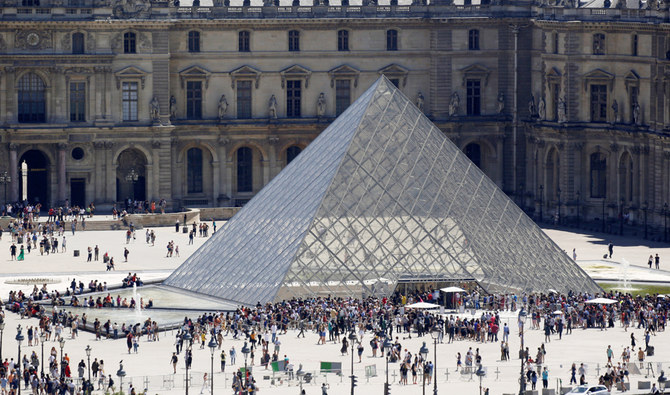
The Louvre, home of the “Mona Lisa” and other priceless artworks, closed after workers expressed fear of being contaminated by the stream of visitors from around the world. Staffers were also concerned about museum workers from Italy who had come to the Louvre to collect works by Leonardo da Vinci that were loaned for an exhibition.
The Louvre, the world’s most popular museum, received 9.6 million visitors last year, almost three-quarters of them from abroad.
“We are very worried because we have visitors from everywhere,” said Andre Sacristin, a Louvre employee and union representative. “The risk is very, very, very great.” While there are no known infections among the museum’s 2,300 workers, “it’s only a question of time,” he said.
The shutdown followed a government decision Saturday to ban indoor public gatherings of more than 5,000 people.
Among the frustrated visitors was Charles Lim from Singapore. He and his wife, Jeanette, chose Paris to celebrate their first wedding anniversary and bought tickets in advance for the Louvre.
“We waited for about three hours before giving up,” he said. “It was incredibly disappointing.”
China, where the outbreak began two months ago, on Sunday reported a slight uptick in new cases over the past 24 hours to 573, the first time in five days that the number exceeded 500. They remain almost entirely confined to the hardest-hit province of Hubei and its capital, Wuhan.
South Korea reported 210 additional cases and two more deaths, raising its totals to 3,736 cases and 20 fatalities. South Korea has the second-largest number of infections outside China, with most of the cases in the southeastern city of Daegu and nearby areas.
South Korea’s president used a speech marking the 101st anniversary of an anti-Japanese independence uprising to call for national unity to overcome the crisis.
Iran’s death toll climbed to 54 as the number of confirmed cases jumped overnight by more than half, to 978. The new figures represent 11 more deaths than reported on Saturday.
Around the world, many cases of the virus have been relatively mild, and some of those infected apparently show no symptoms at all.

Virus spreads to over 60 countries; France closes the Louvre
Short Url
https://arab.news/4g7db
Virus spreads to over 60 countries; France closes the Louvre
- Louvre management confirmed the museum was closed for the entire day, and said it would refund ticket-holders
- Workers met in the morning to discuss coronavirus fears
Trump says Iran ‘want to negotiate’ after reports of hundreds killed in protests
- US President Donald Trump said Sunday that Iran’s leadership had called him seeking “to negotiate” after he repeatedly threatened to intervene militarily if Tehran killed protesters
WASHINGTON: US President Donald Trump said Sunday that Iran’s leadership had called him seeking “to negotiate” after he repeatedly threatened to intervene militarily if Tehran killed protesters.
For two weeks, Iran has been rocked by a protest movement that has swelled in spite of a crackdown rights groups warn has become a “massacre.”
Initially sparked by anger over the rising cost of living, the demonstrations have evolved into a serious challenge of the theocratic system in place since the 1979 revolution.
Information has continued to trickle out of Iran despite a days-long Internet shutdown, with videos filtering out of capital Tehran and other cities over the past three nights showing large demonstrations.
As reports emerge of a growing protest death toll, and images show bodies piled outside a morgue, Trump said Tehran indicated its willingness to talk.
“The leaders of Iran called” yesterday, Trump told reporters aboard Air Force One, adding that “a meeting is being set up... They want to negotiate.”
He added, however, that “we may have to act before a meeting.”
The US-based Center for Human Rights in Iran (CHRI) said it had received “eyewitness accounts and credible reports indicating that hundreds of protesters have been killed across Iran during the current Internet shutdown.”
“A massacre is unfolding,” it said.
The Norway-based NGO Iran Human Rights (IHR) said it confirmed the killing of at least 192 protesters but that the actual toll could be much higher.
“Unverified reports indicate that at least several hundreds, and according to some sources, more than 2,000 people may have been killed,” said IHR.
More than 2,600 protesters have been arrested, IHR estimates.
A video circulating on Sunday showed dozens of bodies accumulating outside a morgue south of Tehran.
The footage, geolocated by AFP to Kahrizak, showed bodies wrapped in black bags, with what appeared to be grieving relatives searching for loved ones.
- Near paralysis -
In Tehran, an AFP journalist described a city in a state of near paralysis.
The price of meat has nearly doubled since the start of the protests, and many shops are closed. Those that do open must close at around 4:00 or 5:00 pm, when security forces deploy en masse.
There were fewer videos showing protests on social media Sunday, but it was not clear to what extent that was due to the Internet shutdown.
One widely shared video showed protesters again gathering in the Pounak district of Tehran shouting slogans in favor of the ousted monarchy.
The protests have become one of the biggest challenges to the rule of supreme leader Ayatollah Ali Khamenei, 86, coming in the wake of Israel’s 12-day war against the Islamic republic in June, which was backed by the United States.
State TV has aired images of burning buildings, including a mosque, as well as funeral processions for security personnel.
But after three days of mass actions, state outlets were at pains to present a picture of calm returning, broadcasting images of smooth-flowing traffic on Sunday. Tehran Governor Mohammad-Sadegh Motamedian insisted in televised comments that “the number of protests is decreasing.”
The Iranian government on Sunday declared three days of national mourning for “martyrs” including members of the security forces killed.
President Masoud Pezeshkian also urged Iranians to join a “national resistance march” Monday to denounce the violence.
In response to Trump’s repeated threats to intervene, Iran’s parliament speaker Mohammad Bagher Ghalibaf said Iran would hit back, calling US military and shipping “legitimate targets” in comments broadcast by state TV.
- ‘Stand with the people’ -
Reza Pahlavi, the US-based son of Iran’s ousted shah, who has emerged as an anti-government figurehead, said he was prepared to return to the country and lead a democratic transition.
“I’m already planning on that,” he told Fox News on Sunday.
He later urged Iran’s security forces and government workers to join the demonstrators.
“Employees of state institutions, as well as members of the armed and security forces, have a choice: stand with the people and become allies of the nation, or choose complicity with the murderers of the people,” he said in a social media post.
He also urged protesters to replace the flags outside of Iranian embassies.
“The time has come for them to be adorned with Iran’s national flag,” he said.
The ceremonial, pre-revolution flag has become an emblem of the global rallies that have mushroomed in support of Iran’s demonstrators.
In London, protesters managed over the weekend to swap out the Iranian embassy flag, hoisting in its place the tri-colored banner used under the last shah.
For two weeks, Iran has been rocked by a protest movement that has swelled in spite of a crackdown rights groups warn has become a “massacre.”
Initially sparked by anger over the rising cost of living, the demonstrations have evolved into a serious challenge of the theocratic system in place since the 1979 revolution.
Information has continued to trickle out of Iran despite a days-long Internet shutdown, with videos filtering out of capital Tehran and other cities over the past three nights showing large demonstrations.
As reports emerge of a growing protest death toll, and images show bodies piled outside a morgue, Trump said Tehran indicated its willingness to talk.
“The leaders of Iran called” yesterday, Trump told reporters aboard Air Force One, adding that “a meeting is being set up... They want to negotiate.”
He added, however, that “we may have to act before a meeting.”
The US-based Center for Human Rights in Iran (CHRI) said it had received “eyewitness accounts and credible reports indicating that hundreds of protesters have been killed across Iran during the current Internet shutdown.”
“A massacre is unfolding,” it said.
The Norway-based NGO Iran Human Rights (IHR) said it confirmed the killing of at least 192 protesters but that the actual toll could be much higher.
“Unverified reports indicate that at least several hundreds, and according to some sources, more than 2,000 people may have been killed,” said IHR.
More than 2,600 protesters have been arrested, IHR estimates.
A video circulating on Sunday showed dozens of bodies accumulating outside a morgue south of Tehran.
The footage, geolocated by AFP to Kahrizak, showed bodies wrapped in black bags, with what appeared to be grieving relatives searching for loved ones.
- Near paralysis -
In Tehran, an AFP journalist described a city in a state of near paralysis.
The price of meat has nearly doubled since the start of the protests, and many shops are closed. Those that do open must close at around 4:00 or 5:00 pm, when security forces deploy en masse.
There were fewer videos showing protests on social media Sunday, but it was not clear to what extent that was due to the Internet shutdown.
One widely shared video showed protesters again gathering in the Pounak district of Tehran shouting slogans in favor of the ousted monarchy.
The protests have become one of the biggest challenges to the rule of supreme leader Ayatollah Ali Khamenei, 86, coming in the wake of Israel’s 12-day war against the Islamic republic in June, which was backed by the United States.
State TV has aired images of burning buildings, including a mosque, as well as funeral processions for security personnel.
But after three days of mass actions, state outlets were at pains to present a picture of calm returning, broadcasting images of smooth-flowing traffic on Sunday. Tehran Governor Mohammad-Sadegh Motamedian insisted in televised comments that “the number of protests is decreasing.”
The Iranian government on Sunday declared three days of national mourning for “martyrs” including members of the security forces killed.
President Masoud Pezeshkian also urged Iranians to join a “national resistance march” Monday to denounce the violence.
In response to Trump’s repeated threats to intervene, Iran’s parliament speaker Mohammad Bagher Ghalibaf said Iran would hit back, calling US military and shipping “legitimate targets” in comments broadcast by state TV.
- ‘Stand with the people’ -
Reza Pahlavi, the US-based son of Iran’s ousted shah, who has emerged as an anti-government figurehead, said he was prepared to return to the country and lead a democratic transition.
“I’m already planning on that,” he told Fox News on Sunday.
He later urged Iran’s security forces and government workers to join the demonstrators.
“Employees of state institutions, as well as members of the armed and security forces, have a choice: stand with the people and become allies of the nation, or choose complicity with the murderers of the people,” he said in a social media post.
He also urged protesters to replace the flags outside of Iranian embassies.
“The time has come for them to be adorned with Iran’s national flag,” he said.
The ceremonial, pre-revolution flag has become an emblem of the global rallies that have mushroomed in support of Iran’s demonstrators.
In London, protesters managed over the weekend to swap out the Iranian embassy flag, hoisting in its place the tri-colored banner used under the last shah.
© 2026 SAUDI RESEARCH & PUBLISHING COMPANY, All Rights Reserved And subject to Terms of Use Agreement.


