

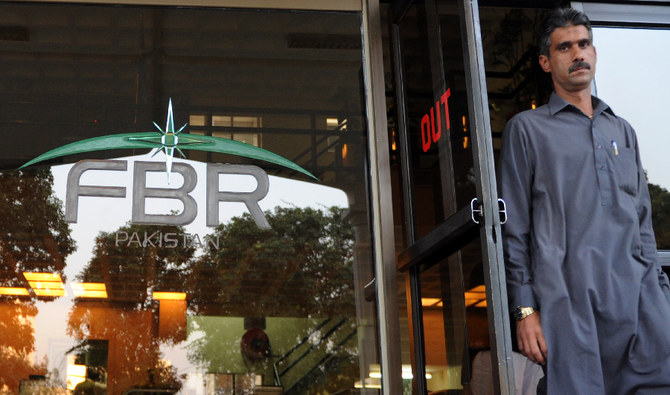

KARACHI: Pakistan’s tax-collecting agency, the Federal Board of Revenue (FBR) missed its IMF endorsed tax collection targets by a massive Rs. 483 billion for the first eight months of the year, despite collecting considerably higher taxes compared to the previous fiscal year.
According to provisional figures, the FBR has collected Rs. 2.7 trillion or 17 percent higher taxes in the current fiscal year between July to February, as it aims for an ambitious Rs. 5.2 trillion (roughly $36 billion) by the end of the fiscal year-- a figure that seems an impossible target for the struggling country, and one that FBR officials hope will be revised by the IMF.
“The situation is that if we push for more taxation [from the people] at this point, the economy will further deteriorate. We want to collect taxes on the income of people, not on their capital. With low growth, we don’t want to go for the original target of 41 percent taxes,” FBR spokesman, Dr. Hamid Ateeq Sarwar, told Arab News on Sunday and added that there was a huge overall increase in tax collection, with Rs. 320 billion collected in February alone.
For the current fiscal year (FY20), Pakistan had initially targeted a Rs. 5.5 trillion revenue target, which is 41 percent higher than previous years, but this had to be revised down to Rs 5.2 trillion after the first review of the country’s economic performance was made by the IMF. The country’s ambitious tax targets have been set under pressure for an IMF loan agreement.
In 2019, Pakistan was able to stave off a balance of payments crisis and secured a $6 billion bailout package from the IMF, agreeing to stringent loan conditions that focused on increased tax collection, which pushed up inflation to record highs. Since then, the country’s major source of revenue, imports, have sharply declined and economic growth has slowed down.
“If imports pick up around 10 percent, we would be touching the Rs. 5 trillion mark, but if they don’t pick up and the situation remains the same, the tax collection may be around Rs 4.7 or Rs 4.8 trillion,” the FBR spokesman said.
With the IMF having completed its second review of the country’s progress under the loan program, high ranking FBR officials say they hope the tax targets will be slashed once more. The IMF is expected to release its third tranche amount of $450 million next month.
Pakistan has a long history of setting higher revenue collection targets and then revising them.
“Since 1947, every year a target is fixed then revised downward and that also not achieved,” Abdullah Yousuf, former chairman of the FBR told Arab News.
Yousuf says big efforts are required to push for enhanced collection.
“It has to be done in a very, very exceptional manner,” he said.
Meanwhile, the tax-collecting agency has been struck with uncertainty for months in the absence of a permanent chairman, and amid a massive corruption scandal involving high-ranking officials that came to light earlier this year.


