

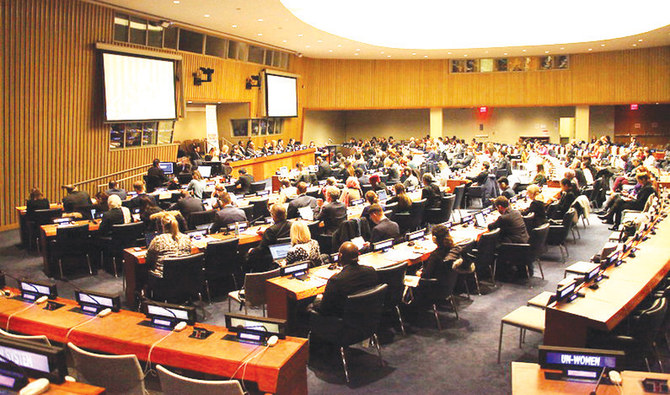
Saudi Green Building Forum participates in UN session

The 58th session of the UN Commission for Social Development (CSocD58) addressed affordable housing.
Short Url
Updated 01 March 2020
Follow

Saudi Green Building Forum participates in UN session

The Saudi Green Building Forum (SGBF) delegation concluded its attendance at the 58th session of the UN Commission for Social Development (CSocD58). The session addressed affordable housing and social protection systems to tackle global homelessness.
The CSocD58 is the first time that the UN Commission for Social Development has addressed homelessness within its agenda. Globally, there are 100 million homeless people and 1.5 billion people who live in inadequate housing. The UN member countries are working to solve this issue. SGBF is one of the few established Saudi Arabian NGOs in consultative status with the UN.
“SGBF supports the integration of affordable housing within urban developments, architectural design and use of materials that support the occupants’ well-being, and minimizing construction waste through efficient methods, including sustainable development goals,” said Faisal Al-Fadl, SGBF chair representative to the UN.

FASTFACT

Globally, there are 100 million homeless people and 1.5 billion people who live in inadequate housing.

SGBF’s mission focuses on the built environment and resilience of city development practices including energy, water, infrastructure, resources and human experience integrated within affordable housing developments in order to minimize negative impact on the planet and the health and happiness of citizens.
By 2050, two-thirds of the population are expected to live in urban areas. With this, homeless populations will likely continue to rise. Homelessness often affects women and girls the worst due to the violence and extreme poverty they experience. Older women are one of the fastest growing demographics in homelessness.
The SGBF was first initiated in 2010 and established in 2014. In 2017, the foundation became the first professional association body from Saudi Arabia in consultative status with the UN.


Washing water waste out of fashion

Updated 18 February 2026
Follow

Washing water waste out of fashion

Suat Ozsoy, vice president of commercial operations at Epson META-CW Asia, explores how the fashion industry can innovate and become more sustainable by reducing water consumption.

We have all had that perfect pair of jeans — the ones that fit just right, in the perfect color, and with a style that feels like it was made for us. But when you look a little closer, we might realize they are not as perfect as they seem. Why? Because it takes nearly 3,781 liters of water to make the average pair of jeans according to the World Economic Forum. That’s enough to fill around 50 baths.

The garment industry has grown up around waterways, which have provided the transportation, power for mills and water sources for production. But it has also led to pollution and huge water waste as per WWF’s report on ‘The Water Risks and Opportunities Facing Apparel and Textile Clusters’.

As the fashion industry continues to grow, the environmental cost of producing clothing is becoming an increasingly urgent issue. Reducing water consumption is essential to creating a more sustainable future for fashion.

Local initiatives and Vision 2030
The UAE, as a hub for innovation and sustainability in the Middle East, increasingly recognizes the need to address environmental challenges like water conservation. Under the framework of Vision 2030, the UAE government has prioritized sustainability, with significant investments in water management and innovative technologies to address water scarcity. The National Water Strategy 2036 aims to ensure the sustainable use of water resources, improving efficiency and reducing waste across various sectors, including textiles. With growing awareness of global water issues, local stakeholders are looking at cutting-edge solutions such as digital textile printing and sustainable manufacturing practices to minimize the ecological impact of industries such as fashion.

An XXXL sized problem
The textile industry has a heavy environmental footprint — both globally and in the Middle East. According to Tadweer Group, the UAE’s annual textile consumption stands at around 500 million items, of which approximately 210,000 tonnes end up as discarded material — up to 90 percent of which currently goes to landfill. This waste is especially significant for a region with ambitious sustainability goals and highlights the urgency for the textile and fashion industries to embrace redesign, recycling and more sustainable manufacturing methods.

Why all the water?
Water waste in clothing production begins with the raw materials. Most textiles are woven from cotton, which requires more water than any other crop. As per Florida State University’s research ‘Clothed in Conservation: Fashion & Water’, producing just 1 kg of raw cotton requires between 7,000 and 29,000 liters of water, whereas 1,827 liters of water are used to produce 1 kg of wheat and cereal grains only need 1,000 liters per kg. The manufacturing process also needs huge volumes of water. The cotton must be bleached, dyed, printed and rinsed. Dyed cotton requires up to 150 liters of water per kg according to the report ‘Why Does it Take So Much Water to Make a Cloth?’ by Decathlon Sustainability.What technology is available to reduce the huge waste associated with traditional analogue methods used in clothing manufacture?

Technology that is making an impact
The pre- and -post treatment of fabrics for printing is an area where new technology can significantly reduce water use. Epson’s Monna Lisa ML-13000 is an example of a modern digital printer that uses pigment ink, simplifying the whole process and reducing water use by up to 97 percent compared to traditional textile printing.

Digital textile printing also allows for on-demand production, removing unnecessary water and textile waste associated with traditional analogue processes that are not well-suited for low print volumes, resulting in over production. Digital printers are also compact in size and can help shorten supply chain processes, keeping production closer to where it is consumed.

Cutting waste in other ways
Epson’s digital printing is just one of the technologies that is helping the textile industry move toward more sustainable production. Another is Epson’s Dry Fiber Technology for textiles.

A prototype is in development that defibrates used clothing and mill ends into base fibers, which can be supplied for subsequent processes to create new non-woven materials. The defibering process is waterless, although moderate humidity is required. If used widely, this could help solve two of the industry’s major challenges: the huge volume of water needed for production and the current low volume of clothing recycling.

To highlight the possibilities of sustainable technology, renowned UAE-based fashion designer Michael Cinco collaborated with Epson during Arab Fashion Week 2023. Using Epson’s digital printing technology, Cinco was able to print intricate designs for his runway collection inspired by Gustav Klimt, showcasing the power of sustainable, high-quality textile printing. This collaboration underscores the growing importance of environmentally conscious practices in the fashion industry, especially in the UAE, where sustainability is becoming an increasingly integral part of the fashion landscape.

A change of mindset
Next time you choose a garment, think about the innovation behind it and envision a future where informed choices help drive responsible production and help protect our environment for the next generation.

To learn more about Epson’s innovation for the textile industry, visit: https://www.epson.ae/discover/sustainable-technologies