

Pakistani Umrah pilgrims to be compensated, says Saudi envoy

1 / 2
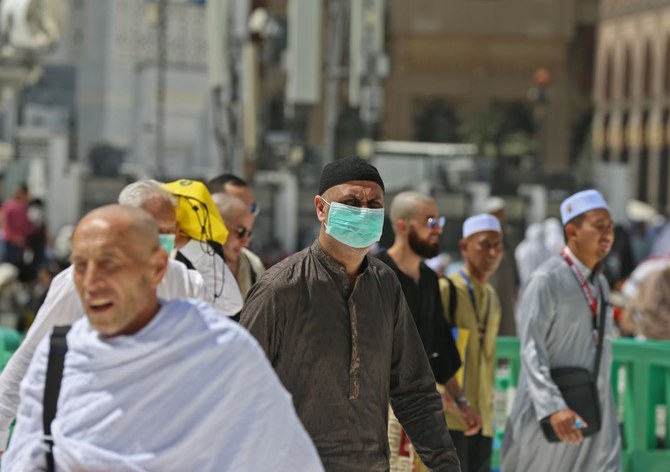
The decision to put a temporary halt will apply to electronic visas obtained online and traditional ones issued upon arrival in the Kingdom. (Photo/Social media)
2 / 2
All Pakistani Umrah pilgrims affected by the temporary travel ban to the Kingdom due to the threat of coronavirus will be compensated, the Saudi Ambassador to Pakistan said. (AFP)
Short Url
Updated 29 February 2020
Follow

Pakistani Umrah pilgrims to be compensated, says Saudi envoy

  • “Passengers who have Pakistan International Airlines (PIA) tickets will be able to get full refund from the PIA offices or their travel agents,” the airline’s spokesperson said
  • Saudi Arabia on Thursday placed a temporary ban on Umrah pilgrims to prevent the spread of coronavirus

ISLAMABAD: All Pakistani Umrah pilgrims affected by the temporary travel ban to the Kingdom due to the threat of coronavirus will be compensated, the Saudi Ambassador to Pakistan Nawaf bin Said Al-Malki said on Friday.

“Pakistani Umrah pilgrims who had to travel to Saudi Arabia during the dates of suspension will be compensated in the best possible way,” Al-Malki told Arab News on Friday. “They will be able to travel on the same visa or will be issued a fresh one free of charge.”
Saudi Arabia on Thursday placed a temporary ban on Umrah pilgrims to prevent the spread of coronavirus.
“Passengers who have Pakistan International Airlines (PIA) tickets will be able to get full refund from the PIA offices or their travel agents,” the airline’s spokesperson Abdullah Hafeez Khan told Arab News, adding that it was up to the passengers if they wanted to avail the refund option or get their seats readjusted after the ban.
Meanwhile, Saudi airlines also announced full refund of tickets through a circular.
“The Pakistani mission in Saudi Arabia is in touch with the Saudi authorities on this issue and will take all possible measures to facilitate Pakistani pilgrims,” Arshad Munir, spokesperson for the Pakistani Embassy in Saudi Arabia, told Arab News.
Faizan Akhtar, a member of Pakistan’s Umrah Travel Agents’ Association, said that the situation would become clear in the next few days, but all the passengers would get refunds or manage to travel on the same Umrah package after the ban.
“There was a previous incident of flight suspension during the Pakistani-Indian standoff last year which disturbed Umrah pilgrims. They were compensated by the Saudi authorities, who extended their visas without extra charges and airlines adjusted their seats accordingly. We haven’t received any official communication on this so far, but the situation will become clear in the next few days,” Akhtar said.
Earlier, the Ministry of Tourism announced that for the time being the Kingdom would no longer be approving passes for travelers from China, Italy, Korea, Japan, Malaysia, Singapore and Kazakhstan.
The decision will apply to electronic visas obtained online and traditional ones issued upon arrival in the Kingdom. In addition, tourist visas already issued to residents of the listed countries will be temporarily suspended.

FASTFACT

The Ministry of Tourism announced that for the time being the Kingdom would no longer be approving passes for travelers from China, Italy, Korea, Japan, Malaysia, Singapore and Kazakhstan.

Visas will still be available for citizens of other qualifying countries not on the list, but as a precaution they will not be allowed to visit the holy cities of Makkah or Madinah.
The ministry said that people in countries not eligible for electronic visas could check their Saudi travel status by calling the helpline 00966920000890. Residents of the US, the UK and Schengen nations could use the same number to inquire about obtaining a tourist visa.
Appreciation
The Muslim World League (MWL) has given its full support to the temporary precautionary measures taken by the Kingdom to ban foreign worshippers from entering the country before the annual Hajj pilgrimage, in line with international efforts to stop the spread of the killer virus.
MWL Secretary-General Dr. Mohammed bin Abdulkarim Al-Issa said that the preventive measures were temporary and fell within the legitimate duty stipulated by Shariah law, stressing the importance of complying with international standards in this regard.
“The resolution stresses the Kingdom’s concern over the safety of pilgrims and visitors from the risk of spreading the disease and any leniency entails a great responsibility,” he added.
Arab League Secretary-General Ahmed Aboul Gheit said that the action taken by Saudi Arabia would contribute to limiting the spread of the coronavirus in crowded places such as the Two Holy Mosques.
The Islamic Call Center for Latin America and the Caribbean States described the Kingdom’s preventive measures as “wise” and “in the public interest,” while Egypt’s Al-Azhar said: “These measures are permissible, legitimate and rewarded. Rather, they are a legal duty to protect people.”
The World Health Organization noted that the Kingdom’s moves would enable Saudi Arabia to implement sustainable measures to prevent and control the virus and protect crowds during this important season.


Moscow made an offer to France regarding a French citizen imprisoned in Russia, says Kremlin

Updated 26 December 2025
Follow

Moscow made an offer to France regarding a French citizen imprisoned in Russia, says Kremlin

  • Laurent Vinatier, an adviser for Swiss-based adviser Center for Humanitarian Dialogue, Vinatier was arrested in Moscow in June 2024
  • He is accused of failing to register as a “foreign agent” while collecting information about Russia’s “military and military-technical activities” 

The Kremlin on Thursday said it was in contact with the French authorities over the fate of a French political scholar serving a three-year sentence in Russia and reportedly facing new charges of espionage.
Kremlin spokesman Dmitry Peskov told reporters that Russia has made “an offer to the French” regarding Laurent Vinatier, arrested in Moscow last year and convicted of collecting military information, and that “the ball is now in France’s court.” He refused to provide details, citing the sensitivity of the matter.
French President Emmanuel Macron is following Vinatier’s situation closely, his office said in a statement. French Foreign Ministry spokesperson Pascal Confavreux said Thursday that all government services are fully mobilized to pay provide consular support to Vinatier and push for his liberation as soon as possible.
Peskov’s remarks come after journalist Jérôme Garro of the French TF1 TV channel asked President Vladimir Putin during his annual news conference on Dec. 19 whether Vinatier’s family could hope for a presidential pardon or his release in a prisoner exchange. Putin said he knew “nothing” about the case, but promised to look into it.
Vinatier was arrested in Moscow in June 2024. Russian authorities accused him of failing to register as a “foreign agent” while collecting information about Russia’s “military and military-technical activities” that could be used to the detriment of national security. The charges carry a maximum penalty of five years in prison.
The arrest came as tensions flared between Moscow and Paris following French President Emmanuel Macron’s comments about the possibility of deploying French troops in Ukraine.
Vinatier’s lawyers asked the court to sentence him to a fine, but the judge in October 2024 handed him a three-year prison term — a sentence described as “extremely severe” by France’s Foreign Ministry, which called for the scholar’s immediate release.
Detentions on charges of spying and collecting sensitive data have become increasingly frequent in Russia and its heavily politicized legal system since Moscow invaded Ukraine in February 2022.
In addition to criticizing his sentence, the French Foreign Ministry urged the abolition of Russia’s laws on foreign agents, which subject those carrying the label to additional government scrutiny and numerous restrictions. Violations can result in criminal prosecution. The ministry said the legislation “contributes to a systematic violation of fundamental freedoms in Russia, like the freedom of association, the freedom of opinion and the freedom of expression.”
Vinatier is an adviser for the Center for Humanitarian Dialogue, a Switzerland-based nongovernmental organization, which said in June 2024 that it was doing “everything possible to assist” him.
While asking the judge for clemency ahead of the verdict, Vinatier pointed to his two children and his elderly parents he has to take care of.
The charges against Vinatier relate to a law that requires anyone collecting information on military issues to register with authorities as a foreign agent.
Human rights activists have criticized the law and other recent legislation as part of a Kremlin crackdown on independent media and political activists intended to stifle criticism of the war in Ukraine.
In August 2025, Russian state news agency Tass reported that Vinatier was also charged with espionage, citing court records but giving no details. Those convicted of espionage in Russia face between 10 and 20 years in prison.
Russia in recent years has arrested a number of foreigners — mainly US citizens — on various criminal charges and then released them in prisoner swaps with the United States and other Western nations. The largest exchange since the Cold War took place in August 2024, when Moscow freed journalists Evan Gershkovich and Alsu Kurmasheva, fellow American Paul Whelan, and Russian dissidents in a multinational deal that set two dozen people free.