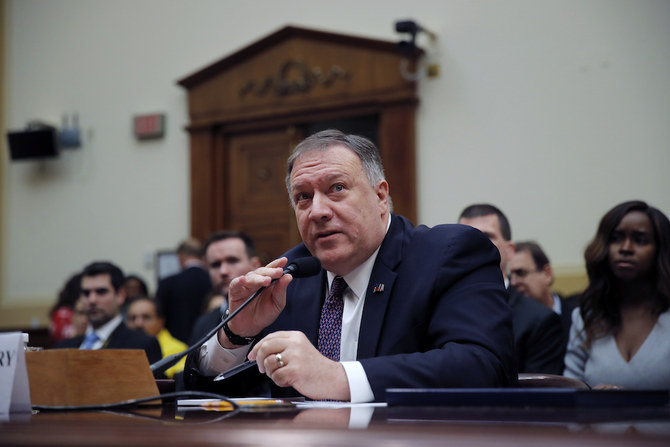
WASHINGTON: US Secretary of State Mike Pompeo said on Friday the United States has offered to help with the coronavirus response in Iran, where the outbreak has killed 34 people, and raised doubts about Tehran’s willingness to share information.
“We have made offers to the Islamic Republic of Iran to help,” Pompeo said in a hearing at House Foreign Affairs Committee. “Their health care infrastructure is not robust and to date, their willingness to share information about what’s really going on inside...Iran has not been robust and I am very concerned that....it is Iran that is not sharing information.”
The new coronavirus which emerged in Wuhan, China, in December has infected tens of thousands of people.
The Islamic Republic is the only country in the Gulf region that has reported deaths from the coronavirus, which has spread from China.
Pompeo also warned Iran not to scuttle an upcoming agreement with the Taliban, accusing the US adversary of seeking to be a “spoiler.”
Pompeo confirmed that a one-week partial truce was holding with the Taliban, who are scheduled to sign the landmark accord with the United States on Saturday.
“There is a history of Iran engaging in activity inside of Afghanistan to act as a spoiler,” Pompeo told the committee.
“We’ve seen just these last six days a significant reduction in violence in Afghanistan and we are watching closely to see if the Islamic Republic of Iran begins to take even more active measure that undermine our efforts at peace and reconciliation,” he said.
He warned that Iran could increase risks for US troops, whose numbers are expected to be sharply scaled down under the Doha agreement.
Iran’s Shiite clerical regime has been historically opposed to the Taliban, which practices an austere form of Sunni Islam, and quietly backed the 2001 US-led invasion that toppled the Taliban regime.
Iran was part of a coalition that backed the anti-Taliban Northern Alliance and in 1998 amassed troops near the Afghan border after a Taliban assault on Iran’s consulate in Herat.
But Iran has increasingly been involved in proxy conflicts with the United States elsewhere, notably in Iraq.
Iran has been mostly cautious in its recent comments on Afghanistan.
But Foreign Minister Javad Zarif last year criticized the US talks with the Taliban, saying they only boosted the extremists and alienated the internationally backed government.
(With Reuters and AFP)


![]()

Pompeo says US offered to help Iran with coronavirus response
Short Url
https://arab.news/5nd46
Pompeo says US offered to help Iran with coronavirus response
- The hearing meant to focus on Trump administration's dealings with Iran and Iraq, but centered on the coronavirus
- Washington is watching to see if Iran may seek to play a spoiler role in Afghanistan


Latest updates



© 2026 SAUDI RESEARCH & PUBLISHING COMPANY, All Rights Reserved And subject to Terms of Use Agreement.