

OIC condemns violence against Muslims in India

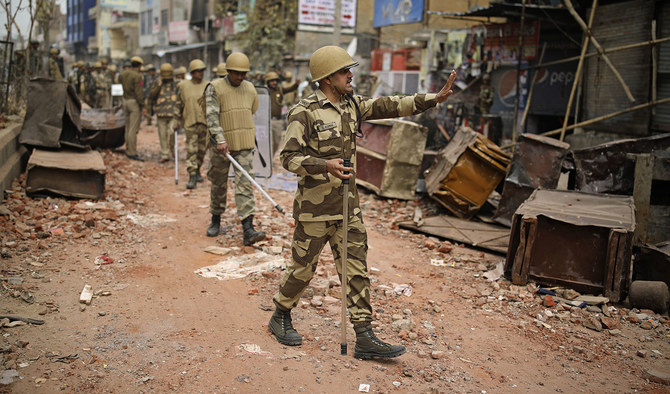
An Indian paramilitary soldier asks residents to stay indoors as they patrol a street vandalized in Tuesday's violence in New Delhi on Feb. 27, 2020. (AP)
Short Url
Updated 27 February 2020
Follow

OIC condemns violence against Muslims in India

  • The inter-governmental organization calls on Indian authorities to ensure safety of all Muslim citizens
  • Pakistan welcomes the OIC condemnation of communal violence against Indian Muslims

ISLAMABAD: The Organization of Islamic Cooperation (OIC) on Thursday condemned anti-Muslim violence in India, asking the administration in New Delhi to bring the extremist Hindus perpetrating such extremist acts to justice.

“OIC condemns the recent and alarming violence against Muslims in India, resulting in the death and injury of innocent people and the arson and vandalism of mosques and Muslim-owned properties. It expresses its sincere condolences to the families of the victims of these heinous acts,” the OIC said in a Twitter post while calling on the Indian government to protect Muslim minorities across the country.

“The OIC calls on Indian authorities to bring the instigators and perpetrators of these acts of anti-Muslim violence to justice and to ensure the safety and security of all its Muslim citizens and the protection of Islamic holy places across the country,” said the tweet.

India has witnessed intense violence since the country passed the Citizenship Amendment Act (CAA) last December which was widely viewed as anti-Muslim. More than 30 people have been killed so far in the deadliest violence the Indian capital, New Delhi, has experienced in several decades.

“We welcome the response and concern shown by the OIC on communal violence against Muslims in India,” Pakistan’s foreign office spokesperson Aisha Farooqui told Arab News on Thursday.
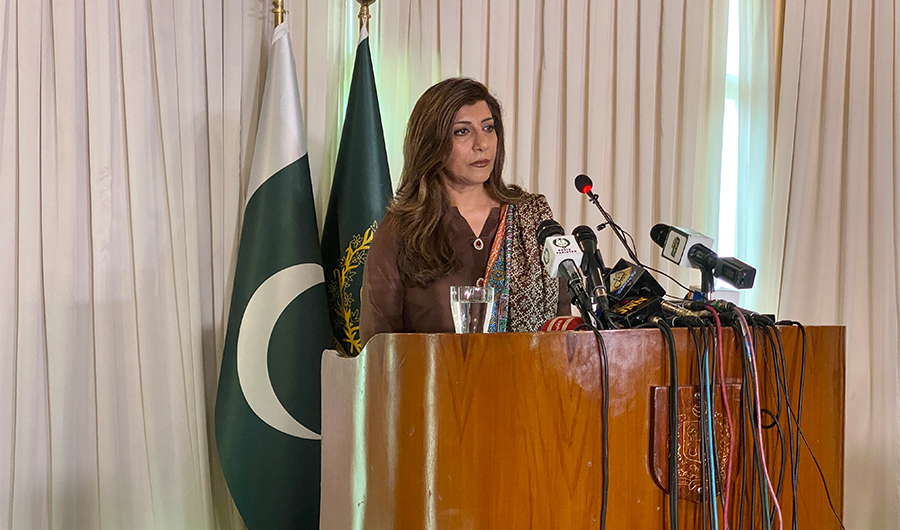


Pakistan’s Foreign Office Spokesperson Aisha Farooqui is addressing a weekly media briefing in Islamabad on Feb. 27, 2020. (AN Photo)

She demanded further deliberations on the matter by the biggest inter-governmental body of Muslim countries.

“The OIC should take up this issue and talk about it since more than 30 people have died and over 200 have been injured in the violence. This is the worst form of communal violence and Islamophobia in India. This is a matter of great concern for us and should also be a matter of grave concern for the entire Muslim world,” Farooqui said, acknowledging that the OIC had played a consistent, clear and positive role on Kashmir through its contact group for the last many decades.

“Pakistan is very concerned about the reports of vandalizing Muslim community’s homes and shops, and the desecration of their mosques. Our leadership and the international community at large have also expressed concern over the situation,” Farooqui said.

She said the people of Kashmir had suffered state oppression for decades at the hands of Indian authorities, and now that violence had also reached New Delhi.

“What is happening in India, especially during the last two weeks, is a continuation of an extremist and majoritarian mindset that proposes discriminatory policies toward minorities. This is the pattern we have witnessed in India for the last few years. The state oppression through which Kashmiris were suffering in the occupied territory has now found its way into the Indian capital,” Farooqui said.


Pakistan launches first skills impact bond to fund training with private capital

Updated 8 sec ago
Follow

Pakistan launches first skills impact bond to fund training with private capital

  • New $3.57 million pilot ties investor returns to job placement and retention outcomes
  • The program aims to upskill youth at scale, with 40 percent of trainees targeted to be women

KARACHI: Pakistan on Tuesday launched its first-ever Pakistan Skills Impact Bond (PSIB), a private-capital-funded instrument aimed at financing technical training by linking investor repayments to measurable employment outcomes, as the government seeks new ways to upskill its rapidly growing workforce without relying solely on public spending.

The Rs 1 billion ($3.57 million) pilot tranche, backed by a government guarantee, is part of a three-year program designed to fund skills training through an outcome-based model, under which investors are repaid only if trainees achieve results such as certification, job placement and at least six months of employment retention.

Social impact bonds are a form of results-based financing in which private investors provide upfront capital for social programs, while governments or donors repay them only if agreed performance targets are met. Pakistan’s skills bond is intended to shift training finance away from traditional input-based budgets toward a market-oriented approach that rewards verified outcomes and crowds in private investment.

“Speaking at the event, Senator Muhammad Aurangzeb, Federal Minister for Finance and Revenue, underscored the transformational importance of the PSIB in Pakistan’s broader economic reform agenda and human capital strategy,” the finance division said in a statement. “He described the day as ‘an important moment focused on education and training,’ reiterating that Pakistan’s demographic dividend can only be realized if the country succeeds in upskilling and reskilling its youth at scale.”

The program is anchored in collaboration with the National Vocational and Technical Training Commission (NAVTTC) and is expected to evolve over time, with later tranches potentially linking repayments to a small share of trainees’ future earnings, a move officials say could help make the model financially self-sustaining.

The bond forms part of a broader government push to adopt social impact financing across priority areas including education, gender equality, health, climate resilience and poverty reduction, the statement said.

“Highlighting gender inclusion as central to the program design, the Finance Minister welcomed the recommendation led by the British Asian Trust that 40 percent of trainees under the PSIB be women, acknowledging that women’s participation and leadership in the workforce will play a decisive role in shaping Pakistan’s economic trajectory,” it added.

The Ministry of Finance has provided the initial guarantee to help establish credibility and attract investors, but has stressed the support is limited to the pilot phase.

The government has noted the model is intended to support Pakistan’s large youth population by aligning training with labor market demand, including high-value digital skills, while reducing long-term pressure on public finances.

The launch ceremony was attended by senior government officials, development partners, private sector representatives and international organizations involved in structuring and financing the bond.