

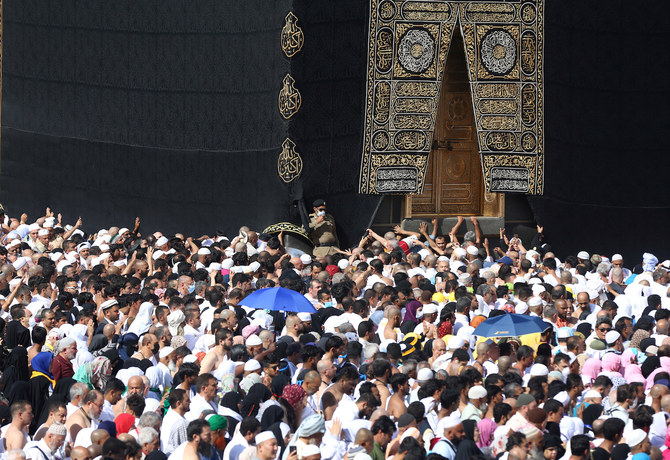
Saudi Arabia suspends entry for Umrah pilgrimage over coronavirus fears

A police officer wears a face mask to prevent contracting coronavirus as Muslim pilgrims pray near the Kaaba in the Grand mosque in Makkah, Saudi Arabia on Feb. 27, 2020. (Reuters)
Short Url
Updated 28 February 2020
Follow

Saudi Arabia suspends entry for Umrah pilgrimage over coronavirus fears

  • Emirates will not allow Umrah pilgrims or tourists from nearly two dozen countries to fly to the Kingdom
  • Health ministry says no confirmed cases of coronavirus in the Kingdom

RIYADH: Saudi Arabia has placed a temporary ban on Umrah pilgrims in an attempt to ensure public safety by preventing the spread of the coronavirus.

Most foreign pilgrims often visit the Prophet’s Mosque in Madinah before or after the completion of their religious duties in Makkah, this has also been halted.

It is one of a number of precautionary restrictions announced early on Thursday as health authorities in the Kingdom closely monitor the spread of the virus. Tourist-visa holders from countries judged to pose a particularly high risk of spreading the virus will also be denied entry.

The Saudi health ministry said again on Thursday that there were ‘no known cases’ in the Kingdom.

Meanwhile, the Organization of Islamic Cooperation said it supports Saudi Arabia’s actions to protect pilgrims and visitors from coronavirus.

The Egyptian Dar Al-Iftaa also said Saudi Arabia’s decision to temporarily suspend Umrah visas over the coronavirus outbreak was in accordance with Sharia law.

The suspension of Umrah visas due to the coronavirus outbreak preserves the lives of pilgrims, it said.

Indonesia on Thusday said they asked the Kingdom to allow its citizens to continue their Umrah pilgrimage, with hundreds of pilgrims stranded at Jakarta airport following the temporary ban.

Later in the day, Dubai's Emirates said it would no longer carry to Saudi Arabia passengers with Umrah pilgrimage visas or tourists from nearly two dozen countries starting Thursday, until further notice.

In addition, Saudi nationals and citizens of Gulf Cooperation Council nations will not be able to use a national identity card to travel to and from the Kingdom for the time being. Exceptions to this shall be granted to Saudis returning home, and citizens of GCC countries who are in the Kingdom and want to return to their home countries, provided that they left or entered the Kingdom using a national identity card.

Health authorities at entry points will verify which countries travelers visited before arriving in Saudi Arabia and apply all necessary precautionary measures.

Saudi officials stressed that the restrictions are temporary and will be continuously reviewed by the health authorities. They reiterated the Kingdom’s support for and implementation of international efforts to limit the spread of the virus, and the Foreign Ministry urged citizens not to travel to the countries worst affected by the coronavirus.

Opinion

This section contains relevant reference points, placed in (Opinion field)

Nearly 7 million Umrah pilgrims visit the Kingdom each year, the majority of whom arrive at airports in Jeddah and Madinah.

Earlier, it emerged that seven Saudis are among the latest coronavirus cases in Bahrain and Kuwait. The Bahraini Ministry of Health on Wednesday said six Saudi women has tested positive for the virus.

They had arrived at Bahrain International Airport on a flight from Iran. The total number of confirmed cases in the country stands at 26. Studies at schools and universities have been suspended for two weeks in an effort to limit the spread of the virus.

Kuwait announced the first case of a Saudi citizen infected by the virus. The man, who had arrived in the country from the Iranian city of Mashhad, has been placed in quarantine for 14 days. There have been 26 confirmed cases of the virus to date in Kuwait.

The Saudi Ministry of Health has been providing neighboring Arab countries with advice and guidelines for controlling infectious diseases such as the coronavirus and dealing with health emergencies.

Dr. Hani bin Abdul Aziz Jokhdar, the deputy minister of public health, said that the guidelines were based on Saudi Arabia’s experience of protecting the health and well-being of pilgrims during Hajj season.

He led the Kingdom’s delegation at a meeting of the Executive Office of the Council of Arab Ministers for Health on Wednesday at the Arab League headquarters in Cairo.


National program identifies 165 native plants for afforestation efforts in Asir

Updated 29 December 2025
Follow

National program identifies 165 native plants for afforestation efforts in Asir

  • The survey is part of broader plans focused on restoring degraded land, using native vegetation 

JEDDAH: Saudi Arabia’s National Afforestation Program has identified more than 165 species of native plants suitable for afforestation in the Asir region, highlighting the ecological diversity of one of the Kingdom’s most environmentally varied areas, the Saudi Press Agency reported.

The findings form part of broader national efforts to expand vegetation cover, address land degradation, and support sustainability goals linked to the Saudi Green Initiative and Vision 2030.

According to the program, the identified species are distributed across a wide range of natural environments in Asir, including mountainous terrain, highlands, slopes, valleys, plains, rocky landscapes, and coastal areas stretching from the Red Sea to Tihama.

The species belong to numerous plant families, including Fabaceae, Anacardiaceae, Burseraceae, Capparaceae, Ebenaceae, Euphorbiaceae, Malvaceae, Myrtaceae, Oleaceae, and Primulaceae, among others.

Plants suitable for afforestation range from large and small trees to perennial and annual shrubs, herbs, succulents, bulbs, and climbing plants. 

Among the most notable species identified are the grey mangrove, mastic tree, mooring or ben tree, juniper, sycamore fig, wild olive, henna, wild jasmine, hawthorn, and arak.

The Saudi Arabian Botanical Society described the announcement as an important step in protecting plant diversity and strengthening the ecosystem conservation in the Kingdom. 

Munirah bin Hamad Al-Hazani, founder and president of the society, said that prioritizing native species is central to sustainable afforestation.

“Focusing on the cultivation of native plants adapted to diverse environments forms the cornerstone of sustainable afforestation projects, as it plays a pivotal role in enhancing vegetation cover, combating land degradation, and conserving natural and financial resources,” she told Arab News.

Al-Hazani added that long-term success depends on cooperation between government bodies and the nonprofit sector, alongside community involvement and environmental awareness programs.

The National Afforestation Program has increasingly emphasized community participation, working with government agencies, private companies, and nonprofit organizations to support planting initiatives and environmental education. Its approach includes promoting volunteerism and discouraging harmful environmental practices, while focusing on the use of native plants adapted to local conditions.

Parallel efforts are underway in other regions of the Kingdom to support vegetation restoration through research and infrastructure development. In Jouf, often referred to as the Kingdom’s food basket, the King Salman bin Abdulaziz Royal Reserve Development Authority has established a Central Nursery and a Wild Seeds Research and Production Station to address the growing demand for reliable sources of native seeds and seedlings.

The project was launched in 2023 under the directive of Prince Abdulaziz bin Saud bin Naif, the minister of interior and chairman of the authority’s board of directors. 

Since then, the facilities has become a key component of vegetation restoration efforts within the reserve.

The authority has focused on building operational capacity by recruiting and training specialists to manage cultivation and research activities. The research and production station includes 14 mother-seed production fields containing over 400,000 trees and shrubs. 

Planting began in late 2024, with more than 30 native plant species represented, selected for their role in the reserve’s natural ecosystem. 

The facility also includes two seed storage units with a combined capacity of 3,000 kilograms. Seeds are collected annually from multiple sites within the reserve and used for seedling production habitat rehabilitation.

The Central Nursery spans 6,000 square meters and includes 30 greenhouses spanning 1,500 square meters, as well as two shade houses used during summer months. A plant hardening facility, designed to prepare seedlings for natural environmental conditions, covers 10,000 square meters and is divided into seven sections. The nursery’s annual production capacity reaches 1.5 million seedlings, representing more than 15 native plant species. 

Together, these initiatives underscore the growing role of native plant research and propagation in Saudi Arabia’s afforestation strategy, particularly as the Kingdom works to balance environmental restoration with long-term sustainability goals.