

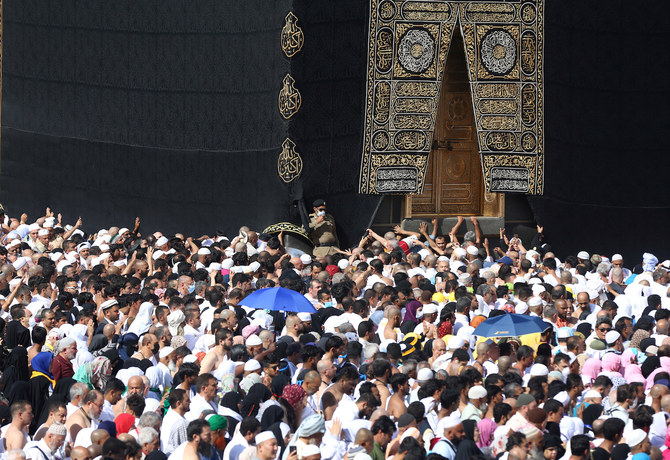
Saudi Arabia suspends entry for Umrah pilgrimage over coronavirus fears

A police officer wears a face mask to prevent contracting coronavirus as Muslim pilgrims pray near the Kaaba in the Grand mosque in Makkah, Saudi Arabia on Feb. 27, 2020. (Reuters)
Short Url
Updated 28 February 2020
Follow

Saudi Arabia suspends entry for Umrah pilgrimage over coronavirus fears

  • Emirates will not allow Umrah pilgrims or tourists from nearly two dozen countries to fly to the Kingdom
  • Health ministry says no confirmed cases of coronavirus in the Kingdom

RIYADH: Saudi Arabia has placed a temporary ban on Umrah pilgrims in an attempt to ensure public safety by preventing the spread of the coronavirus.

Most foreign pilgrims often visit the Prophet’s Mosque in Madinah before or after the completion of their religious duties in Makkah, this has also been halted.

It is one of a number of precautionary restrictions announced early on Thursday as health authorities in the Kingdom closely monitor the spread of the virus. Tourist-visa holders from countries judged to pose a particularly high risk of spreading the virus will also be denied entry.

The Saudi health ministry said again on Thursday that there were ‘no known cases’ in the Kingdom.

Meanwhile, the Organization of Islamic Cooperation said it supports Saudi Arabia’s actions to protect pilgrims and visitors from coronavirus.

The Egyptian Dar Al-Iftaa also said Saudi Arabia’s decision to temporarily suspend Umrah visas over the coronavirus outbreak was in accordance with Sharia law.

The suspension of Umrah visas due to the coronavirus outbreak preserves the lives of pilgrims, it said.

Indonesia on Thusday said they asked the Kingdom to allow its citizens to continue their Umrah pilgrimage, with hundreds of pilgrims stranded at Jakarta airport following the temporary ban.

Later in the day, Dubai's Emirates said it would no longer carry to Saudi Arabia passengers with Umrah pilgrimage visas or tourists from nearly two dozen countries starting Thursday, until further notice.

In addition, Saudi nationals and citizens of Gulf Cooperation Council nations will not be able to use a national identity card to travel to and from the Kingdom for the time being. Exceptions to this shall be granted to Saudis returning home, and citizens of GCC countries who are in the Kingdom and want to return to their home countries, provided that they left or entered the Kingdom using a national identity card.

Health authorities at entry points will verify which countries travelers visited before arriving in Saudi Arabia and apply all necessary precautionary measures.

Saudi officials stressed that the restrictions are temporary and will be continuously reviewed by the health authorities. They reiterated the Kingdom’s support for and implementation of international efforts to limit the spread of the virus, and the Foreign Ministry urged citizens not to travel to the countries worst affected by the coronavirus.

Opinion

This section contains relevant reference points, placed in (Opinion field)

Nearly 7 million Umrah pilgrims visit the Kingdom each year, the majority of whom arrive at airports in Jeddah and Madinah.

Earlier, it emerged that seven Saudis are among the latest coronavirus cases in Bahrain and Kuwait. The Bahraini Ministry of Health on Wednesday said six Saudi women has tested positive for the virus.

They had arrived at Bahrain International Airport on a flight from Iran. The total number of confirmed cases in the country stands at 26. Studies at schools and universities have been suspended for two weeks in an effort to limit the spread of the virus.

Kuwait announced the first case of a Saudi citizen infected by the virus. The man, who had arrived in the country from the Iranian city of Mashhad, has been placed in quarantine for 14 days. There have been 26 confirmed cases of the virus to date in Kuwait.

The Saudi Ministry of Health has been providing neighboring Arab countries with advice and guidelines for controlling infectious diseases such as the coronavirus and dealing with health emergencies.

Dr. Hani bin Abdul Aziz Jokhdar, the deputy minister of public health, said that the guidelines were based on Saudi Arabia’s experience of protecting the health and well-being of pilgrims during Hajj season.

He led the Kingdom’s delegation at a meeting of the Executive Office of the Council of Arab Ministers for Health on Wednesday at the Arab League headquarters in Cairo.


Outdoor festival brings new energy to Ithra

Updated 11 sec ago
Follow

Outdoor festival brings new energy to Ithra

  • Inaugural Food Festival offers workshops and diverse cuisine with a relaxed vibe

DHAHRAN: The King Abdulaziz Center for World Culture, or Ithra, launched its inaugural outdoor Food Festival on Monday, turning part of its grounds into a lively culinary space in view of the iconic building. 

Music, laughter and the smell of cooking fill the area, guiding visitors toward the festival site. 

Music, laughter and the smell of cooking guide visitors toward the Food Festival site organized by Ithra. (AN photo)

The festival program includes four specialized cooking workshops — taco, pizza, steak and sushi — each running for three days and powered by Filmmaster. While registration is required to participate, visitors can watch the chefs prepare dishes in the open-air kitchen.

Beyond the workshops, visitors can explore 10 food stations offering a range of cuisines, including Saudi, Indian, Egyptian, Mexican, Japanese and Lebanese.

HIGHLIGHTS

• The Food Festival program includes four specialized cooking workshops — taco, pizza, steak and sushi — each running for three days and powered by Filmmaster.

• While registration is required to participate, visitors can watch the chefs prepare dishes in the open-air kitchen

One such booth is Whoa Tea & Desserts, which was bubbling with excitement on opening night. Its founder, Liu Yang, who also goes by the name of Edwin, told Arab News why his business chose to participate.

Music, laughter and the smell of cooking guide visitors toward the Food Festival site organized by Ithra. (AN photo)

“I found the Saudi market is very good and they have so many young people here, so me and my two friends we decided to resign and we started a business here targeting the young people,” he told Arab News.

The Chinese entrepreneur has now lived in Saudi Arabia for more than four years, spending the first half of that time working for a Chinese company before deciding to branch out.

Music, laughter and the smell of cooking guide visitors toward the Food Festival site organized by Ithra. (AN photo)

The company brought their own brand of Chinese milk tea, fruity and matcha drinks as well as an assortment of snacks, and even board games, to their shop.

“Now we, in two years, have more than 10 branches in Riyadh and we decided to come to Alkhobar, so soon we will have three shops here which will open in the Eastern Province; one at the end of January and two in February,” he added.

Music, laughter and the smell of cooking guide visitors toward the Food Festival site organized by Ithra. (AN photo)

Since they are opening locally next month, the festival was the perfect way to introduce their products for customers to sample.

Ekin, who moved to Saudi Arabia last year from the US, told Arab News why she chose to bring her family, which included two young children under 10, to the festival.

“We are members at Ithra, we love Ithra. So that is why we trusted that this event was going to be a success,” she told Arab News.

“This is the perfect weather — I love the outdoors eating option. It’s also spacious; there are picnic tables. I think the variety makes it even better because you don’t have to wait in the line for a long time to just grab food,” she said.

The festival is set to end on Jan. 3.