US targets Iranian-backed Kataib Hezbollah militia active in Iraq

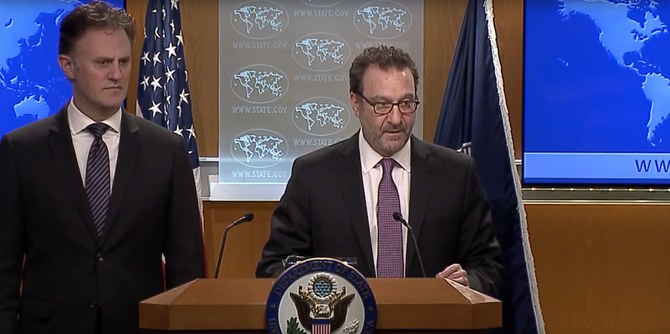
The US on Wednesday blacklisted a senior member of Iranian-backed Kataib Hezbollah militia, punishing it for its attacks targeting US forces. (Screenshot/YouTube)
Short Url
Updated 27 February 2020
Follow

US targets Iranian-backed Kataib Hezbollah militia active in Iraq

  • US State Department said it has designated Ahmad Al-Hamidawi as a Specially Designated Global Terrorist
  • Washington blames groups for regular rocketing and shelling of bases hosting US forces

WASHINGTON: The US on Wednesday blacklisted a senior member of Iranian-backed Kataib Hezbollah militia, punishing it for its attacks targeting US forces, most recently for killing an American contractor in an Iraqi military base near the northern city of Kirkuk.

The US State Department said it has designated Ahmad Al-Hamidawi as a Specially Designated Global Terrorist (SDGT), Secretary General of Kataib Hezbollah (KH), an Iran-backed terrorist group active in Iraq and Syria, which Washington designated as terrorist organization in 2009.

------

RELATED: US targets individuals, entities linked to Lebanon's Martyrs Foundation

------

"The Kataib Hezbollah group continues to present a threat to U.S. forces in Iraq," Nathan Sales, the State Department's counterterrorism coordinator, said at a news briefing. "We're adding to the pressure that has existed on this group for a decade."

Washington has blamed Iran-backed paramilitary groups for increasingly regular rocketing and shelling of bases hosting US forces in Iraq and of the area around the US Embassy in Baghdad.

An attack last month hit the US Embassy compound itself, and a rocket attack on a military base in the north in December killed a US civilian contractor. This triggered a string of events resulting in with the US killing the top Iranian commander Qassem Soleimani and Iraqi paramilitary chief Abu Mahdi al-Muhandis in a drone strike in Baghdad last month.


Arab and Islamic states reject Israel’s recognition of Somaliland

Updated 8 sec ago
Follow

Arab and Islamic states reject Israel’s recognition of Somaliland

  • Israel formally recognized Somaliland as an “independent and sovereign state” on Friday

A group of foreign ministers from Arab and Islamic countries, alongside the Organisation of Islamic Cooperation (OIC), have firmly rejected Israel’s announcement of its recognition of the Somaliland region within Somalia.

In a joint statement issued on Saturday, the ministers condemned Israel’s decision, announced on December 26, warning that the move carries “serious repercussions for peace and security in the Horn of Africa and the Red Sea region” and undermines international peace and security, the Jordan News Agency reported.

The statement described the recognition as an unprecedented and flagrant violation of international law and the charter of the United Nations, which uphold the principles of state sovereignty, unity and territorial integrity, JNA added.

Israel formally recognized Somaliland as an “independent and sovereign state” and signed an agreement to establish diplomatic ties, as the region’s leader hailed its first-ever official recognition.

The ministers reaffirmed their full support for the sovereignty of Somalia, rejecting any measures that would undermine its unity or territorial integrity.

They warned that recognizing the independence of parts of states sets a dangerous precedent and poses a direct threat to international peace and security.

The statement also reiterated categorical opposition to any attempt to link the move with plans to displace the Palestinian people outside their land, stressing that such proposals are rejected “in form and substance.”

Alongside the Jordanian foreign ministry, the joint statement was issued by the foreign ministers of Egypt, Algeria, Comoros, Djibouti, The Gambia, Iran, Iraq, Kuwait, Libya, Maldives, Nigeria, Oman, Pakistan, Palestine, Qatar, Somalia, Sudan, Turkiye and Yemen, as well as the OIC.

Saudi Arabia on Friday expressed full support for the sovereignty, unity, and territorial integrity of Somalia, and expressed its rejection of the declaration of mutual recognition between Israel and Somaliland.