


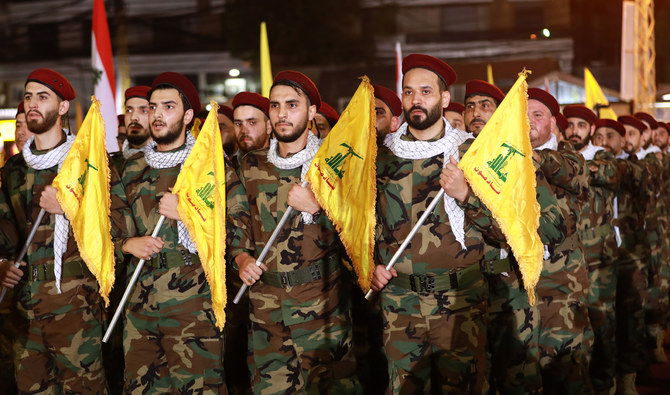

BEIRUT: Activists in Lebanon, in particular those who speak out against Hezbollah, continue to face physical attacks, arrest, psychological pressure and threats to their families. The individuals being targeted include lawyers, journalists, media personalities and writers.
On Monday, Asrar Shebaro, a correspondent for An-Nahar newspaper, was attacked in a public place. It happened while she was working at Rafic Hariri International Airport in Beirut covering the arrival of a flight from Iran as part of a story about the response of Lebanese authorities to the coronavirus threat.
A video she filmed showed an unidentified young man attacking her and taking her phone by force. He told her she was not allowed to film in the airport because these were “families” there, which is a term Hezbollah uses to describe its supporters. The man deleted a number of videos Shebaro had filmed of passengers arriving from Iran. When she asked him under whose authority he was acting and who he represented, he said that he belonged to a political party.
In a message posted on the An-Nahar website, the newspaper said: “The bullying of the media and the truth will not dissuade this newspaper from completing its message by accurately conveying information and holding those responsible for their fragile measures taken to combat the Coronavirus.”
Activists in Lebanon, especially Shiites, have faced threats as the protests against corruption, the financial crisis in the country, high levels of unemployment and the lack of basic services escalated. Some told Arab News they have been prevented from visiting their families in the southern suburbs of Beirut, and that pressure has been put on their relatives. In some cases, protesters have been forced to sleep in tents at protest sites or other locations.
“The pressure and attacks have diminished after a decision was taken to prevent the supporters of the Amal Movement and Hezbollah from confronting activists in the protest squares, but this does not stop moral pressure,” said activist Mohamed Kassem, who is a secondary school teacher.
Opinion
This section contains relevant reference points, placed in (Opinion field)
Protester Mahmoud Fakih, who lives in Beirut, said he avoids neighborhoods dominated by the Amal Movement and Hezbollah.
“At the beginning of the revolution, the pressure on us was great but it decreased with the decline of the movement,” he said. “Yet, we are still cautious. For example, I do not go to my village in the south. There is real social hostility to us there. We were previously attacked in the Zuqaq Al-Blat area but nobody documents these attacks.”
Ali Al-Amin, another activist, said: “At the beginning of the protests, a number of Shiite clerics strongly participated but suddenly they disappeared from the protest sites. It was found that, in cooperation with security services that have good relations with Hezbollah, false charges were filed against one of them related to unpaid taxes, so he was arrested and held in custody for a few days. Another cleric…is still detained on another charge, and a third was severely beaten.”
The pressure exerted on activists is not limited to one particular social group. According to Al-Amin, the situation is “more complicated and linked to a range of internal and external issues … Everyone who disagrees with Hezbollah is subject to repression and threats.”
Some protesters have faced arrest and detention as a result of opinions posted on social media. In the most recent case, activist Charbel Khoury was interrogated on Monday by the authorities about messages he had posted. His arrest was ordered by a judge alleged to be a supporter of the Free Patriotic Movement, while lawyers protested outside the Palace of Justice in Beirut to demand the independence of the judiciary from political influence.
One of Khoury’s lawyers described his arrest as a “judicial scandal. We have had enough of the suppression of the revolutionaries and the violation of freedom of opinion and expression. The Lebanese judiciary is today facing a major test.”
Al-Amin said: “The way in which Hezbollah suppresses militants differs from that of other parties. Hezbollah is a security party and it does not initiate a direct reaction; it refers the matter to the ‘family’ environment to exert pressure. And this (the family) of course does not operate on its own, but there is an apparatus that manages it and incites it.”
He added: “Despite the iron grip other parties have on their supporters, many of them came out from under the cloak of those parties and joined the protests and turned against their parties. But the Shiite community is still governed by a security apparatus that even controls the security institutions of the state.”
A passenger on a flight from Qom in Iran tested positive for the coronavirus last Thursday. It was the first case discovered in Lebanon. Hezbollah MP Hassan Fadlallah said that focusing on the issue of people traveling from Iran to Lebanon and calling for flights to be grounded “is a politicization of the issue.”


