


Hosni Mubarak: Egypt’s warrior leader left his mark on Middle East history

Mubarak in air force uniform in 1975. (AFP)
Short Url
Updated 26 February 2020
Follow

Hosni Mubarak: Egypt’s warrior leader left his mark on Middle East history

  • While some may disagree with Mubarak’s legacy, his love for the country that he ruled for 30 years cannot be denied
  • The Egyptian leader died at a Cairo hospital at the age of 91 following health complications

CAIRO: Former Egyptian President Hosni Mubarak, who passed away on Tuesday, ruled Egypt for 30 years. His rule began in a spirit of reform, with the release of political prisoners, support for the independence of the judiciary and the freedom of the press and a great deal of tolerance for his political opponents.

What is certain is that Mubarak’s role in the contemporary history of Egypt lies mainly in the military, as he belonged to a generation of warrior leaders. He was chosen by Gamal Abdel Nasser after the defeat of 1967, when he was a colonel, in order to rebuild the destroyed air force and prepare it for the victory of October 1973.
Some may disagree about Mubarak’s legacy, but it is unfair and transgressive to underestimate his value and role as a pilot.
I will not forget a comment, from a friend of mine from the Gulf, on the change he witnessed in the character of Egypt during the country’s rush to try Mubarak, and even execute him, after his fall. “The crisis that the Egyptian people suffer from is that, for the first time, they have lost their two most important characteristics: Patience and tolerance,” he told me.
I will also never forget the comment of an English friend during Mubarak’s trial, and his transfer from his home to the hospital, and from there to the courtroom cage that had been specially built for him, and then to prison. At that time, my friend wondered: “Didn’t Mubarak fight with the army one day?” I replied: “He even participated in three wars: The Suez war in 1956, the June 1967 war, and finally the October 1973 war, which was truly the most important victory in the history of the Arabs.” The man marveled at the insult Mubarak had to endure, saying: “Had he been in my country, the situation would have been different.”
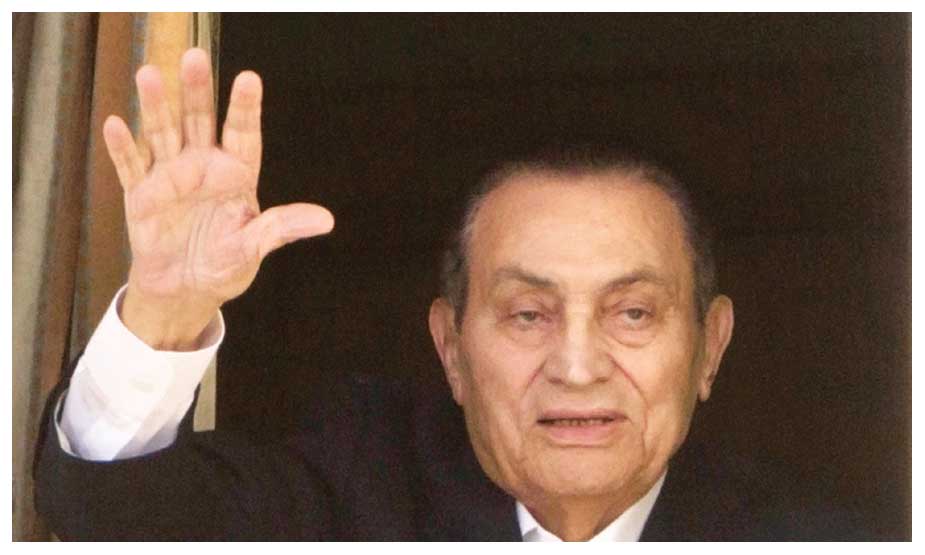


He resigned as president in 2011, ushering in elections won by the Muslim Brotherhood. (AP)

For sure, Mubarak belonged to the generation of great warrior leaders, and that is an undeniable role that cannot be erased. At the same time, he was the ruler of Egypt for 30 years, and he is certainly subject to criticism, agreements and differences.

It is possible to explain a part of Mubarak’s behavior on the eve of his removal from power in order to preserve the blood of the Egyptians, and his decision to remain in the country, by saying that he was a leader who fought for the sake of Egypt. He did not kill tens of thousands or destroy cities to remain in power. He did not run away from the accusations leveled against him. Rather, he was tried in his country as a former president — acquitted in some cases and convicted in one — which gave a symbolic value to Egypt.
I still remember when he said to me with love and pride, after I interviewed him in 2009, how he preserved all of Egypt’s history and topography, and how he had visited all of its cities. He spoke with a real passion, one that explains why he did not leave the country when he abdicated.
The trials of the former president were not the most severe acts against him — that,  I think, was the moment when his successors decided to withdraw all the medals and decorations he had received from him. I think that was the most difficult moment.
Many believe — and I am one of them — that a politician’s accountability for his errors should be in political action. I do not agree that accountability and justice for what are deemed political errors should be meted out through the use of vindictive punishments.
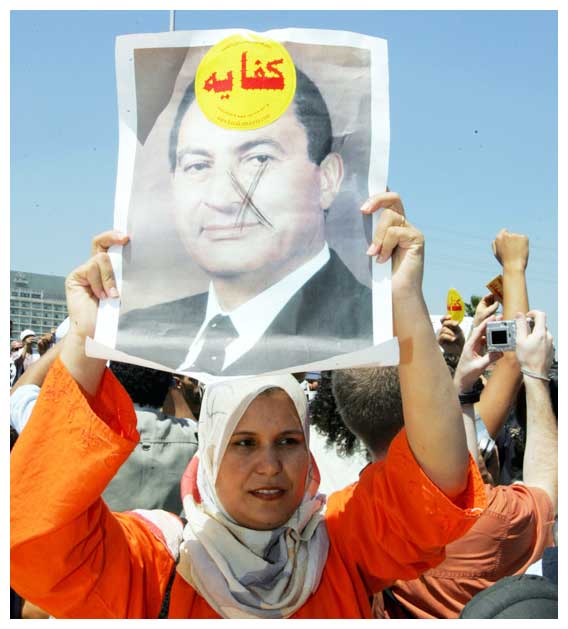


His final years as president saw rising discontent against him. (AFP)

There are those who considered Mubarak’s reign as three decades of darkness and dictatorship, of looting, corruption and retreat, but it can be noticed that the number of these people has decreased significantly during recent years. On the other hand, there is a large sector that believes Mubarak made right and wrong decisions, and these people believe that, had Mubarak decided to withdraw from public life after the death of his grandson in 2009, and the surgery he underwent, he would have had a distinguished position in the hearts of the Egyptians. There is a third group that calls itself “Mubarak’s children.” These people find in their former president nothing but good, and their position was strengthened because of the way the Muslim Brotherhood ruled.
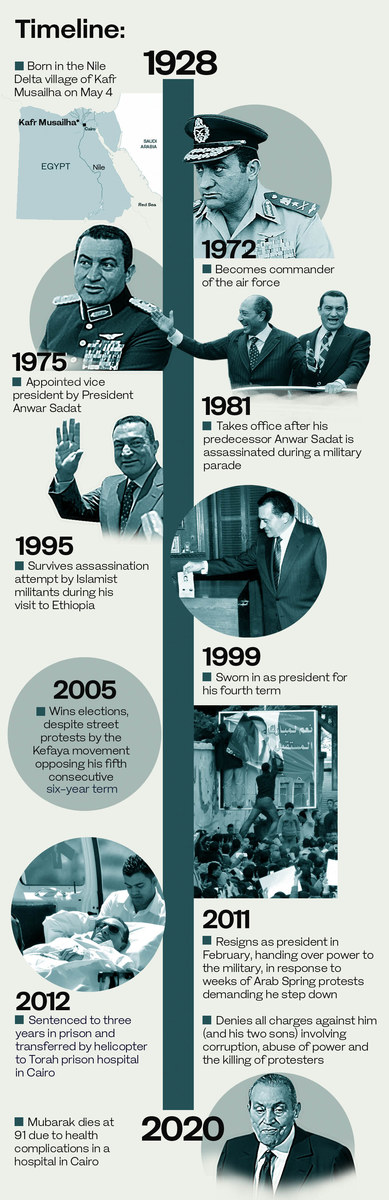
So, as we see, there are understandable difference in assessing Mubarak’s legacy. What was not understood, however, was the sweeping and overpowering attack not on Mubarak the president, but on Mubarak the fighter pilot — Mubarak the man.
God was merciful to him. He gave him the chance to see a large part of his rehabilitation after he suffered a lot during the long months following the fall of his regime in 2011. He was ultimately cleared of all charges but, more importantly, he began to talk again about the role of the air force. His memoirs, which he wrote when he was vice president, were published to show him as a military commander and a fighter pilot who fought for his country.
For many Egyptians, it seemed he had been helped through  divine intervention. He entered intensive care about a month ago. A few days before his death, he received the news that his sons, Alaa and Gamal, had been acquitted in their final case. And one of the last things Mubarak said, according to his lawyer, Farid Al-Deeb, after he learned of the news of the innocence of his two sons, was: “Praise be to God. Our Lord has done justice to us after so many years.”
People will always remember that Mubarak gave a real margin to political forces and the media throughout his rule. This was one of the reasons he remained in power for so long, and was not the cause of his downfall.


Dr. Abdellatif El-Menawy is a critically acclaimed multimedia journalist, writer and columnist who has covered war zones and conflicts worldwide. Twitter: @ALMenawy


Iraq now largely at peace, UN says, with stronger security and a development drive underway

Updated 3 sec ago
Follow

Iraq now largely at peace, UN says, with stronger security and a development drive underway

  • UN’s top official in the country touts ‘remarkable transformation,’ with growing confidence in state institutions, improved regional standing, and progress on stability
  • The UN is not leaving Iraq now that its Assistance Mission in the country has ended, he says, instead it is shifting its focus toward developmental support

NEW YORK CITY: The UN’s role in Iraq is shifting from a political mission to a development-focused partnership, the organization’s top official in the country said on Wednesday.

The move reflects what it sees as major improvements in security, governance and economic conditions in the nation after two decades of international engagement.

Ghulam Isaczai, the UN’s resident and humanitarian coordinator for Iraq, told reporters at the UN headquarters in New York that Iraq was now “a country at peace, with increased security and a clear determination to win the battle of development.” This echoed remarks by UN Secretary-General Antonio Guterres during a recent visit to the country.

Isaczai said Iraq had undergone a “remarkable transformation” over the past 20 years, with growing confidence in state institutions, improved standing in the region, and steady movement toward stability.

Poverty declined from about 20.5 percent in 2018 to lower levels in 2024 (17.5 percent) and 2025, he added, and Iraq’s Human Development Index might have reached a level that qualifies as high human development for the first time in four decades.

A nationwide census conducted last year put Iraq’s population at 46 million, about 60 percent of whom are under the age of 25. The collected data also revealed an increasing trend toward urbanization, which Isaczai said was putting greater pressure on city services but would allow the UN and other partners to better target development assistance.

Improved security conditions have enabled about 5 million internally displaced people to return to their homes, he added. However, about 100,000 remain displaced, most of them in camps in the Kurdistan Region, primarily as a result of housing shortages.

About 90,000 of those remaining in camps are Yazidis, largely from the Sinjar area, where unresolved security, administrative and political issues continue to hamper returns.

Isaczai told Arab News that progress depends in part on the full implementation of the Sinjar agreement between the federal government and the Kurdistan Regional Government, as well as greater financial support for housing and compensation.

He also highlighted Iraq’s role in the repatriation of its citizens from northeastern Syria, describing it as a difficult but commendable decision. About 23,000 Iraqis, mostly women and the children of former Daesh fighters, have been returned so far, with UN support, mainly from Al-Hol camp. Most of the returnees are now undergoing reintegration processes, he said, and an estimated 3,000 Iraqis remain in Syria

On the political front, Isaczai noted that Iraq successfully held the first stage of its sixth parliamentary elections in November last year, with voter turnout rising to 36 percent, up 12 percentage points from the previous election in 2021. About a third of the candidates were women and they secured 97 of the 329 parliamentary seats, he said.

The UN Assistance Mission for Iraq formally concluded its mandate on Dec. 31, 2025, marking the end of a mission-led phase that began after the 2003 US-led invasion. Isaczai said the UN was not leaving the country but instead shifting the focus of its presence toward developmental support through 25 UN agencies that operate under the resident coordinator system.

The UN and the Iraqi government recently signed a five-year cooperation framework, costed at more than $1 billion, that will focus on four priority areas: economic reform; social protection and service delivery; the environment and climate change; and governance, human rights and the rule of law.

Despite operating within a constrained global funding environment, Iraq has indicated it will contribute financially to the implementation of the framework, Isaczai said, signaling a growing sense of national ownership and a shift from being a long-term recipient of aid to becoming a partner in development. The UN plans to establish a joint partnership fund with the Iraqi government to support the framework.

Asked by Arab News about the challenges that remain, Isaczai identified climate change and water scarcity as among the most critical, particularly in southern Iraq. He said some projections suggest temperatures in the country could rise by around 3 degrees Celsius, underscoring the need for adaptation, mitigation and more efficient water management.

Economic diversification is another major challenge, he added, noting that about 90 percent of Iraq’s state revenue comes from oil. Transitioning to a non-oil economy will take time, he said, but the government’s “Vision 2050” aims to boost agriculture, tourism and manufacturing. Infrastructure projects linking Iraq with Europe, along with incentives for non-oil exports, could also help create jobs and diversify trade.

Reform of the public sector remains difficult, Isaczai said, because a large share of the population depends on the government wages, pensions and subsidies that consume much of the national budget.

Regarding security concerns, Isaczai said the Iraqi government had taken positive steps to bring all weapons under state control through dialogue with armed groups, though progress could slow during the formation of a new government. 

He acknowledged that Daesh cells continue to pose a threat but said Iraqi security forces and their partners had become increasingly capable and confident in carrying out counterterrorism operations.

Reflecting on the legacy of the UN Assistance Mission for Iraq, Isaczai said one of its key achievements was the support it had provided for the country’s democratic institutions, including elections that Iraqi officials said could not have been conducted independently a decade ago.

The UN will continue to advocate for the voluntary, dignified return of all displaced Iraqis, he added, while acknowledging that bureaucratic and compensation-related hurdles still need to be addressed.