KUALA LUMPUR: Malaysia’s king has intervened to stabilize the government following Monday’s shock resignation of Prime Minister Mahathir Mohamad.
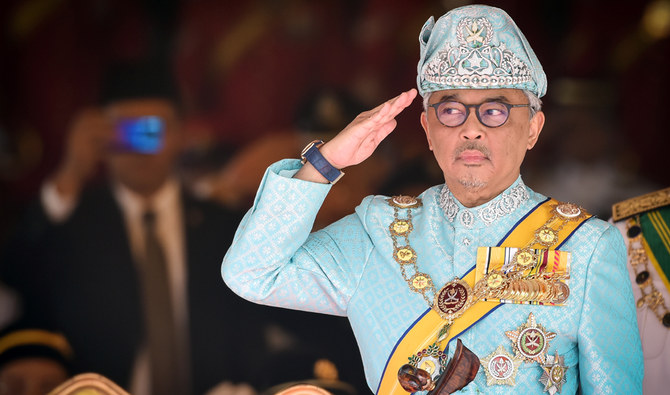
King Abdullah Ri'ayatuddin Al-Mustafa Billah Shahis conducting personal interviews with 222 members of parliament at his palace in an unprecedented move.
He does not have any political power under Malaysia’s constitutional monarchy system, but will be able to deduce from the interviews which lawmaker has the most support in parliament to become prime minister.
“Let me do the duties, I hope we will find the best solution for the country,” King Abdullah told the media.Rumors of a power transition began to swirl over the weekend when MP Azim Ali held separate meetings with Mahathir, as well as with opposition parties Barisan Nasional and the Malaysian Islamic Party (PAS).
The exit of 11 MPs from the People’s Justice Party (PKR) and the Malaysian United Indigenous Party (BERSATU) from the Pakatan Harapan coalition, as well as Mahathir's resignation, led to the breakup of the alliance and left Malaysia without a government as it no longer commanded a majority.
Mahathir, who was appointed interim prime minister by the king, returned to office on Tuesday to chart the next course of action for the new government coalition.
The Comptroller of the Royal Household Ahmad Fadil Shamsuddin said all MPs would be invited for a personal interview by the monarch.
“The interview will be brief, within two to three minutes,” Shamsuddin said, adding that the whole process would be overseen by the chief secretary to the government, Mohammed Zuki bin Ali.
Ninety MPs travelled to the palace on Tuesday afternoon for the interview, with the remaining scheduled to meet the king on Wednesday.
“We will be transparent about the processes to avoid any media speculation,” Shamsuddin said.
The royal intervention was viewed as the right move for Malaysia at such a critical juncture, according to one expert.
“It is perhaps the best way for the king to determine whether the prime minister has the support of the majority of the MPs,” Adib Zalkapli, director of BowerGroupAsia, told Arab News. “The Pakatan Harapan coalition has collapsed and the king is exercising his majesty’s powers in the formation of the new government,” Zalkapli said.
One of the most intriguing aspects of the upheaval and horsetrading is the apparent isolation of Anwar Ibrahim, Mahathir’s anointed successor and prime-minister-in-waiting.
Anwar had teamed up with his former nemesis Mahathir ahead of the 2018 elections to oust the government of Najib Razak but said on Sunday he had been betrayed by his coalition partners.
Mahathir on Tuesday met leaders from the PKR, BERSATU, the United Malays National Organisation, PAS and others.
The political whirlwind has led to uncertainty in Putrajaya, Malaysia’s administrative center. One civil servant, who chose not to be named, told Arab News: “Unfortunately, I don’t really know much about what’s happening. We are all waiting for news as well.”
Political scientist Prof. Shamsul Amri Baharuddin, from the National University of Malaysia, said that the interim period would be a boon for Mahathir and his long-held agenda to bring back a Malay, ethnic-led plural society nation.
"Before this, since 1987, he has continuously split the Malays. Now he unites them at the end of his life, before the next general elections,” he told Arab News.
Mahathir’s resignation sent shockwaves through the country’s economy, with the stock exchange tumbling to its lowest point in 10 years.
The upheaval also means that the economic stimulus package which was supposed to be unveiled by the now-dissolved government this week has been put on hold, effectively leaving the country in limbo as far as major decision-making is concerned.
“I think his (the king’s) immediate role is to stabilise the government – to send a message that it is business as usual and that a new, stable government could be formed as soon as possible,” Zalkapli said, adding that a large number of MPs wanted the uncertainty to end soon. “Common sense will prevail.”


![]()

Malaysian king intervenes after Mahathir's resignation
Short Url
https://arab.news/26csg
Malaysian king intervenes after Mahathir's resignation
- Mahathir on Tuesday met leaders from the PKR, BERSATU, the United Malays National Organisation, PAS and others


Latest updates


© 2026 SAUDI RESEARCH & PUBLISHING COMPANY, All Rights Reserved And subject to Terms of Use Agreement.