

Death of the ‘accidental pharaoh’: Arab and world leaders react to passing of Hosni Mubarak

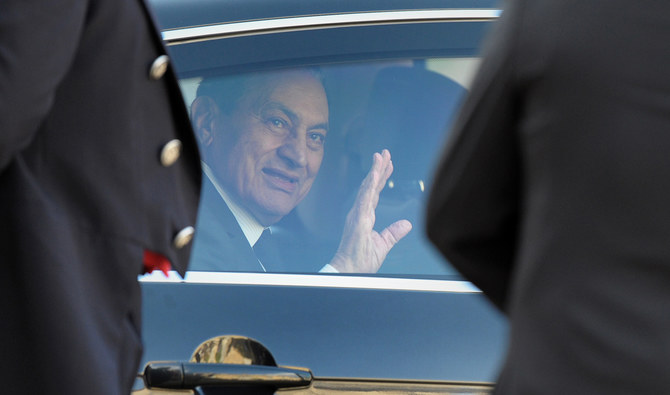
Hosni Mubarak died on Tuesday aged 91. He had led Egypt for 30 years. (AFP)
Short Url
Updated 26 February 2020
Follow

Death of the ‘accidental pharaoh’: Arab and world leaders react to passing of Hosni Mubarak

  • Hosni Mubarak never expected to lead Egypt … but the assassination of Anwar Sadat propelled him into a presidency that lasted for 30 years

CAIRO: Middle East and world leaders paid tribute on Tuesday to Hosni Mubarak, the Egyptian air force officer who never expected to become president but ruled his country for 30 years.

Mubarak, who was 91, took office in October 1981 after six years as vice president, when Anwar Sadat was assassinated in Cairo by Islamist militants. He was forced to stand down in February 2011 after 18 days of protests during the so-called “Arab Spring.”

The former president died in the intensive care unit of a Cairo military hospital, where he underwent surgery a few weeks ago.

Mubarak was admired and detested in equal measure, both in Egypt and in the wider Middle East, a paradox reflected in reactions to his death.

The office of President Abdel Fattah El-Sisi offered condolences and described Mubarak as one of the “heroes of the October 1973 war against Israel.”

In Saudi Arabia, King Salman and Crown Prince Mohammed bin Salman sent their “deepest condolences and sincere sympathies” to Mubarak’s family, and the Egyptian president and people.


Gallery: Mubarak’s 30 years in power saw him meet many world leaders


Sheikh Mohammed bin Zayed Al-Nahyan, crown prince of Abu Dhabi, described Mubarak as “an Arab leader who worked loyally for Arab unity and stability and stood firmly against extremism and terrorism.” 

Anwar Gargash, the UAE’s minister of state for foreign affairs, said he was “a statesman ... who espoused nationalistic and historical positions.”

Palestinian President Mahmoud Abbas said he mourned Mubarak’s death “with great sorrow” and praised his support of the Palestinian cause. 

Israeli Prime Minister Benjamin Netanyahu spoke of his “deepest sorrow” on behalf of Israel and its people. “President Mubarak, a personal friend of mine, led his nation to peace and security,” he said.

The former head of the International Atomic Energy Agency, Mohamed El-Baradei, a key opposition figure in Mubarak’s declining years, also paid tribute. “May God have mercy on the former president ... and grant his family patience and comfort,” he said.


Abdellatif El-Menawy — Hosni Mubarak: Egypt's warrior leader left his mark on Middle East history 


Protesters who took part in the revolution that unseated Mubarak were also forgiving. “He was loyal and loving of Egypt,” said opposition activist Wael Ghoneim. “He took on a great responsibility toward the Egyptian people.

“He was right a lot of the time and also wrong a lot of the time ... history will decide.”

Former presidential candidate Ayman Nour, who ran against Mubarak in the 2005 elections and was later jailed, was also conciliatory. “I promise to God I personally forgive him,” he said.

Ordinary Egyptians, many of whom admired Mubarak but complained of corruption, oppression and unemployment under his rule, had mixed feelings about his death.

“We had good and bad memories,” said Sherin Saad, a woman in her 30s, who criticized graft and the privatization of public companies, which Mubarak’s critics say enriched the elite.

Atef Bayoumi, walking on the Nile Corniche in central Cairo, said: “He was a patriot. Regardless of the final events, he surely did good things for the country.”

However, Gamal Eid, a prominent human rights activist, said: “My condolences to all tyrants, they lost one today.”

Such views, however, will be in a minority for the rest of this week. Mubarak’s funeral will take place on Wednesday, with full military honors, followed by three days of official mourning throughout Egypt.


Sudan’s prime minister takes his peace plan to the UN, but US urges humanitarian truce now

Updated 23 December 2025
Follow

Sudan’s prime minister takes his peace plan to the UN, but US urges humanitarian truce now

  • Sudan’s prime minister is proposing a wide-ranging peace initiative to end a nearly 1,000-day war with a rival paramilitary force
  • It seems unlikely the RSF would support the proposal, which would essentially give government forces a victory and take away their military power

UNITED NATIONS: Sudan’s prime minister on Monday proposed a wide-ranging peace initiative to end a nearly 1,000-day war with a rival paramilitary force, but the United States urged both sides to accept the Trump administration’s call for an immediate humanitarian truce.
Kamil Idris, who heads Sudan’s transitional civilian government, told the Security Council his plan calls for a ceasefire monitored by the United Nations, African Union and Arab League, and the withdrawal of paramilitary forces from all areas they occupy, their placement in supervised camps and their disarmament.
Sudan plunged into chaos in April 2023 when a power struggle between the military and the powerful paramilitary Rapid Support Forces exploded into open fighting, with widespread mass killings and rapes, and ethnically motivated violence. This has amounted to war crimes and crimes against humanity, according to the UN and international rights groups.
It seemed highly unlikely the RSF would support the prime minister’s proposal, which would essentially give government forces a victory and take away their military power.
In an indirect reference to the truce supported by the US and key mediators Saudi Arabia, Egypt and the United Arab Emirates, known as the Quad, Idris stressed to the UN Security Council that the government’s proposal is “homemade — not imposed on us.”
In early November, the Rapid Support Forces agreed to a humanitarian truce. At that time, a Sudanese military official told The Associated Press the army welcomed the Quad’s proposal but would only agree to a truce when the RSF completely withdraws from civilian areas and gives up their weapons — key provisions in the plan Idris put forward on Monday.
Idris said unless the paramilitary forces were confined to camps, a truce had “no chance for success.” He challenged the 15 members of the Security Council to back his proposal.
“This initiative can mark the moment when Sudan steps back from the edge and the international community — You! You! — stood on the right side of history,” the Sudanese prime minister said. He said the council should “be remembered not as a witness to collapse, but as a partner in recovery.”
US deputy ambassador Jeffrey Bartos, who spoke to the council before Idris, said the Trump administration has offered a humanitarian truce as a way forward and “We urge both belligerents to accept this plan without preconditions immediately.”
Bartos said the Trump administration strongly condemns the horrific violence across Darfur and the Kordofan region — and the atrocities committed by both the Sudanese Armed Forces and the Rapid Support Forces, who must be held accountable.
UAE Ambassador Mohamed Abushahab, a member of the Quad, said there is an immediate opportunity to implement the humanitarian truce and get aid to Sudanese civilians in desperate need.
“Lessons of history and present realities make it clear that unilateral efforts by either of the warring parties are not sustainable and will only prolong the war,” he warned.
Abushahab said a humanitarian truce must be followed by a permanent ceasefire “and a pathway toward civilian rule independent of the warring parties.”
UN Assistant Secretary-General for political affairs Khaled Khiari reflected escalating council concerns about the Sudan war, which has been fueled by the continuing supply of increasingly sophisticated weapons.
He criticized unnamed countries that refuse to stop supplying weapons, and both government and paramilitary forces for remaining unwilling to compromise or de-escalate.
“While they were able to stop fighting to preserve oil revenues, they have so far failed to do the same to protect their population,” Khiari said. “The backers of both sides must use their influence to help stop the slaughter, not to cause further devastation.”
The devastating war in Sudan has killed more than 40,000 people according to UN figures, but aid groups say the true number could be many times higher. The conflict has created the world’s largest humanitarian crisis, with over 14 million people displaced, disease outbreaks and famine spreading in parts of the country.