Gold gains 2% as virus fears push Pakistani investors to safe havens

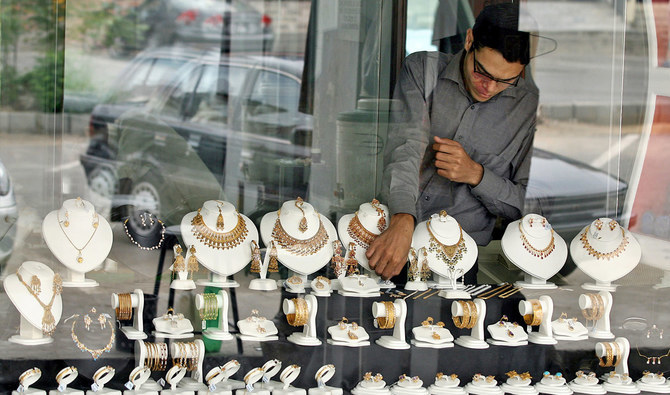
In this file photo, a Pakistani shopkeeper arranges jewelry in the window of a jewelry shop in Islamabad on July 7, 2006. (AFP)
Short Url
Updated 15 March 2020
Follow

Gold gains 2% as virus fears push Pakistani investors to safe havens

  • Rates jumped up by Rs2,000 per tola in Pakistan to an all-time high of Rs96,300 on Monday
  • Gold is seen as a safe store of value during times of turmoil, becomes popular when other assets offer low returns

KARACHI: The value of gold was up by more than two percent both in the international and local markets on Monday, traders in Pakistan said, as growing concerns that the coronavirus outbreak could impact the global economy pushed investors toward safe havens.

Gold was trading at $1,685 per ounce (OZ), up by 2.49 percent on Monday afternoon in the international market, while rates jumped by Rs 2,000 per tola (11.66 grams) in Pakistan to an all-time high of Rs96,300.

Global concerns of an economic slowdown stemming from the outbreak of coronavirus have rattled commodity markets and pushed oil and metal prices down. But gold, traditionally seen as a safe store of value during times of turmoil, has become more popular as other assets offer low returns.

“People are moving to hold safe assets after international institutions predicted the impact of coronavirus that is hampering global economies,” CEO of Arif Habib Commodities, Ahsan Mehanti, told Arab News. “People are selling currency to buy gold because when global growth weakens they invest in safe assets and that is gold generally.”

A Reuters poll in January said gold prices would hold above $1,500 an ounce this year and make modest gains in 2021 as low-interest rates and geopolitical uncertainty bolstered its appeal.

“Gold has re-established its safe-haven status,” Standard Chartered analyst Suki Cooper told Reuters last month. “We expect gold to test seven-year highs in 2020.”

The trend, Pakistani analysts say, shows that gold prices will continue to climb toward $1,700 an ounce.

“Prices have risen even above the reach of average investors. In the wedding season, the demand for gold spikes but now business is down to around 20 percent,” said Hajji Haroon Chand, president of the All Sindh Saraf Jewellers Association. “Only rich investors are buying gold now because at Rs 96,300 per tola, it is beyond the purchasing power of small investors,” Chand added.

On Monday, energy prices tumbled by more than three percent as brent crude traded at $55.87 per barrel while US WTI crude was down 3.58 percent to $51.47 in afternoon trade according to Pakistan Standard Time.

Pakistan’s equity market also closed down by 1105 points or 2.75 percent on Monday as coronavirus triggered sell-off.

“The market is down because investors fear that coronavirus from Iran may affect Pakistan also,” Muhammad Sohail, CEO of Topline Securities, said. “Global markets are down as virus cases rise.”

Iran, which borders Pakistan, said on Monday that the outbreak had killed at least 12 people, the largest number of coronavirus-linked deaths outside China.


Pakistan urges developed nations, global institutions to expand role in climate financing

Updated 4 sec ago
Follow

Pakistan urges developed nations, global institutions to expand role in climate financing

  • Pakistan is recognized among countries worldwide most affected by climate-induced disasters
  • Planning minister stresses redesigning global financial system on principles of responsibility, equity

ISLAMABAD: Pakistan’s Planning Minister Ahsan Iqbal this week called on developed nations and international financial institutions to play a greater role in helping developing countries adopt green technologies at lower costs, state-run media reported. 

Pakistan has suffered frequent climate change-induced disasters over the past couple of years, ranging from floods, droughts, heatwaves, cyclones and other irregular weather patterns. 

This year the South Asian country reported over 1,000 deaths from floods and landslides triggered by heavy rains and the melting of glaciers. 

“He [Iqbal] said Pakistan has urged developed countries and international financial institutions to expand their role in climate financing to enable developing nations to adopt green technologies at lower costs,” state-run Associated Press of Pakistan (APP) reported on Saturday. 

The minister was speaking at the Second Asia Energy Transition Summit held at Pakistani university LUMS on Saturday. 

Iqbal warned that climate change is intensifying emergencies and increasing economic burdens on vulnerable countries, adding that financial incentives and concessional financing have become indispensable for sustainable climate action.

“He further emphasized the need to redesign the global financial system based on the principles of collective responsibility and equity,” APP said. 

The minister noted that Pakistan has been introducing comprehensive reforms in its development agenda to promote renewable energy, solar power and green technological solutions. 

The country, he said, possesses “strong solar potential,” a robust renewable energy market, a wide talent pool in engineering and science and an enabling environment for green innovation.

Pakistan has regularly urged developed countries to fulfill past pledges and provide easy access to climate funding without attaching conditions, especially at Conference of Parties (COP30) climate summits. 

Islamabad was instrumental in getting the Fund for Responding to Loss and Damage (FRLD) established at the COP27 climate summit in Egypt in 2022. The Loss and Damage Fund aims to help developing and least developed countries cope with both economic and non-economic impacts of climate change, such as extreme weather events and slow-onset crises like sea-level rise and droughts.