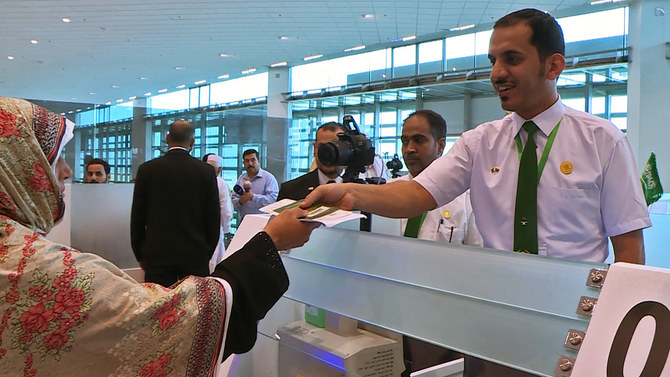

ISLAMABAD: The spokesperson for Pakistan’s Ministry of Religious Affairs said on Monday Saudi Arabia’s move to allow visit visas on arrival for Pakistanis exemplified the strength of bilateral ties between the two countries.
The new visa regime was launched in January this year and will allow one-year multiple entry visas for anyone traveling to the Kingdom with a valid visa from the United Kingdom, the United States or the European Union.
“We welcome this initiative by the Saudi government to grant visit visas on arrival to Pakistanis on which they can also perform Umrah,” Imran Siddiqui told Arab News.
Pakistanis across the country also responded positively on Monday to Saudi Arabia’s announcement.
“This is the best decision taken by the Saudi government, especially for frequent travelers, and will also increase pilgrimage to the Kingdom,” Ahmed Hanif, a resident of Lahore, told Arab News.
Hanif said he had already availed the visa on arrival facility and was able to go through immigration in fifteen minutes when he visited Saudi Arabia to perform Umrah in late January this year.
“When I landed at Madina airport, there were two special counters for people using this facility,” Hanif said. “You have to show a valid visa from either UK or the US or a Schengen permit on which you are required to have traveled once; after verifying this, they stamped the Saudi one-year multiple visa.”
Under the new initiative, visitors can perform Umrah but not Hajj, and can apply for visas on arrival at any international airport in the Kingdom.
The visa costs SR440 ($117) and needs to be paid through a credit card. Once processed, visitors are allowed to stay in the Kingdom for 90 days at a stretch and can re-enter multiple times, as long as the visa remains valid.
A circular issued by the Saudi General Authority of Civil Aviation (GACA), and available with Arab News, said it is mandatory for first time visitors to fly Saudi-based airlines – Saudi Airlines, Flynas or Flyadeal — while repeat visitors with a valid Saudi visit visa can use any airline.
“I got a one-year multiple entry visa last week when I went to perform Umrah,” Abubakar Siddiqui, a businessman from Sialkot, told Arab News. “I am a frequent traveler to Europe so it is ideal for me to use a Saudi airline for a connecting flight and perform Umrah by staying for a day or two in Makkah.”
Siddiqui said the new visa facility meant less travel time, reduced travel arrangements and was also cost-effective since he no longer had to use travel agents who overcharged for urgent visas.