

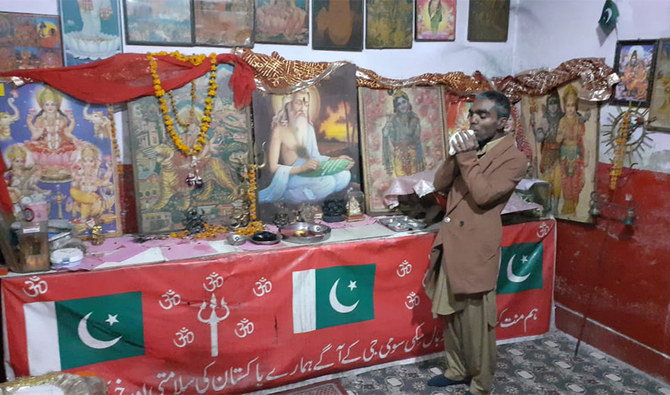

LAHORE: In the heart of Pakistan’s bustling eastern city, an ancient Hindu temple considered a ‘home’ to its devotees, is falling apart.
At the corner of a narrow Anarkali street in Lahore, an area peppered with quashed homes and tiny shops, sits the 1,200 year old Valmiki Mandir. It is one of Lahore’s only two functional Hindu temples and serves the small, impoverished Valmiki community of the city.
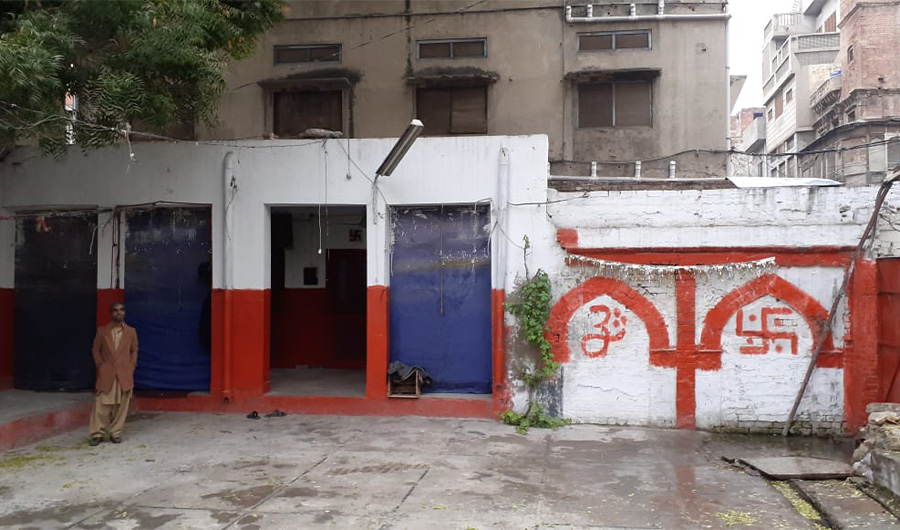
This picture taken on December 12 shows a part of the 1,200-year-old Valmiki Mandir in Lahore, Pakistan. It is one of the last two functional temples for Hindus in the city and the only one for followers of the sect. (AN photo via Malik Shafiq)
“The Valmiki Mandir is the only functional mandir in Lahore where people of our faith gather every Tuesday for prayer. It is in terrible condition. We run it at our own expense as the government does not give us any funds,” Bhaagat Laal Khokhar, the priest and custodian of the temple told Arab News, pointing to the peeling walls and broken doors of the building.
According to the Pakistan Hindu Council, there are roughly 8 million Hindus living in Pakistan, a Muslim majority country of 210 million people.
The sect of the Valmiki are devotees of the sage considered to be the writer of the epic Ramayana, a holy scripture to Hindus.
“The Valmiki sect of Hindu religion is the oldest one, and the books authored by Valmiki are the basis of the religion,” Laal said.
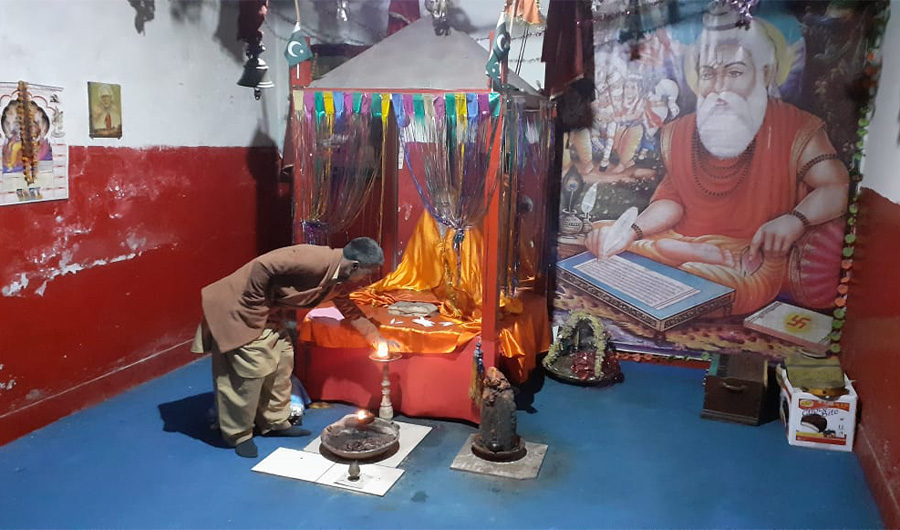
An area of the Valmiki temple which houses all the idols. In Lahore, only five families remain who follow the Valmiki faith, and small groups of no more than 20 people gather at the temple to practice their rituals every Tuesday. (AN photo via Malik Shafiq)
In 1992, following the aftermath of the Babri Mosque attack in India, an angry, armed mob stormed into the Valmiki Temple and practically reduced it to rubble, setting the building on fire. The idols inside were destroyed, and the statues’ embellishments were stolen.
“They took way every valuable thing they could carry,” Laal recalled.
Since then, the temple has remained in a largely dilapidated state.
“No government has ever paid any attention to its renovation, reconstruction or functioning. My family has been serving this temple for seven generations on a self-help basis,” said Pandat Bhagat Ram, a spiritual leader of the Valmiki people.
For the handful of Valmikis left in Lahore, the temple is not only an important religious site, but also a home.
Ramesh Dhani, a young man who traveled 600 km to find work in Lahore, said the temple is where Hindus from different areas come together every week to share their stories.
“I am from Rahim Yar Khan and work in a market. There are several Hindus in the city who have come from other parts of the country. We gather here every Tuesday and perform religious rituals and interact with each other and share our happiness and sorrows,” Dhani told Arab News.
In Lahore, only five families remain who follow the Valmiki faith, and small groups of no more than 20 people gather at the temple to practice their rituals every Tuesday.
Currently, the temple’s property is being contested in the courts-- a case to which the Evacuee Trust Properties Board (ETPB) is a party.
“This mandir is not in the control of ETPB, rather a family is running the affairs of it. We have asked them to come, sit together and work with us jointly. We are ready to cooperate with them in all matters,” Fraz Abbas, Deputy Secretary of the ETPB told Arab News.
In November last year, the government of Pakistan announced it would renovate and restore 400 Hindu temples, on the occasion of the opening of the Kartarpur Corridor near Lahore.
At the time of partition in 1947, there were hundreds of temples in Pakistan, but roughly 20 have survived over the years. Lahore’s second temple, Krishna Mandir, lies in the city’s suburbs.
In 2014, a survey carried out by the All-Pakistan Hindu Rights Movement found that 95 percent of a total 428 temples in Pakistan had either been destroyed or converted in shops, offices and schools after 1990.
“I am from Dhami village in Bahawlpur district and work in a factory in Lahore,” said another temple-goer, Ravi Kumar.
“My family lives in the village and this temple is my home in the city,” he continued. “It gives me courage to live away... because every person who comes here every Tuesday is family to me.”


